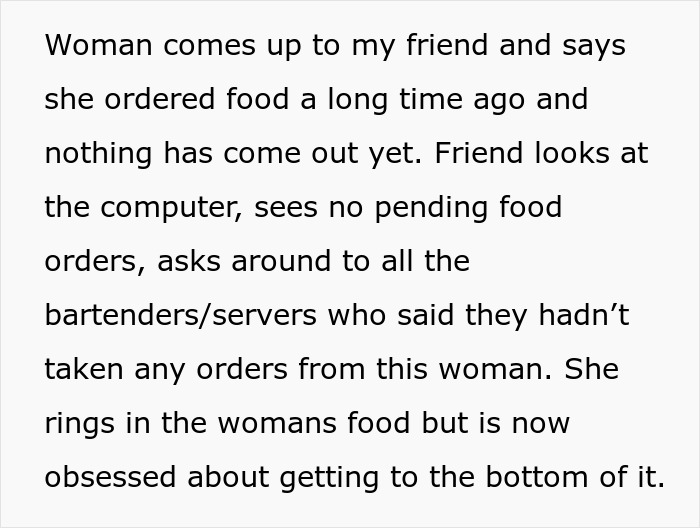
The expectation that women will remember everyone’s food order isn’t just a quirky social norm—it’s a quiet assertion of labor, a subtle reinforcement of gendered roles that have been baked into our collective consciousness like overproofed dough. Why is it that when a group of friends or colleagues gather, the woman is often the one who scribbles down orders on napkins, the one who double-checks with the server, the one who fields the inevitable “Wait, did you get my extra guac?” moments? This isn’t about memory; it’s about the unspoken assumption that women will absorb, retain, and execute emotional and logistical labor without complaint. It’s time to dissect this phenomenon—not with a scalpel, but with the precision of a chef’s knife, slicing through the layers of expectation to reveal the rot beneath.
The Invisible Ledger of Emotional Labor
Every time a woman is tasked with remembering a food order, she’s not just recalling a preference—she’s maintaining a ledger of social harmony. The act of remembering isn’t neutral; it’s an investment in the group’s comfort, a way to ensure no one feels overlooked or inconvenienced. But here’s the catch: this labor is rarely acknowledged, let alone compensated. It’s the emotional equivalent of a waiter who clears plates without being tipped. Women are expected to be the living, breathing CRM systems of social interactions, storing preferences like a database while men are free to forget and move on. The problem isn’t forgetfulness; it’s the assumption that women will never forget. It’s the belief that their brains are hardwired for caretaking, even when the caretaking extends to a table of strangers at a corporate lunch.
Consider the language used to describe this phenomenon. We say things like, “She’s so good at remembering things,” or “She’s the organized one.” These phrases are backhanded compliments, thinly veiled acknowledgments of unpaid work. They frame the woman’s memory as a natural gift rather than a learned skill honed by years of navigating a world that expects her to prioritize others’ needs above her own. The expectation isn’t just that she’ll remember; it’s that she’ll do so without resentment, without exhaustion, without ever asking why it’s her responsibility in the first place.
The Myth of the “Naturally Nurturing” Woman
Society clings to the myth of the “naturally nurturing” woman like a child to a security blanket. This myth posits that women are inherently better at remembering details, at anticipating needs, at keeping the social machinery running smoothly. But this isn’t nature—it’s conditioning. From childhood, girls are praised for being “helpful,” for remembering birthdays, for keeping track of their siblings’ schedules. Boys, on the other hand, are often encouraged to focus on tasks that don’t involve emotional labor. The result? A generation of adults who see women’s memory as an innate trait rather than a skill cultivated by relentless social reinforcement.
This myth does more than just place an unfair burden on women; it erases the labor of men who do remember orders, who do take on emotional labor. It creates a false dichotomy where women are either the “good” nurturers or the “bad” ones who dare to prioritize themselves. The truth is, memory is a muscle, and like any muscle, it atrophies when unused. When men are never expected to remember orders, their memory for such details weakens. Meanwhile, women are stretched thin, their brains repurposed as communal notepads. The myth of natural nurturing isn’t just outdated—it’s a tool of oppression, a way to justify the unequal distribution of invisible labor.

The Power Dynamics of Who Asks, Who Remembers
There’s a subtle power dynamic at play in who is expected to remember orders and who isn’t. The person who asks the question—“What does everyone want?”—is often the one who assumes they won’t be the one to remember. The person who volunteers to write it down is often the woman, the junior employee, the person who has been socialized to believe their role is to facilitate others’ comfort. Meanwhile, the person who says, “I’ll just have whatever,” or “Surprise me,” is often the one who holds the most social capital. They’re the ones who can afford to be careless with their preferences because they know someone else will pick up the slack.
This dynamic reveals a deeper truth about power: the people who are least expected to remember are the ones who have the most freedom to forget. They’re the ones who can say, “I don’t eat gluten,” and then proceed to order a sandwich with a side of denial. They’re the ones who can change their minds mid-meal without consequence. Meanwhile, the woman who remembers is trapped in a cycle of second-guessing, her memory a prison of others’ whims. The power to forget is a privilege, and it’s one that’s disproportionately denied to women.
Breaking the Cycle: A Call for Collective Amnesia
So how do we break this cycle? The answer isn’t for women to start forgetting orders—it’s for everyone to stop expecting them to remember in the first place. The first step is to normalize the act of writing things down. Not as a sign of weakness, but as a sign of efficiency. The second step is to challenge the assumption that women are the default keepers of social harmony. When a man forgets an order, don’t laugh it off as a quirk; ask why he didn’t write it down. When a woman remembers, don’t praise her like she’s performed a miracle; treat it as the mundane, expected task it is.
We need to redefine what it means to be a good friend, a good colleague, a good partner. Being good isn’t about remembering everyone’s coffee order—it’s about respecting their autonomy enough to ask them directly. It’s about recognizing that emotional labor isn’t a feminine trait; it’s a human one, and it should be shared equally. The next time you’re at a restaurant, watch who reaches for the pen. If it’s always the same person, ask yourself why. And then ask yourself what you’re going to do about it.

The Future: A World Where No One Remembers (And That’s Okay)
The ultimate goal isn’t for women to stop remembering orders out of resentment—it’s for the expectation to disappear entirely. Imagine a world where no one is expected to remember anything. Where orders are written down, double-checked, and confirmed like a legal contract. Where the burden of memory isn’t placed on the shoulders of the most socially conditioned group. It’s not a utopian fantasy; it’s a simple shift in perspective. The next time you’re at a gathering, take a moment to observe who is doing the remembering. And then ask yourself: Why them?
The act of remembering orders is a microcosm of a larger issue—the way society expects women to absorb the emotional and logistical labor of others without question. It’s time to stop asking women to be the living, breathing CRM systems of the world. It’s time to start asking why we ever thought that was acceptable in the first place.









Leave a Comment