
The moment your feet cross the threshold of your home, your workday does not end—it mutates. The labor you anticipated at the office is but a fraction of the daily toil you undertake. Welcome to the “second shift,” an invisible battlefield where the weight of domestic demands collides with the exhaustion of paid employment. This phenomenon is not just a fact of life; it’s a piercing reflection of systemic gender inequities that continue to chain caregivers, predominantly women, to relentless cycles of physical and emotional labor. To truly grasp the magnitude of the second shift is to confront the deeply ingrained societal scripts that dictate who does what when the clock stops ticking at nine-to-five. Prepare to have your perspective irrevocably shifted.
The Unseen Labor: Defining the Second Shift
The term “second shift” captures a cruel duality—an invisible workload that begins the moment the workday officially ends. This isn’t simply about chores; it’s about the emotional ingenuity it takes to manage a household, nurture relationships, and sustain the fragile ecosystem that is family life. For many, especially women, stepping through their front door signals a new kind of labor, one uncompensated, undervalued, but utterly obligatory.
This second shift encompasses myriad tasks: preparing meals, laundering clothes, managing children’s schedules, resolving conflicts, and maintaining the emotional well-being of the household. It’s a relentless cycle fed by ingrained cultural expectations and perpetuated by economic structures that refuse to acknowledge domestic work as labor deserving of time, respect, and remuneration.

By redefining our understanding of labor to include this invisible workload, we confront a systemic blindness that has long allowed society to sideline and exploit the tireless efforts disproportionately shouldered by women.
The Psychological Toll: Exhaustion Beyond Physical Strain
The second shift extracts a price far beyond sore muscles and aching backs. It exacts a cumulative psychological toll that chips away at one’s mental health and identity. After a day of professional responsibilities, women often walk into homes rife with tasks that demand yet more energy—often emotional labor, an equally exhausting and invisible strain. Emotional labor refers to managing not only their own moods and feelings but also anticipating and responding to the emotional needs of family members.
Imagine having to not only plan a strategic presentation at work but also mediate sibling disputes, remember parent-teacher meetings, and provide unwavering emotional support to a partner, all while suppressing your own mental fatigue. The relentless all-consuming nature of this labor leaves little room for self-care or mental replenishment—resources essential to human sustainability.
Consequently, many women describe a profound sense of invisibility and depletion where their efforts are overlooked, their sacrifices normalized, and their mental well-being discounted. This is no mere tiredness—it is a systemic erosion of agency and aspiration.
Economic and Social Consequences: Trapped in an Unfair Cycle
The second shift is not simply a psychological burden—it carries tangible economic consequences that perpetuate gender inequality. Time and energy spent on unpaid labor at home translate to missed opportunities for career advancement, additional work hours, or personal pursuits that could contribute to financial independence.
Women, historically and statistically, face stalled career trajectories in part because the second shift forces compromises: part-time work, passing on demanding projects, or declining travel opportunities. This dynamic cements a cycle where women’s economic power is suppressed while their labor is redirected toward invisible domestic duties. It also entrenches wage gaps and reinforces patriarchal notions about women’s “place” in both home and workplace.
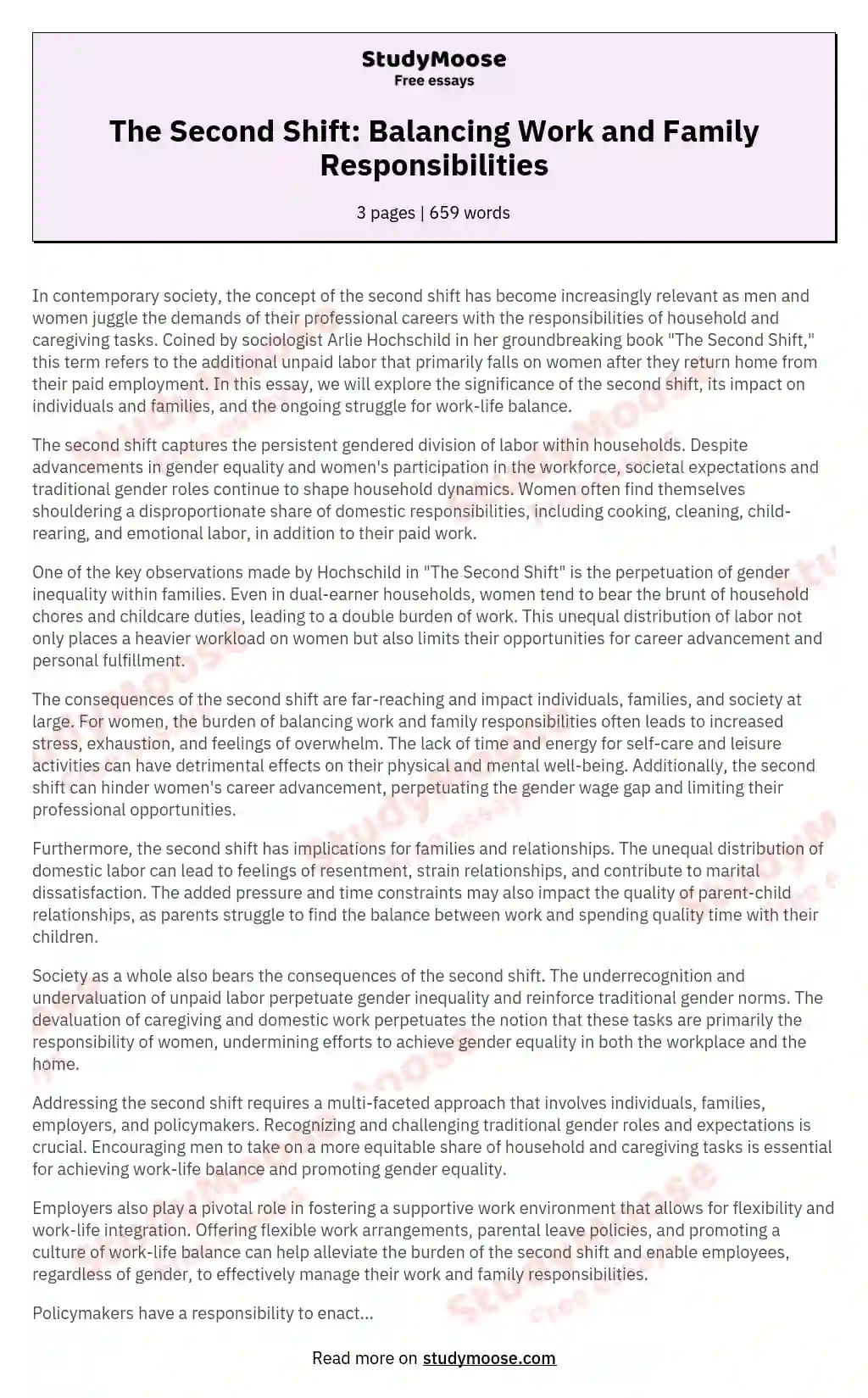
This cycle is a social quagmire—one that underpins structural inequalities, restricts social mobility, and upholds archaic gender roles. The second shift is an invisible chain; to break it requires systemic change, not just individual sacrifice.
Reframing Domestic Work: Toward Equity and Recognition
To dismantle the oppressive edifice of the second shift, society must fundamentally reframe domestic labor. It demands recognition—not as a benign extension of gender roles but as legitimate work deserving of valuation and redistribution. This reimagining requires cultural shifts that challenge the automatic allocation of caregiving and home management to women.
Policy changes are paramount: paid family leave, affordable childcare, flexible work schedules, and workplace cultures that value caregiving as a shared responsibility. Concurrently, households must engage in honest negotiations around labor division—with an emphasis on equitable sharing rather than token gestures.
The cultural narrative must evolve from the myth of the “superwoman” who effortlessly balances everything, toward an authentic acknowledgement of human limits and the need for communal support. Only then can the second shift become a shared endeavor—equal parts challenge and cooperation.
The Power of Awareness: Shifting Perspectives to Ignite Change
Understanding the second shift is merely the first step on a path toward emancipation. By exposing the realities of this relentless labor and its consequences, individuals and communities can begin to unpick long-held assumptions about gender, work, and worth. Awareness fuels empathy; empathy sparks dialogue; dialogue seeds transformation.
Men must be invited—not coerced—to join the conversation, to witness the lived realities of their partners, and to reexamine their roles beyond the traditional provider archetype. Structural change requires collective effort, and that change starts by naming the problem and refusing to normalize inequality.

The second shift is a clarion call—a demand for justice and recognition. As we peel back layers of invisibility, we expose opportunities to rethink how work, family, and care intersect. The moment you step home is not the end, but a pivotal transition—and by shifting our perspective, we can start to rewrite the narrative that has long imprisoned countless workers in endless cycles of uncompensated toil.









Leave a Comment