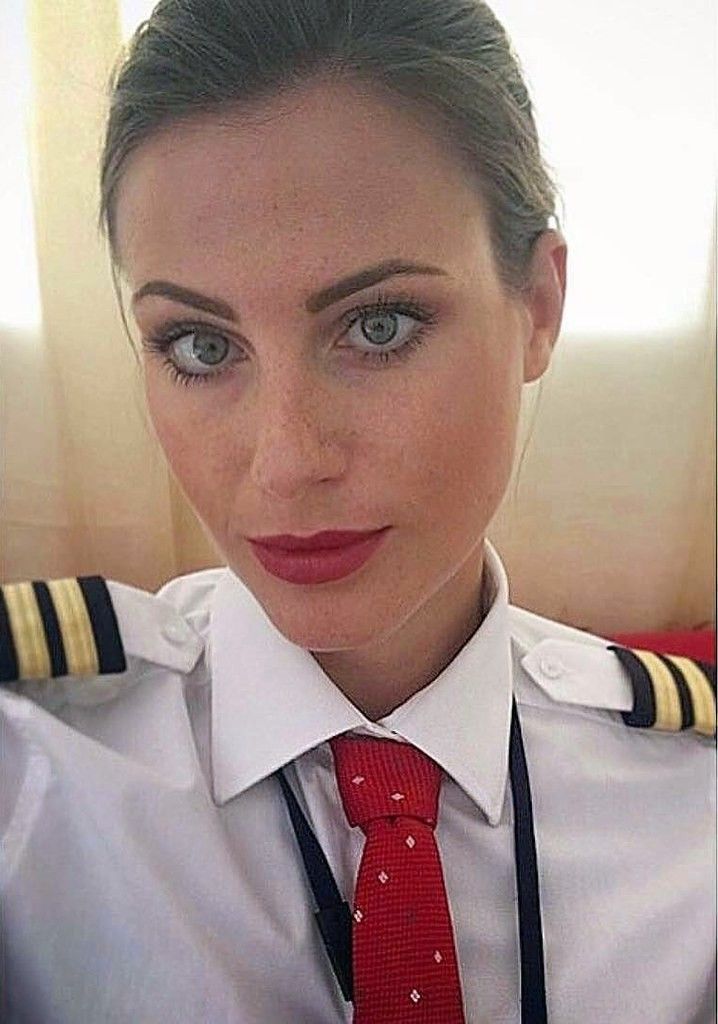
In the grand theater of aviation, where the sky is the only limit, a silent revolution has taken flight—not in the roar of engines, but in the hemline of a uniform. For generations, the cockpit has been a bastion of male dominance, its doors bolted shut to women by centuries of tradition, bias, and outright exclusion. Yet, as the world hurtles toward equity, one detail lingers like a stubborn stain: the skirt option. Not a choice. Not a freedom. But an *option*—as if femininity were a concession, a compromise, a footnote in the manual of aviation history. This is the story of the woman who stepped into the pilot’s seat, only to find her uniform had been tailored by a tailor who forgot to ask for her measurements.
The Uniform as a Metaphor: When the Sky Demands a Hemline
Imagine, for a moment, that you are a woman who has just earned her wings. You stand before the mirror, donning the uniform that marks you as a pilot—a symbol of authority, precision, and mastery over the elements. But there’s a catch. The uniform, that sartorial shackle, comes with a skirt. Not because you asked for it. Not because it’s practical. But because somewhere, in the dim corridors of tradition, it was decided that femininity must be performative, even in the face of 30,000 feet of turbulence. The skirt is not a garment; it’s a statement. A reminder that the sky, despite its boundless expanse, still measures women by the length of their clothing.
The absurdity is staggering. Would a male pilot be offered a kilt? A sarong? A pair of bloomers? Of course not. The uniform is a uniform—until it isn’t. For women, it’s a costume, a performance, a daily negotiation between professionalism and the expectations of a world that still measures competence in centimeters of fabric. The skirt option is not a courtesy; it’s a concession. A concession that says, “We’ll let you in, but only if you do it our way.”
The Skirt as a Symbol: Who Decides What’s Professional?
Professionalism is a moving target, shaped by power, prejudice, and the unspoken rules of who gets to define them. For women in aviation, professionalism has long been conflated with conformity—conformity to a male-dominated ideal that erases femininity entirely or, worse, weaponizes it against them. The skirt is not just a piece of clothing; it’s a litmus test. A test of whether a woman can be both competent and feminine without being seen as a distraction, a liability, or a novelty.
Consider the cognitive dissonance: a woman in a skirt piloting a plane is often met with skepticism, as if the act of flying were somehow less credible when paired with a hemline. Yet, a man in the same skirt would be met with curiosity, amusement, or even admiration—a quirk, a statement, a rebellion. The double standard is not just unfair; it’s a reflection of how deeply ingrained the idea of women as interlopers in male spaces remains. The skirt is not a choice; it’s a cage disguised as a concession.
The Practicality Paradox: Why a Skirt in the Cockpit is a Flight Risk
Let’s talk about practicality, shall we? Aviation is not a runway show. It’s a high-stakes ballet of precision, where every second counts and every movement must be calculated. A skirt is not an accessory in the cockpit; it’s a liability. It restricts movement. It risks snagging on controls. It’s a distraction in an environment where focus is paramount. Yet, the uniform designers—those gatekeepers of sartorial tradition—insist on offering it as an option. Why? Because tradition is easier than innovation. Because change is harder than compliance. Because it’s easier to ask women to adapt than to ask the system to evolve.
The irony is delicious. The aviation industry prides itself on cutting-edge technology, on pushing the boundaries of what’s possible. Yet, when it comes to the uniforms of the people who make it all possible, it clings to the past like a child to a security blanket. The skirt is not a nod to modernity; it’s a relic of a time when women were expected to be decorative, not decisive. It’s a reminder that even in the 21st century, the sky is still policed by the ghosts of old hierarchies.
The Global Divide: Skirts, Suits, and the Invisible Barriers
This is not a universal truth. Around the world, the story of women in aviation—and their uniforms—varies wildly. In some countries, the skirt is a non-negotiable relic of colonial-era dress codes, a stubborn refusal to acknowledge that women might have legs, let alone the right to move freely in them. In others, the uniform is gender-neutral, a radical act of defiance against the idea that femininity must be performative to be acceptable. But even in the most progressive corners of the globe, the shadow of the skirt lingers. It’s a ghost that haunts every female pilot, a reminder that the fight for equality is not over—it’s just taken a sartorial turn.
The global divide is a mirror held up to the world’s contradictions. In one country, a woman might be celebrated for breaking the sound barrier; in another, she might be told to tuck her skirt in before she’s allowed to taxi the plane. The uniform is not just a uniform; it’s a map of progress and regression, a visual representation of how far we’ve come and how much further we have to go.
The Future of Flight: Will the Skirt Ever Disappear?
The question is not whether the skirt will disappear—it’s when. The aviation industry is changing, albeit slowly. Women are entering the field in record numbers. Diversity is no longer a buzzword; it’s a necessity. Yet, the uniform remains a stubborn holdout, a relic of a time when women were expected to fit into a mold that was never designed for them. The future of flight lies not in hemlines, but in humanity. In recognizing that a pilot’s worth is not measured by the length of their skirt, but by the skill in their hands and the fire in their eyes.
Perhaps one day, the skirt will be consigned to the annals of history, a quaint reminder of a time when women had to fight for the right to wear pants. Until then, every time a female pilot steps into the cockpit, she does so with the weight of tradition on her shoulders—and the hem of her skirt brushing against the controls, a silent protest against a system that still hasn’t figured out how to let her fly without it.

The skirt is not just a piece of fabric. It’s a symbol. A reminder. A challenge. And until it’s gone, the fight for true equality in the skies will remain unfinished.











Leave a Comment