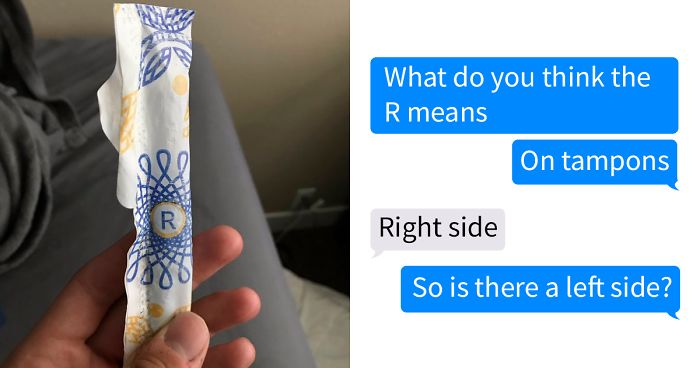
In the grand theater of modern gender dynamics, where lines are blurred and roles are rewritten with each passing day, a simple question posed to men about tampons became a flashpoint of unexpected reactions. What began as a playful inquiry—”Do you carry tampons?”—unraveled into a tapestry of responses that oscillated between solidarity and bewilderment, humor and hostility. This wasn’t just about menstrual products; it was a microcosm of how society grapples with empathy, responsibility, and the unspoken rules of care.
The Question That Unleashed a Pandora’s Box of Reactions
It started innocently enough. A woman, perhaps weary of the perpetual burden of carrying her own supplies, turned to the men in her life and asked: “Do you ever carry tampons?” The question wasn’t a demand or a critique—it was an invitation, a gentle nudge to share the load. What followed was a deluge of responses that revealed more about societal conditioning than about the products themselves.
Some men laughed it off, their responses laced with self-deprecating humor: “Only when I’m lost in a foreign country and need to bribe a customs officer.” Others took it seriously, admitting they kept a spare pack in their bag, “just in case.” But then there were the outliers—the ones who bristled at the implication, as if being asked to carry a tampon was an affront to their masculinity. Their reactions weren’t just about the product; they were about the erosion of a rigid, outdated script that dictates who is responsible for what.
The responses weren’t just answers; they were a mirror held up to society, reflecting our collective discomfort with redefining care outside the binary of gender roles.
The Unspoken Stigma: Why Tampons Still Feel Like a Taboo
Tampons, in all their cylindrical glory, are more than just cotton cylinders—they’re symbols. Symbols of menstruation, of bodily autonomy, of a process that half the world experiences but few talk about openly. When men are asked to carry them, the request isn’t just practical; it’s political. It challenges the notion that care is a woman’s domain, that vulnerability is a feminine trait, and that strength is measured in detachment from the messy, the biological, the human.
Consider the language used in responses: “I don’t carry tampons, but I’ll hold your purse while you do.” The humor is a coping mechanism, a way to deflect the discomfort of a question that disrupts the status quo. It’s easier to joke about carrying a purse than it is to acknowledge that care isn’t a zero-sum game. Yet, in those jokes, there’s a kernel of truth—care is often framed as a burden, something to be avoided or minimized, rather than a shared responsibility.
The stigma isn’t just about the product; it’s about the act of carrying it. A man who carries tampons isn’t just holding cotton—he’s holding a challenge to the idea that men must be stoic, unburdened, and emotionally distant. And that’s a threat to the fragile architecture of traditional masculinity.
The Men Who Said Yes: Breaking the Mold Without Breaking a Sweat
Not all responses were met with resistance. Some men answered with a quiet confidence, as if the question was no more unusual than asking if they carried a pen. “Of course. It’s no different than carrying tissues or band-aids.” These were the men who had already dismantled the idea that care was gendered. For them, carrying a tampon was as mundane as carrying a charger or a wallet—just another item on a long list of things to keep handy.
What’s striking about these men isn’t just their willingness; it’s their lack of performative justification. They didn’t feel the need to explain themselves, to couch their answer in humor or apology. Their responses were matter-of-fact, as if they’d long since moved past the idea that certain tasks were off-limits based on gender. These men are the quiet revolutionaries of everyday life, the ones who recognize that care isn’t a chore to be delegated but a value to be upheld.
Yet, even among these allies, there’s a tension. Because while their actions are commendable, the fact that they stand out at all speaks volumes about how far we still have to go. If carrying a tampon is an act of defiance, then we’re still living in a world where care is a battlefield rather than a shared endeavor.
The Pushback: When Empathy Is Framed as Emasculation
Of course, not everyone was on board. Some responses were laced with defensiveness, as if the mere suggestion that men could participate in menstrual care was an attack on their identity. “I’m not a walking first-aid kit.” “Why should I carry something I’ll never use?” These reactions reveal a deeper discomfort—not with tampons themselves, but with the idea that men might be expected to engage with the realities of women’s bodies.
This pushback isn’t just about tampons; it’s about the erosion of a hierarchy that places men at the top of a pyramid of indifference. When men are asked to care, they’re being asked to step down from a pedestal they didn’t even realize they were standing on. And that’s a fall many aren’t willing to take.
The irony is that this resistance often comes from men who pride themselves on being progressive, who scoff at the idea of toxic masculinity. Yet, when faced with a tangible example of shared responsibility, they retreat into old patterns. It’s easier to dismiss the request as absurd than to confront the discomfort of redefining what it means to be a man.
The Bigger Picture: Why This Matters Beyond Tampons
This isn’t just about who carries a tampon. It’s about who carries the emotional labor of a household. It’s about who is expected to remember birthdays, to plan meals, to notice when someone is upset. The tampon is a stand-in for all the invisible work that women are socialized to perform, while men are socialized to remain oblivious.
When we ask men to carry tampons, we’re not just asking them to hold cotton; we’re asking them to hold space for the idea that care isn’t a gendered obligation. We’re asking them to recognize that vulnerability isn’t weakness, that strength isn’t measured in detachment, and that humanity isn’t a zero-sum game.
The responses to that simple question revealed a society at a crossroads. On one side, there are those who see care as a shared responsibility, who understand that empathy isn’t a finite resource. On the other, there are those who cling to the old scripts, who see any challenge to the status quo as a threat to their identity. The tampon, in all its humble glory, became a litmus test for where we stand on the spectrum of progress.
The Way Forward: Normalizing Care Without the Fanfare
So where do we go from here? The answer isn’t to shame men into carrying tampons or to turn the act into a performative display of allyship. The answer is to normalize care as something that isn’t gendered, something that isn’t a chore but a value. It’s about raising boys who see helping a friend with a tampon as no different than helping them carry groceries. It’s about teaching men that vulnerability isn’t a threat to their masculinity but a testament to their humanity.
Perhaps the next time someone asks a man if he carries tampons, the answer won’t be met with laughter or defensiveness. Perhaps it will be met with a shrug and a “Yeah, of course.” And maybe, just maybe, that shrug will be the beginning of something revolutionary—not because it’s extraordinary, but because it’s ordinary.





Leave a Comment