
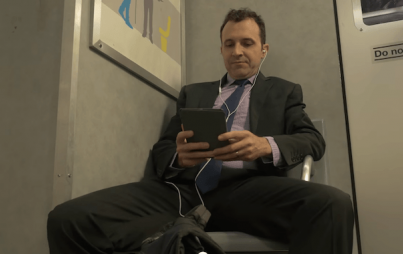
There is a silent war waged in the cramped confines of public transit, a battlefield where personal space is a luxury and the rules of engagement are written in the unspoken language of body language. It is a war where the spoils are not gold or territory, but the right to occupy the world without apology. And in this war, the weapon of choice is not a gun or a sword, but the unapologetic sprawl of a man’s legs, a phenomenon so pervasive it has earned its own lexicon: manspreading. But what if the tables were turned? What if the oppressed became the oppressor, if only for a moment? What if she started sitting like them?
The Anatomy of a Power Play: How Manspreading Became a Symbol of Entitlement
Manspreading is not merely an inconvenience; it is a manifestation of patriarchal entitlement, a physical assertion of dominance in a space that should be neutral. Studies have shown that men, on average, occupy 2.5 times more space than women in public seating, their limbs splayed like the wings of a territorial bird, marking their claim. This is not accidental. It is a ritual, a daily performance of ownership, a reminder that the world is not designed for shared comfort but for the unchecked expansion of male presence.
The irony is that this behavior is rarely questioned. When a woman adjusts her posture to fit into the narrow confines of a subway seat, she is accommodating. When a man sprawls, he is merely existing. The double standard is not just frustrating—it is a violation of the social contract that governs public spaces. Manspreading is not about comfort; it is about control. It is the physical embodiment of the idea that men’s bodies are entitled to more room, more air, more right to the world.
The Subtle Art of Subversion: When Women Claim Their Rightful Space
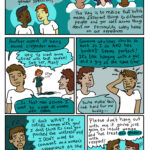
What happens when the oppressed refuse to play by the rules? When they, too, begin to sprawl? The act of a woman sitting with her legs wide, elbows akimbo, is not just a physical act—it is a political statement. It is a reclamation of the body, a refusal to shrink, to apologize, to make herself smaller in a world that demands it.
This is not about mirroring toxic behavior. It is about exposing its absurdity. When a woman manspreads, she is not asserting dominance; she is asserting equality. She is saying, “If you can take up this space without consequence, so can I.” The reactions are telling. Men bristle. They shift uncomfortably. They may even vocalize their displeasure—“Excuse me, miss, you’re taking up too much room.” But the question is not about space. It is about power.
The subversion lies in the discomfort it causes. Manspreading is so normalized that when a woman does it, it disrupts the illusion of inevitability. It forces onlookers to confront the absurdity of the original act. Why is it acceptable for one gender to sprawl but not the other? The answer is not about physics. It is about psychology.
The Psychological Warfare of Public Transit: Who Really Owns the Seat?
Public transit is a microcosm of societal power structures. The seats are not just places to rest; they are symbols of who belongs and who does not. Manspreading is a daily reminder that certain bodies are assumed to have more right to exist in public spaces than others. It is a form of territorial marking, a way for men to assert their presence in a world that often renders women invisible.
But what if women began to treat transit seats as their own? Not in a way that infringes on others, but in a way that challenges the assumption that their bodies are secondary. The psychological impact is profound. When a woman sits with her legs wide, she is not just occupying space—she is redefining it. She is saying that her comfort matters just as much as anyone else’s.
The resistance to this idea is telling. Men who manspread rarely face scrutiny, but a woman who does the same is often met with hostility. Why? Because her act is seen as a threat to the status quo. It is a reminder that the world was never designed for her comfort, and her refusal to comply is an act of rebellion.

The Unspoken Rules of Public Spaces: Who Decides Who Gets to Be Comfortable?
Public spaces are governed by unspoken rules, and the most powerful of these rules is the one that dictates who gets to be comfortable. Manspreading is not just about physical space—it is about psychological space. It is about the assumption that men’s bodies are entitled to more room, more air, more right to the world.
But what if these rules were rewritten? What if women began to assert their right to comfort just as unapologetically? The backlash would be immediate. Men would complain about “inconsiderate” behavior. They would demand explanations. They would treat it as an affront to their sensibilities. And yet, when men manspread, it is rarely questioned. Why? Because the rules were written by them, for them.
The act of a woman sitting with her legs wide is not just about reclaiming space—it is about exposing the hypocrisy of the rules. It is about forcing a confrontation with the idea that comfort is not a universal right but a privilege reserved for those who already hold power.
The Ripple Effect: How Small Acts of Rebellion Challenge the Status Quo
Every act of subversion is a stone cast into the pond of societal norms. The ripples may be small at first, but they spread. When a woman manspreads, she is not just taking up space—she is changing the conversation. She is saying that the rules do not have to be accepted as they are. She is saying that her body matters just as much as anyone else’s.
The ripple effect is already visible. More women are refusing to shrink in public spaces. They are sitting with their legs wide, their arms outstretched, their presence unapologetic. And with each act, the illusion of inevitability begins to crack. Manspreading is no longer just a man’s game. It is a reminder that the world was never designed for anyone’s comfort—except those who have the power to enforce it.
The question is not whether women should manspread. The question is why men ever thought they had the right to do it in the first place.







Leave a Comment