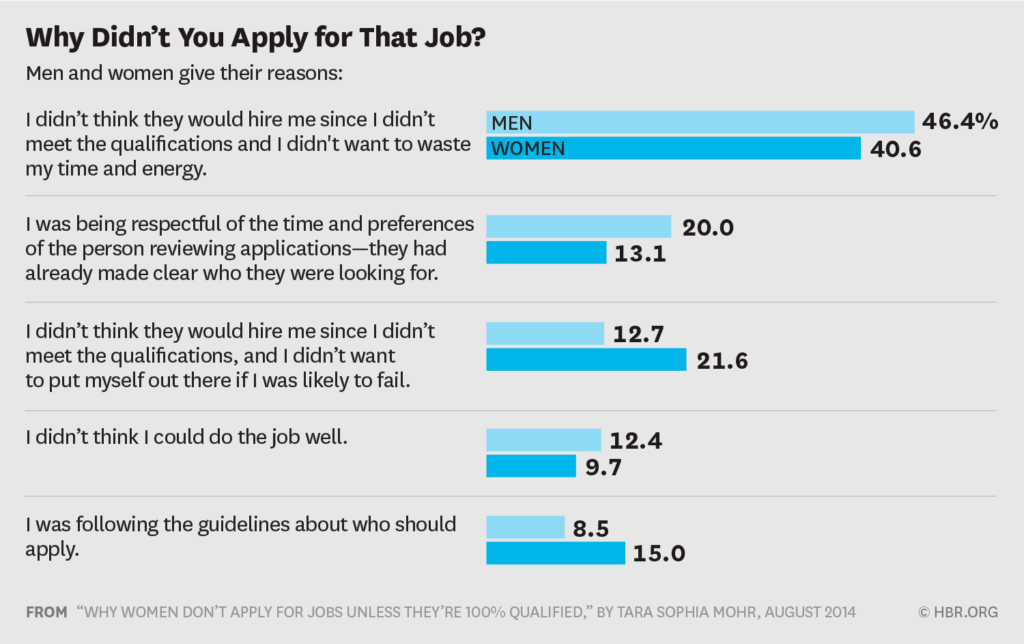
Why do women often hold back, waiting until they are 100% qualified before tossing their hats into the job ring, while men saunter in with only 60% of the boxes ticked? Is it prudence? Perfectionism? Or an ingrained societal script whispering limitations into ears from childhood onwards? Let’s delve into this intriguing conundrum and unearth the intricate dynamics fueling these contrasting application behaviors.
The Confidence Conundrum: Femininity and the Myth of Perfection
Imagine a world where confidence isn’t just an internal feeling but a currency spent in job markets. Women tend to internalize a rigorous checklist, often dismissing their candidacy unless every criteria sparkles brightly. This phenomenon isn’t mere cautiousness; it’s a formidable interplay of social conditioning and psychological wiring. From a young age, women receive subliminal and overt cues teaching them to strive for flawlessness, to avoid mistakes, and to prove their worth beyond shadow of doubt. The consequence? They tether their aspirations to a rigid standard of preparedness.
Meanwhile, men glide through the application process, buoyed by a cultural narrative that rewards risk-taking and bold declarations. This disparity in confidence thresholds suggests that confidence isn’t solely about competence, but also about how society frames ambition and self-worth for different genders. The task is not merely to debunk these myths but to understand how they shape professional pursuits and gatekeep opportunities.

Risk Tolerance and the Gendered Appetite for Ambiguity
Risk. It’s that elusive whisper nudging one to leap before fully sure of the landing. Men often exhibit higher tolerance for ambiguity and risk in professional contexts, an inclination deeply rooted in evolutionary psychology and reinforced by cultural scripts that celebrate the daring pioneer archetype. Women, conversely, might approach risk with surgical precision, weighing potential pitfalls more vigilantly.
This calculated caution can be a double-edged sword. On one side, it cultivates exceptional readiness and minimizes failure, but on the other, it throttles opportunities, especially in fast-moving industries where agility trumps perfection. Thus, the 100% threshold for women may reflect not just self-doubt but an adaptive strategy shaped by historical exclusion and higher stakes attached to failure.
Structural Barriers and the Specter of Scrutiny
Beyond internal psychology lies the unforgiving architecture of workplace power dynamics. Women, especially in male-dominated sectors, face heightened scrutiny. Each misstep is magnified, often unfairly attributed to gender rather than circumstance. This hyper-vigilance breeds a survival strategy: come in fully armed with credentials, leaving no room for criticism.
Moreover, hiring managers—consciously or unconsciously—may harbor biases that throttle women who don’t appear “overqualified.” Evidence suggests that women anticipate these biases and prepare themselves to counteract skepticism. This preemptive perfectionism can be exhausting, but it is a necessary armor in environments rife with unequal expectations.
The Impostor Syndrome: A Silent Saboteur
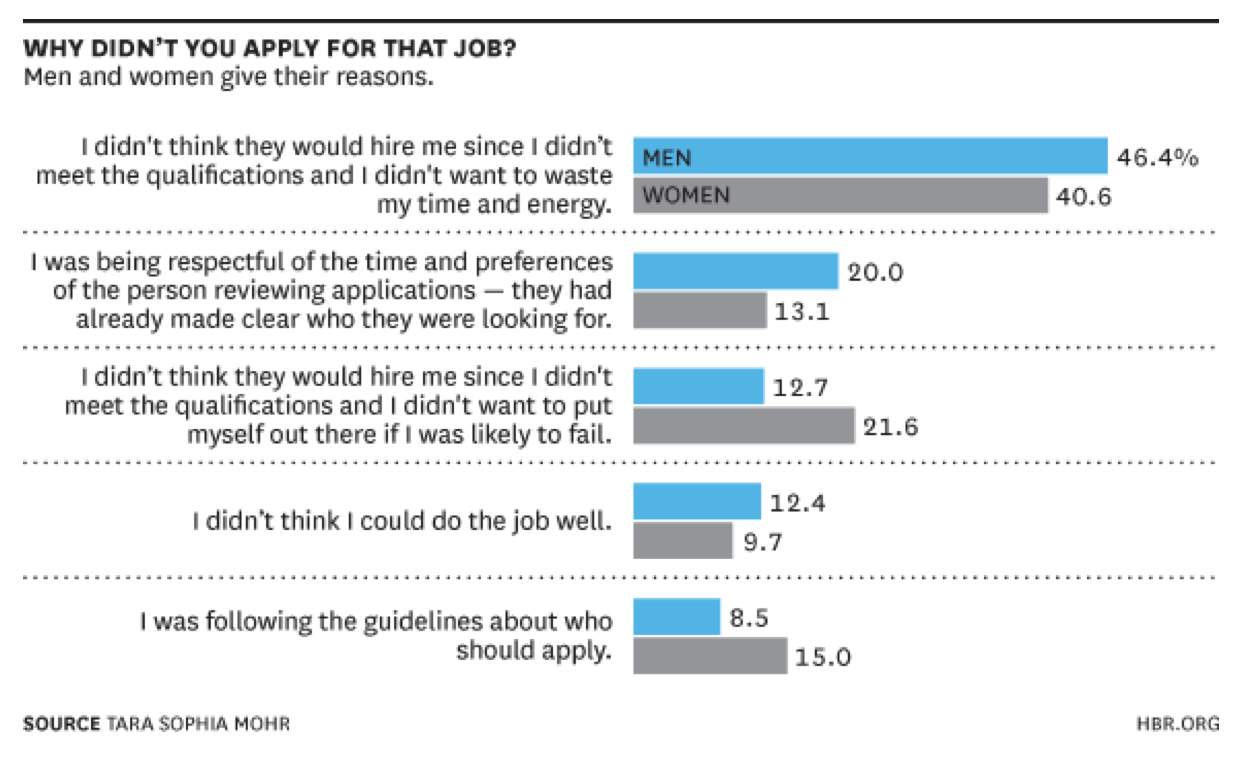
Crippling and clandestine, impostor syndrome disproportionately plagues women, whispering poisonous doubts: “You don’t belong here,” “You aren’t good enough.” This internal saboteur distorts ambitious vision, tethering women to exhaustive proof of competence before daring to reach out for opportunities.
In contrast, men are less frequently shackled by such self-doubt, emboldened by societal validation that normalizes and even celebrates audacity over accuracy. For women, the fight against impostor syndrome is more than a psychological battle; it is a revolt against systemic undervaluation.
Rewriting the Narrative: Encouraging Authentic Application Practices
What if women embraced the same latitude as men—to apply boldly, imperfectly, and ambitiously? The implications could be seismic. Organizations must dismantle gatekeeping cultures that penalize “less-than-perfect” applicants. Recruiters should wield awareness of gendered application patterns to sculpt more inclusive, encouraging hiring practices.
Simultaneously, empowering women through mentorship, visibility, and resilience training can shatter the internalized imperatives of exactitude. Celebrating audacity as a form of competence redefines professional landscapes and fuels a more equitable pipeline of talent. The equation must shift: qualifications are critical, but so are the courage and potential that lie beyond them.
The Road Ahead: Cultivating Courage and Changing Culture
Women applying only when 100% qualified isn’t simply a quirk; it’s birdsong signaling a deeper challenge within the labor ecosystem. To unlock true gender parity, society needs to nurture not just skills, but indomitable confidence and risk appetite for all. Transparency in job requirements, clear communication of growth potential, and validation of non-traditional experiences must become standard.
The question remains—can we rewrite the rules that dictate when one is “ready enough” to try? Because talent left waiting behind a comfort zone always rots. And the world doesn’t need perfect candidates; it needs brave ones.






Leave a Comment