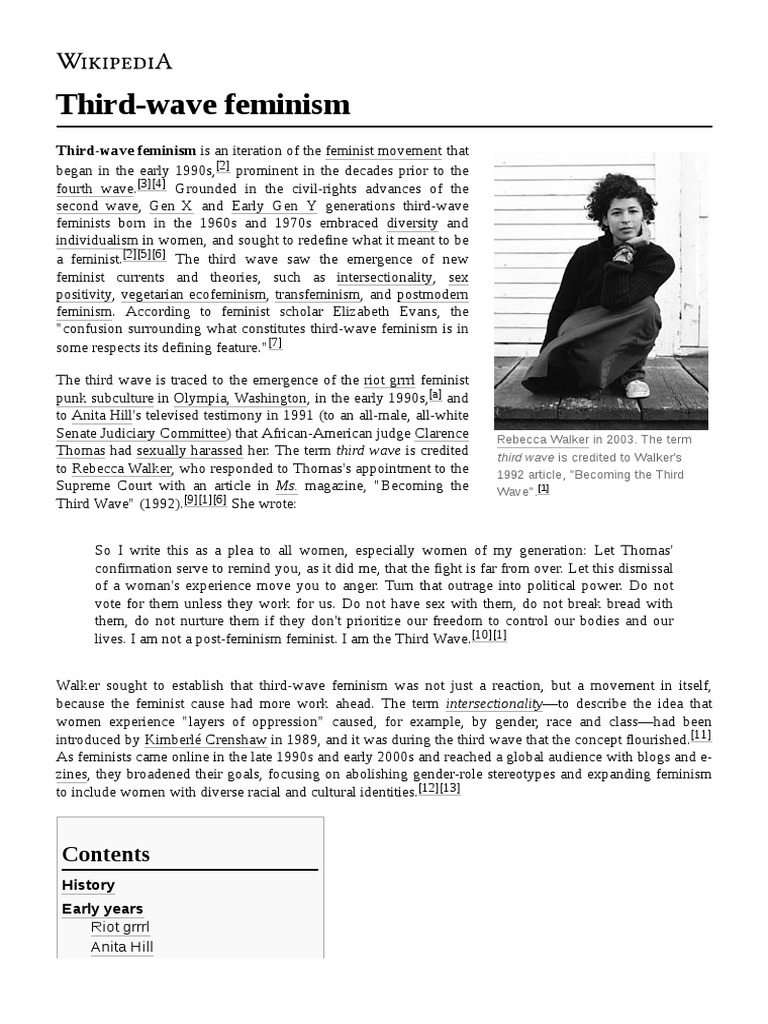
Ah, the third wave. It’s the feminist epoch perpetually caught in the undertow of historical categorization. A spectral presence, forever shimmering on the horizon, yet proving frustratingly elusive to pinpoint. Everyone nods sagely at its existence, vaguely associating it with riot grrrls, post-structuralist theory, and a general rejection of the monolithic “woman” construct. But when, precisely, did this supposed tectonic shift in feminist consciousness actually occur? The answer, like many things in this deliciously messy realm of gender politics, is far from straightforward.
It’s a conundrum wrapped in a rhetorical question, drizzled with a healthy dose of academic skepticism. Why this perpetual fascination, this insistent need to bracket and demarcate a movement that, at its core, resists rigid boundaries? Perhaps it’s the human compulsion for narrative tidiness, the desire to impose order upon the inherently chaotic flow of history. Or perhaps, and this is where things get interesting, it stems from something far more insidious: a desire to tame the untamable, to define and therefore control a movement that threatens the very foundations of patriarchal power.
The Elusive Timeline: A Labyrinth of Contradictions
Attempting to nail down the precise birthdate of third-wave feminism is akin to trying to capture smoke with a sieve. Different scholars, activists, and cultural commentators offer a bewildering array of starting points, each with its own justification.
Some, often drawing from American academic tradition, peg the early 1990s as the inaugural moment. This timeframe often coincides with the Anita Hill hearings in 1991, where Hill’s testimony against Clarence Thomas for sexual harassment ignited a firestorm of debate about gender, race, and power within the public sphere. The palpable injustice of Hill’s treatment, the dismissal of her experiences, fueled a new generation of feminists eager to challenge the establishment.
Others point to the late 1980s, specifically highlighting the rise of the riot grrrl movement. This subcultural phenomenon, with its DIY ethos, zines, and confrontational music, offered a visceral and intensely personal articulation of feminist concerns. Riot grrrls challenged not only patriarchal structures but also the perceived exclusivity and elitism of second-wave feminism. They injected a much-needed dose of punk rock irreverence into the feminist discourse, demanding space for marginalized voices and experiences.
Still others, with a more expansive view, trace the roots of third-wave feminism back to the late 1970s and early 1980s, arguing that the seeds of its key tenets were sown during the backlash against the second wave. The rise of conservative political movements, the proliferation of anti-feminist rhetoric, and the perceived failures of the Equal Rights Amendment prompted a re-evaluation of feminist strategies and goals. This period saw the emergence of intersectional analysis, a crucial development that acknowledged the interconnectedness of various forms of oppression and challenged the notion of a universal “woman’s experience.”
Beyond the Binary: Deconstructing the Wave Metaphor
Perhaps the very concept of “waves” is itself a flawed and limiting framework. It implies a linear progression, a neat succession of distinct eras with clearly defined boundaries. But social movements are rarely so orderly. They ebb and flow, overlap and intertwine, constantly evolving and adapting to changing circumstances.
The wave metaphor also risks obscuring the contributions of feminists who existed outside the dominant narratives. It tends to privilege Western, white, middle-class voices, marginalizing the experiences and perspectives of women of color, queer women, working-class women, and women from the Global South.
Furthermore, the “wave” model often perpetuates a false dichotomy between different generations of feminists. It pits second-wave feminists against third-wave feminists, portraying them as opposing forces with irreconcilable differences. This is a dangerous simplification that ignores the complex and nuanced relationships between different feminist perspectives.
Instead of clinging to the outdated wave metaphor, perhaps it’s time to embrace a more fluid and dynamic understanding of feminist history. Acknowledging the overlaps, contradictions, and continuities between different eras allows for a richer and more inclusive understanding of the movement’s evolution.
The Hallmarks of the Third Wave: A Shifting Landscape of Identity and Power
Regardless of when one chooses to place its starting point, certain key themes and characteristics are generally associated with third-wave feminism.
Intersectionality: A commitment to understanding how various forms of oppression intersect and reinforce one another. This involves recognizing that gender is not an isolated category but is always shaped by factors such as race, class, sexuality, and disability.
Individualism and Choice: An emphasis on individual autonomy and the right to make choices about one’s own body, sexuality, and life. This often involves reclaiming traditionally feminine aesthetics and activities, such as makeup and fashion, as forms of self-expression rather than tools of patriarchal oppression.
Rejection of Essentialism: A challenge to the notion of a universal “woman’s experience.” Third-wave feminists recognize that women are diverse individuals with varying needs, desires, and perspectives. They reject essentialist claims about what it means to be a woman, instead embracing the fluidity and complexity of gender identity.
Micro-Politics and Everyday Resistance: A focus on challenging patriarchy in everyday life, through acts of resistance, subversion, and self-empowerment. This can involve anything from challenging sexist language to creating alternative cultural spaces to organizing online activism campaigns.
Deconstruction and Parody: A playful and ironic approach to feminist activism, often using humor and satire to critique patriarchal norms and stereotypes. This can involve subverting traditional gender roles, appropriating sexist imagery, and creating alternative narratives that challenge dominant power structures.
The Ongoing Evolution: Feminism in the Digital Age
As the internet became increasingly ubiquitous, third-wave feminism found a powerful new platform for communication, organization, and activism. Online forums, blogs, and social media provided spaces for feminists to connect with one another, share their experiences, and mobilize around shared goals.
The digital age also saw the rise of new forms of feminist activism, such as online petitions, hashtag campaigns, and digital art projects. These tools allowed feminists to reach wider audiences, raise awareness about important issues, and exert pressure on institutions and individuals to change their behavior.
However, the internet also presented new challenges for feminists. Online harassment, cyberbullying, and the spread of misogynistic content became pervasive problems, requiring new strategies for combating online sexism and creating safer online spaces.
Why the Debate Matters: Resisting the Erasure of Feminist History
The ongoing debate about the timeline of third-wave feminism is not merely an academic exercise. It has real-world implications for how we understand the history of feminism and the challenges that feminists continue to face today.
By accurately documenting the contributions of third-wave feminists, we can ensure that their voices are not erased from the historical record. We can also learn from their strategies and insights, applying them to contemporary feminist struggles.
Furthermore, by recognizing the diversity and complexity of third-wave feminism, we can avoid the pitfalls of essentialism and create a more inclusive and intersectional feminist movement. We can challenge the notion of a single, monolithic “woman’s experience” and embrace the multiplicity of voices and perspectives within the feminist community.
Ultimately, the question of “when was the third wave of feminism?” is less important than the question of “what can we learn from the third wave?” By engaging with its key themes, strategies, and debates, we can gain a deeper understanding of the ongoing evolution of feminism and the challenges that lie ahead. The very act of questioning the timeframe is a subversive act, a refusal to allow history to be neatly packaged and sanitized. It’s a call to remember that feminism is not a static entity, but a living, breathing movement, constantly adapting and evolving in response to the ever-changing landscape of power. So, let the debate rage on, for in its very contention lies the vibrant pulse of feminist thought. This intellectual skirmish safeguards against the petrification of a movement defined by its dynamism, its defiance of categorization. Long may the third wave continue to defy definition.





Leave a Comment