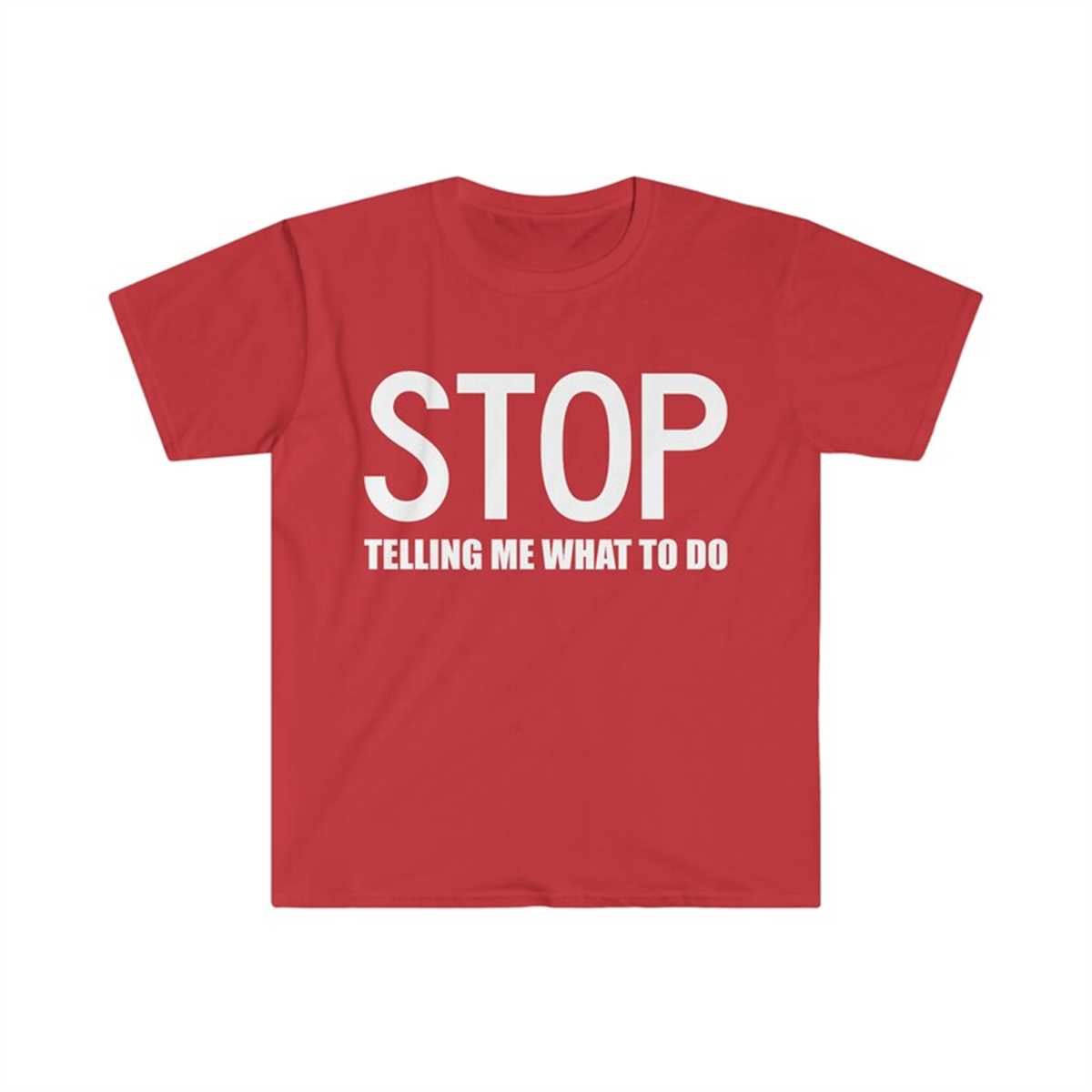
The first time I wore a “Stop Telling Me to Smile” shirt in public, the world seemed to pause. Not in the way it does when a sudden silence falls over a crowded room, but in the way a mirror shatters—each shard reflecting a different version of the truth. The reactions were immediate, visceral, and, in many ways, a microcosm of the very entitlement the shirt was designed to challenge. This wasn’t just about a piece of fabric emblazoned with words; it was a confrontation, a silent scream, a demand for respect. And the responses? They revealed more about the onlookers than they did about me.
The Unspoken Contract of Public Spaces
Public spaces are governed by an unspoken contract, one that dictates who is allowed to occupy them without fear and who must constantly prove their right to be there. Women, particularly women of color, are often subjected to this contract’s most brutal terms. A smile is not a gift; it is a currency, and the demand for it is a tax levied on our autonomy. When I wore that shirt, I wasn’t just making a statement—I was rejecting the premise that my presence in public should be contingent on my willingness to perform emotional labor for strangers.
But the reactions proved how deeply ingrained this contract is. Some men, their faces flushed with indignation, would sidestep me as if I’d just violated a sacred rule. Others would meet my gaze with a smirk, as though my defiance was a personal affront to their sense of entitlement. A few even took it upon themselves to “correct” me, their voices dripping with condescension: “You’d be so much prettier if you smiled.” These were not isolated incidents; they were echoes of a societal script that has been written, rehearsed, and performed for centuries.
The Spectrum of Reactions: From Mockery to Violence
The responses to the shirt were not uniform; they ranged from the absurdly trivial to the outright dangerous. Some people laughed, as if the idea of a woman refusing to smile was the punchline to a joke they alone understood. Others treated it as a dare, their eyes lingering just a second too long, their bodies inching closer, as though proximity could somehow coerce compliance. A few even went so far as to mimic the words on the shirt, their voices dripping with sarcasm: “Oh, I’m sorry, I didn’t realize you were the smile police.”
Then there were the ones who couldn’t resist the urge to “educate” me. “You know,” one man said, leaning in with the confidence of someone who had never been told no, “if you smiled more, people would be nicer to you.” His tone suggested that my refusal to perform was not just a personal choice but a moral failing. It was as if he had taken it upon himself to remind me that my worth was tied to my compliance, that my refusal to smile was an act of rebellion against some divine order.
The most chilling reactions, however, were the ones that veered into outright hostility. A woman once spat at my feet and called me a “feminazi,” her words laced with venom. Another man followed me for blocks, his voice a low growl: “You think you’re so tough? Let’s see how tough you are when I—” He didn’t finish the sentence, but the implication was clear. These were not just reactions to a shirt; they were reactions to the idea that a woman could exist without seeking validation, without performing, without shrinking herself to make others comfortable.
The Psychology of Entitlement: Why the Demand for Smiles Persists
The insistence on women’s smiles is not merely a social faux pas; it is a psychological phenomenon rooted in the belief that female bodies exist for public consumption. This entitlement is not limited to men; women, too, have internalized the idea that a woman’s refusal to smile is an affront to decorum. The shirt, in this context, was not just a statement but a provocation—a challenge to the very foundations of this entitlement.
Consider the language used to dismiss the shirt’s message: “She’s just being dramatic.” “Can’t she take a joke?” “It’s just a shirt.” These phrases are not accidental; they are tools of gaslighting, designed to undermine the validity of the wearer’s experience. The demand for a smile is not a request; it is a demand for submission, and the refusal to comply is met with hostility because it disrupts the illusion of control that so many cling to.
This entitlement is also a reflection of the commodification of female bodies. In a world where women are constantly told that their value is tied to their appearance, the demand for a smile is just another way to police their behavior. It is a reminder that their bodies are not their own, that they exist in a state of perpetual performance, where every glance, every comment, every unsolicited opinion is a reminder of their place in the hierarchy.
The Power of Defiance: What the Shirt Really Represented
Wearing the shirt was not about making a political statement; it was about reclaiming agency. It was a refusal to be reduced to a decorative object, a refusal to perform emotional labor for the sake of others’ comfort. The reactions to the shirt were not just about the words on the fabric; they were about the fear of losing control, the fear of a world where women are not required to smile to be deemed worthy of existence.
But defiance is not without its consequences. The shirt became a symbol of resistance, but it also became a target. Strangers felt emboldened to comment, to touch, to harass. The shirt was not just a piece of clothing; it was a provocation, and provocation invites retaliation. Yet, in the face of this backlash, there was also solidarity. Other women approached me, their eyes alight with recognition. “I’ve been there,” they’d say. “I understand.” These moments were fleeting but powerful, a reminder that defiance is not solitary.
The shirt’s message was clear: women do not exist to be seen, to be smiled at, to be made comfortable. They exist to take up space, to demand respect, to refuse the terms of a contract that was never theirs to sign. The reactions to the shirt revealed the fragility of the systems that rely on compliance, the cracks in the facade of entitlement. And in those cracks, there is hope.
The Ripple Effect: How One Shirt Sparked Conversations
The reactions to the shirt extended far beyond the individuals who encountered it in person. Social media amplified the message, turning a personal act of defiance into a collective one. Women shared their own stories of being told to smile, their own experiences of harassment, their own moments of defiance. The shirt became a catalyst, a conversation starter, a way to bridge the gap between personal experience and collective action.
But the ripple effect was not limited to women. Men, too, began to question their own complicity. Some shared their discomfort with the idea that they had ever expected a woman to smile for their benefit. Others acknowledged the ways in which they had internalized the demand for female compliance. These conversations were not always comfortable, but they were necessary. They forced a reckoning with the unspoken rules that govern our interactions, the ways in which we police each other’s behavior without even realizing it.
The shirt’s legacy is not just in the reactions it provoked but in the conversations it sparked. It was a reminder that change does not happen in a vacuum. It happens when individuals refuse to accept the status quo, when they challenge the norms that have been ingrained in them, when they demand better—not just for themselves, but for everyone.
The Future: A World Without the Demand for Smiles
The demand for women to smile is a relic of a time when female bodies were considered public property. It is a remnant of a society that polices women’s emotions, that demands their compliance, that treats their autonomy as negotiable. But the reactions to the shirt proved that this demand is not inevitable. It is a choice, one that can be rejected, one that can be dismantled.
Imagine a world where women are not told to smile. A world where their presence in public is not contingent on their willingness to perform. A world where their emotions are not policed, where their defiance is not met with hostility, where their bodies are not treated as communal spaces. This world is not a utopia; it is a possibility. And it starts with the refusal to smile on command.
The shirt was more than a statement; it was a declaration. It said: I will not perform for you. I will not shrink myself to make you comfortable. I will take up space, unapologetically. And in that declaration, there is power—a power that cannot be taken, only surrendered. The reactions to the shirt were telling, but they were not the end of the story. They were a beginning, a crack in the foundation, a sign that the demand for smiles is not as unshakable as it seems.




Leave a Comment