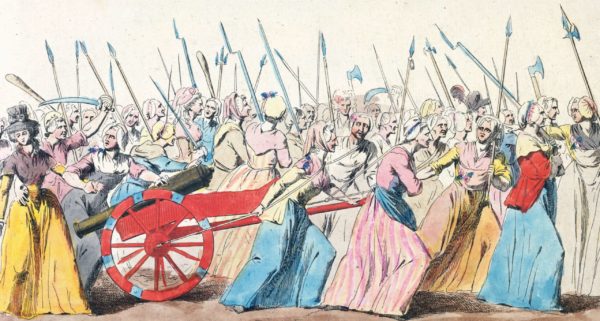
The Women’s March on Versailles was not merely a protest—it was a seismic upheaval, a collective roar that shattered the gilded cages of monarchy and ignited the flames of revolution. On October 5, 1789, thousands of women, their faces flushed with hunger and fury, stormed the royal palace, demanding bread, justice, and the abdication of a king who had let his people starve. This was not a singular act of defiance; it was the birth of a new era, where the marginalized seized the narrative and rewrote history with their bare hands. To understand this pivotal moment is to grasp the raw power of collective action—and to recognize that revolutions are not born in palaces, but in the bellies of the hungry.
The Spark That Lit the Powder Keg: Hunger as a Weapon of the Oppressed
Imagine a city where the scent of rotting bread mingles with the stench of desperation. Paris in 1789 was a powder keg, and the fuse had been lit by years of bread shortages, soaring grain prices, and a monarchy that hoarded wealth while its subjects withered. The women of Paris—market vendors, seamstresses, mothers—were the first to feel the pinch of scarcity. Their children wailed in empty cradles; their husbands, if they had work at all, earned wages that couldn’t stretch to a loaf of bread. When rumors spread that Marie Antoinette had hoarded grain in Versailles while Paris starved, the women’s rage crystallized into action. They were not asking for charity; they were demanding accountability. And so, with pitchforks, knives, and the unshakable resolve of those who had nothing left to lose, they marched.
The march was not a leisurely stroll. It was a 12-mile pilgrimage of fury, a procession of bodies that moved like a single organism, fueled by hunger and the intoxicating promise of change. Along the way, they were joined by National Guardsmen—men who, though not all feminists in the modern sense, recognized the righteousness of their cause. The women’s demands were clear: bread, and the king’s return to Paris. There was no room for negotiation. The monarchy had played its hand; now, it would face the consequences.

The Palace Under Siege: When the Oppressed Stormed the Ivory Tower
Versailles was not just a palace; it was a symbol of everything that had failed France. Its gilded halls echoed with the laughter of aristocrats who dined on truffles while peasants gnawed on bark. When the women arrived, they were met not with sympathy, but with the cold indifference of a court that had never known want. The king, Louis XVI, was a man of indecision, his will as flimsy as the silk of his courtly robes. His wife, Marie Antoinette, was the embodiment of the aristocracy’s detachment—a woman who famously quipped, “Let them eat cake,” a phrase she almost certainly never said, but one that haunted her nonetheless.
The women did not come to plead. They came to take. They stormed the palace, their voices a thunderclap of demands. Some carried the severed heads of royal guards on pikes; others brandished the king’s own muskets, turned against him. The National Guard, now fully aligned with the protesters, surrounded the palace, a human shield against any attempt by the monarchy to flee. For hours, the women held the king and queen hostage in their own home, forcing Louis to sign decrees and agree to return to Paris. The message was unmistakable: the people were no longer subjects to be ruled, but sovereigns who would dictate their own fate.
This was not just a political coup; it was a psychological one. The women had shattered the illusion of invincibility. If they could storm Versailles, what couldn’t they do? The monarchy’s aura of divine right crumbled under the weight of their collective will. The king’s return to Paris was not a surrender—it was a surrender of power, a recognition that the old world was dead, and a new one was being born in the streets.

The Ripple Effects: How the March Reshaped a Nation and a Revolution
The Women’s March on Versailles was not an isolated event; it was the catalyst that accelerated the French Revolution into full throttle. Within days, the king’s authority was reduced to a shadow of its former self. The National Assembly, emboldened by the women’s actions, began drafting the Declaration of the Rights of Man and of the Citizen—a document that, while flawed in its exclusion of women, laid the groundwork for modern democracy. The march proved that power was not a birthright of the elite, but a force that could be seized by the masses.
Yet the revolution’s legacy is complicated. While the women who marched were hailed as heroines in the immediate aftermath, their contributions were quickly sidelined. The revolutionaries who followed—men like Robespierre and Danton—spoke of liberty and equality, but their vision did not extend to women. The same women who had stormed Versailles were later excluded from political life, their demands for suffrage and representation ignored. The irony is bitter: the revolution they helped ignite would betray them, consigning their names to the footnotes of history while men carved their legacies in stone.
But the march’s impact transcended France. It sent shockwaves across Europe, a warning to monarchs that their subjects would no longer tolerate tyranny. It inspired future generations of feminists, from the suffragettes of the 19th century to the women who marched on Washington in 2017. The Women’s March on Versailles was not just a moment in time; it was a blueprint for how power could be wrested from the powerful. It taught us that revolutions are not won with swords alone, but with the unyielding will of those who refuse to be silenced.
Lessons for Today: What the Women’s March Teaches Us About Power and Protest
In an era where women’s rights are still under siege—where reproductive freedoms are rolled back, where femicide rates soar, where women’s voices are drowned out in boardrooms and parliaments— the Women’s March on Versailles is a reminder that change is not given; it is taken. The women who marched in 1789 did not wait for permission. They did not ask for equality; they demanded it. And in doing so, they redefined what was possible.
Modern feminists would do well to study their tactics. The march was not a single event, but a sustained uprising. The women of Paris did not disperse after Versailles; they continued to agitate, to organize, to push for a world where no woman would have to march for bread while kings feasted. Today, we see echoes of their struggle in movements like #MeToo, in the global protests against gender-based violence, in the fight for reproductive justice. The tools have changed—social media, strikes, legal challenges—but the core demand remains the same: justice, or else.
There is also a cautionary tale here. The revolution that followed the march devoured its own children, turning on the very women who had made it possible. It is a reminder that progress is never linear, that victories are fragile, and that the fight for equality must be relentless. The women of Versailles did not live to see the world they fought for. But their actions ensured that the world would never be the same again.

The Unfinished Revolution: Why the Fight Continues
The Women’s March on Versailles was a revolution in miniature—a microcosm of the larger upheaval that would reshape France and, by extension, the world. But revolutions are never truly finished. They are ongoing, a series of skirmishes in a war that has no end. The women who marched in 1789 did not achieve full equality, nor did they secure the rights they deserved. Yet their defiance planted a seed, one that has grown into a forest of feminist movements spanning centuries.
Today, as we stand on the shoulders of those who came before us, we must ask ourselves: What would the women of Versailles do in our place? Would they accept half-measures, or would they demand everything? The answer is clear. They would not stop marching. They would not stop fighting. And neither should we.





Leave a Comment