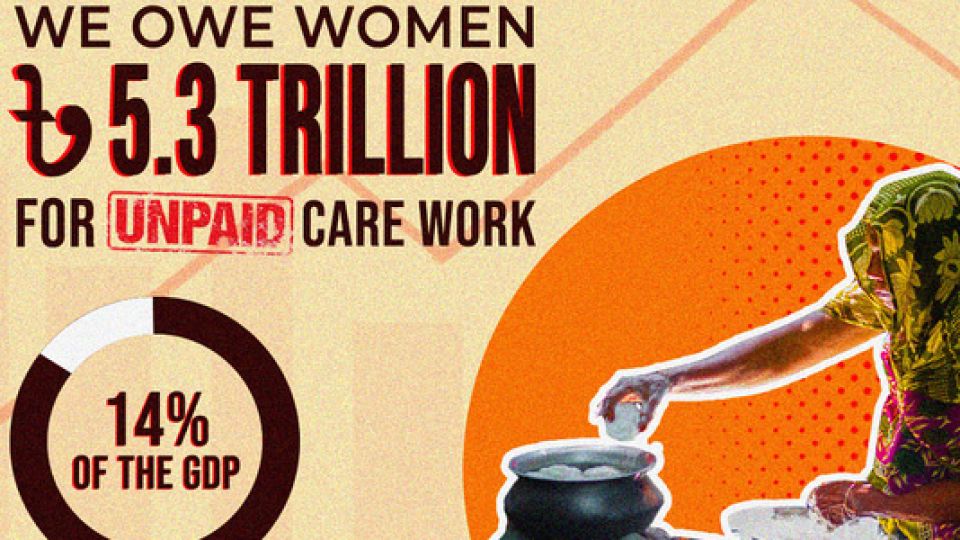
The world runs on invisible labor. The meals prepared before dawn, the tears wiped at midnight, the laundry folded in silence—none of these appear in GDP reports, yet without them, economies would collapse. The unpaid care work performed overwhelmingly by women has long been dismissed as “natural” or “expected,” a quiet assumption woven into the fabric of patriarchal societies. But what if we dared to quantify this labor? What if we assigned it a monetary value? The numbers that emerge are not just staggering; they are revolutionary. They expose the lie that care is a personal virtue rather than a societal necessity. They force us to confront an uncomfortable truth: the global economy is not just built on exploitation—it is built on the unpaid labor of half the world’s population.
The Myth of the “Natural” Caregiver
From childhood, girls are conditioned to associate self-worth with nurturing. Dolls are placed in their hands before they can walk; chores are assigned before they can read. This is not coincidence—it is indoctrination. The idea that women are “naturally” inclined toward caregiving is a myth, a social construct designed to justify their unpaid labor. Studies show that even in households where both partners work full-time, women still perform 75% of unpaid care work. This imbalance is not a reflection of biology; it is the result of centuries of gendered expectations, where care is framed as a moral duty rather than a choice. The moment we assign a monetary value to this work, we shatter the illusion that it is voluntary. It is not. It is coerced by a system that depends on it.
Consider the language used to describe this labor: “sacrifice,” “devotion,” “love.” These words are not neutral; they are weapons. They transform exploitation into virtue, turning the most basic human needs into a moral obligation. When a woman stays up all night nursing a sick child, she is not performing a selfless act—she is fulfilling a role assigned to her by a system that refuses to pay for what it demands. The moment we calculate the hours she spends, the energy she expends, the opportunities she forfeits, we expose the rot at the core of this narrative. Care is not a gift. It is labor. And labor deserves compensation.

The Trillions That Hold Up the World
If we were to tally the global value of unpaid care work, the figure would dwarf the GDP of entire nations. Estimates suggest it accounts for nearly $11 trillion annually—more than the combined output of India, Japan, and Germany. This is not a small oversight; it is a deliberate erasure. Governments and corporations benefit from this free labor, yet they contribute nothing to its sustainability. A mother caring for a child, an elderly woman tending to her ailing partner, a daughter cooking for her disabled parent—none of these roles are compensated, yet they are the bedrock of every economy. Without them, hospitals would collapse, schools would fail, and entire industries would grind to the ground.
The irony is stark: the same institutions that profit from this labor would collapse without it, yet they treat it as an infinite resource. This is the paradox of capitalism—it thrives on the unpaid, the undervalued, the invisible. The women who perform this work are not just underpaid; they are unpaid. Their labor is not a transaction; it is a transactional void. The moment we quantify it, we reveal the true cost of a system that treats half its population as a free workforce. The trillions are not just a number; they are a indictment.

The Invisible Tax on Women’s Lives
Unpaid care work is not just an economic issue; it is a human rights crisis. Women who bear this burden are systematically denied opportunities for education, career advancement, and financial independence. They retire into poverty, their contributions erased from pension calculations. They face higher rates of depression, anxiety, and chronic illness, yet their labor is treated as if it has no physical or emotional cost. This is not just exploitation—it is a form of slow violence, a daily erosion of dignity and autonomy.
The consequences ripple outward. When women are trapped in cycles of unpaid labor, entire communities suffer. Children grow up in households where their mothers’ time is not their own. Elders are left without proper care because no one can afford to pay for it. The cycle of poverty is perpetuated not by lack of resources, but by the refusal to acknowledge the value of the labor that sustains society. The “care deficit” is not a natural phenomenon; it is a manufactured crisis, a direct result of a system that treats care as a woman’s responsibility rather than a societal obligation.
Who Benefits from the Silence?
If the value of unpaid care work is so immense, why does it remain invisible? The answer lies in power. Those who benefit from this system—governments, corporations, even some feminist movements—have a vested interest in keeping it hidden. Governments avoid the cost of social services by offloading care onto families, particularly women. Corporations profit from a workforce that is not burdened by caregiving responsibilities because those responsibilities are absorbed elsewhere. And some feminist movements, in their rush to “lean in” or “have it all,” have failed to challenge the structural inequalities that make such rhetoric a privilege reserved for the few.
The silence is not accidental; it is strategic. To acknowledge the value of unpaid care work is to admit that the current system is unsustainable. It is to confront the fact that capitalism, as it stands, cannot function without the unpaid labor of women. The moment we name this labor, we expose the fragility of the structures that depend on it. And that is a threat to the status quo.
What Would a World Without Exploitation Look Like?
Imagine a world where care work is recognized as essential infrastructure. Where governments invest in affordable childcare, eldercare, and healthcare. Where men are not just “helping” with domestic duties but are equally responsible for them. Where women are not penalized for choosing to have children, and where the act of caregiving is not a life sentence of poverty. This is not a utopian fantasy; it is a necessary correction to a broken system.
The first step is to dismantle the myth that care is a woman’s natural role. The second is to demand that this labor be compensated—whether through wages, social security, or public services. The third is to recognize that this is not just a women’s issue; it is a human issue. A society that cannot care for its own is a society on the brink of collapse. The trillions we have ignored for so long are not just a debt to be repaid; they are a blueprint for a more just and sustainable future.
The calculation is simple: if we refuse to pay for care, we are choosing exploitation over humanity. The choice is ours. But the cost of inaction is already being paid—in the exhaustion of women, in the poverty of families, in the slow decay of societies that have forgotten how to care.








Leave a Comment