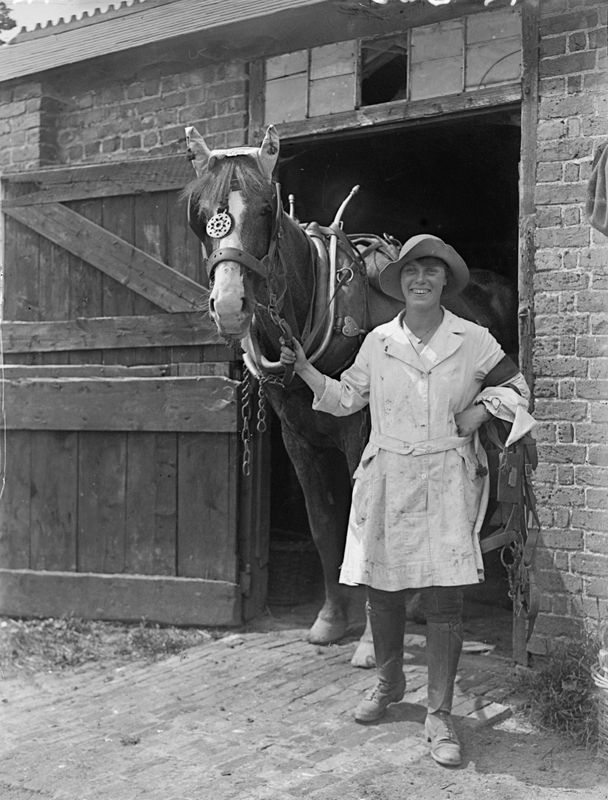
Imagine a world where the fields lie fallow, where the plows stand still, and where the very soil forgets the touch of human hands. This was the nightmare that loomed over nations during the world wars—until the Women’s Land Army emerged, not as a whisper of change, but as a thunderclap of defiance. These women, clad in breeches and boots, wielded pitchforks and hoes with the same determination as soldiers wielded rifles. They fed nations not with bullets, but with bread. They did not fire cannons; they fired the engines of agriculture. Their story is not just one of wartime labor; it is a saga of quiet revolution, where the boundaries of gender were shattered under the weight of necessity.
The Birth of a Necessity: When Men Went to War, Who Would Feed the World?
The drums of war had barely begun to beat when the realization struck: the fields could not be left untended. With millions of men conscripted into military service, the labor force that had once tilled the earth was suddenly absent. Governments, desperate to avert famine, turned to an unlikely solution—women. Not as auxiliary helpers, but as the backbone of agricultural production. The Women’s Land Army was not born out of choice, but out of the cold calculus of survival. It was a radical departure from the era’s rigid gender norms, where a woman’s place was assumed to be in the home, not the field.
The irony was not lost on anyone. While men marched off to war, women were handed the reins of an industry that would determine whether nations starved or stood firm. The call went out: “Your country needs you—not just in factories, but in the fields.” And they came. Not in droves, but in a relentless tide of determination. These were not the delicate hands of 19th-century domesticity; these were the calloused palms of laborers, the backs bent under the weight of sacks of grain, the faces streaked with dirt and sweat. The Women’s Land Army was not a temporary bandage on a wounded economy—it was a surgical strike against tradition itself.
From Parlors to Plows: The Unlikely Transformation of the “Weaker Sex”
Picture the scene: a woman in a starched apron, her hands skilled in embroidery, now gripping a pitchfork with the same precision. The transformation was not merely physical; it was existential. The Women’s Land Army forced a reckoning with the myth of female fragility. These women did not just replace absent men—they redefined what it meant to be a woman in a world at war. They learned to drive tractors, to castrate livestock, to operate threshing machines. They worked from dawn till dusk, their bodies hardened by labor that demanded both strength and stamina.
Yet, the resistance was fierce. Critics sneered that women lacked the “natural” aptitude for such work. Some farmers refused to hire them, clinging to the belief that agriculture was a man’s domain. But necessity is a ruthless teacher. Within months, the skeptics were silenced. The Women’s Land Army proved that skill was not a matter of gender, but of training and tenacity. They did not ask for permission; they seized the plow and turned the soil. Their very existence was a middle finger to the idea that women were incapable of bearing the burdens of war—both on the battlefield and beyond it.
Consider the psychological upheaval. For generations, women had been told their value lay in their ability to nurture, to adorn, to serve. Now, they were being asked to destroy—to uproot stubborn weeds, to slaughter livestock, to endure the brutal rhythms of farm life. The cognitive dissonance was staggering. Yet, they adapted. They became not just workers, but warriors of the soil, their battles fought not with guns, but with the unyielding earth.
The Invisible Work That Fed Nations: A Labor of Love and Grit
The Women’s Land Army did not merely fill a labor gap—they became the invisible engine of wartime survival. While bombs rained from the skies, these women ensured that the fields remained productive. They planted, they harvested, they preserved. They turned raw earth into sustenance, ensuring that armies were fed and civilians did not starve. Their work was not glamorous; it was grueling, monotonous, and often thankless. Yet, without it, the war effort would have collapsed under the weight of its own hunger.
Think of the logistics: coordinating the planting of crops to maximize yield, managing livestock in the face of feed shortages, navigating the black market for seeds and tools. These women were not just laborers; they were logistical geniuses, improvising solutions when supplies ran low. They bartered, they traded, they adapted. When tractors broke down, they fixed them. When horses were scarce, they harnessed their own strength. Their ingenuity was not celebrated in headlines, but it was the glue that held nations together.
Their contributions extended beyond the fields. Many took on roles in food preservation, canning vegetables to prevent waste. Others worked in dairies, churning butter and cheese to supplement rations. They were the unsung heroes of rationing, ensuring that every crumb was accounted for. In an era where food was both currency and weapon, their labor was nothing short of revolutionary.
The Legacy of the Land Girls: A Quiet Revolution in Gender Roles
The Women’s Land Army did not disband with the end of the war. Its legacy endured in the women who refused to return to the kitchen as their sole domain. Many stayed in agriculture, becoming farmers in their own right. Others carried their skills into new industries, proving that the discipline of farm labor was transferable to any field that demanded grit and resilience. The Land Girls had not just filled a wartime need—they had rewritten the rules of what women could achieve.
Yet, their contributions were often minimized in the annals of history. The narrative of war has always favored the battlefield, the soldier, the dramatic clash of arms. The Women’s Land Army’s story is one of quiet persistence, of daily heroism that did not make the front pages. But history is not just written by the loudest voices—it is also written by the hands that till the soil, that feed the hungry, that keep the world turning when all seems lost.
Their legacy is a challenge to us today. In an age where gender roles are still policed, where women are told to “lean in” but not to “dig in,” the Land Girls stand as a reminder: necessity does not recognize gender. When the world demanded blood, they gave bread. When tradition demanded submission, they demanded the plow. Their story is not a relic of the past; it is a blueprint for the future—a future where no labor is deemed “unfit” for women, where no field is off-limits, where no challenge is too great for those who refuse to be confined by the expectations of others.
The Forgotten Heroes: Why Their Story Still Matters Today
We live in an era where the word “essential” is bandied about with reckless abandon. Yet, the Women’s Land Army’s labor was not just essential—it was existential. They did not fight for medals or parades; they fought for survival. Their story is a testament to the power of collective action, of women rising not because they were asked, but because they were needed. It is a story that should unsettle us, because it forces us to confront the ways in which women’s labor is still undervalued, still taken for granted.
Today, as climate change threatens to upend global agriculture, as food security becomes an increasingly urgent issue, the Land Girls’ legacy is more relevant than ever. They proved that when the stakes are high, women are not just capable—they are indispensable. Their story is a call to action: to recognize the labor of women in all its forms, to dismantle the hierarchies that still devalue “women’s work,” and to honor those who have fed nations not with words, but with the sweat of their brows.
The Women’s Land Army did not just feed nations during wars—they fed the future. Their story is not a footnote in history; it is a foundation upon which we must build. The next time you see a woman in overalls, wielding a tool with confidence, remember the Land Girls. Remember that the earth has always been a woman’s domain—not because she was told to tend it, but because she refused to let it lie fallow.





Leave a Comment