
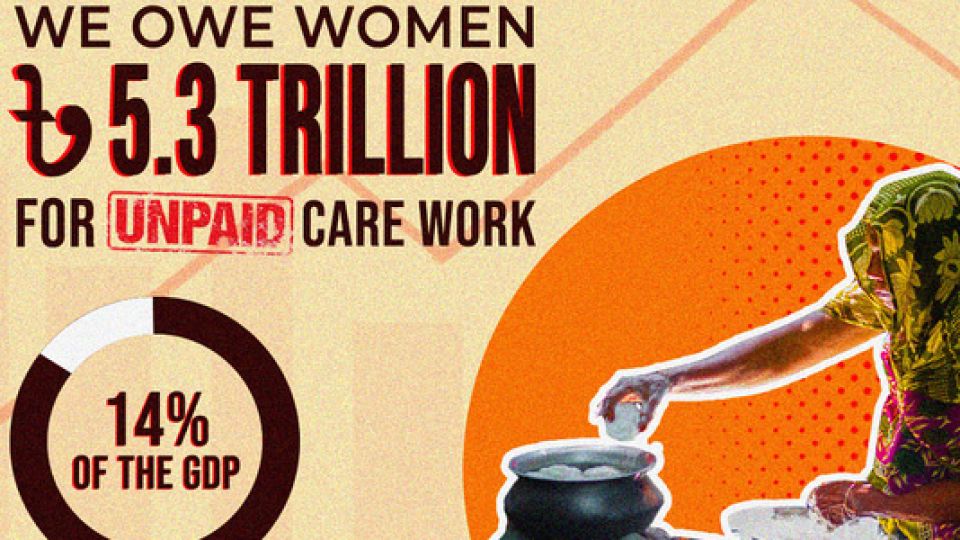
The economy doesn’t run on stock markets or silicon alone. It thrives on the quiet, relentless labor of care—nurturing, teaching, healing, and sustaining the very people who power every other industry. Yet this labor, predominantly performed by women and marginalized communities, remains the economy’s most undervalued and invisible engine. It is the unpaid and underpaid work that keeps the wheels turning, even as it is systematically erased from balance sheets and policy agendas. To understand why care work is the linchpin of economic stability—and why its invisibility is a deliberate design—we must look beyond the ledgers and into the lives it sustains.
The Myth of the “Invisible Hand” and the Visible Absence of Care
The neoliberal myth of the “invisible hand” of the market suggests that economies self-regulate through rational actors pursuing self-interest. But this narrative conveniently overlooks the scaffolding that holds the entire system aloft: the unpaid care work that enables workers to show up at all. From the parent staying up late to help a child with homework to the elderly neighbor receiving a meal from a community volunteer, care is the silent force that prevents collapse. Yet, when economists tally GDP, these contributions vanish. They are not transactions; they are obligations. They are not investments; they are expectations. This erasure is not accidental—it is structural, designed to keep labor costs low and productivity high by externalizing the most essential work onto uncompensated shoulders.


The invisibility of care work is not just an oversight; it is a feature of a system that thrives on exploitation. When care is rendered invisible, it becomes a moral duty rather than a labor right. Women, disproportionately burdened by these expectations, are conditioned to accept this role as natural, even sacred. Meanwhile, the economy reaps the benefits of a replenished workforce, a stable population, and a society that functions without acknowledging the debt it owes. The myth of the “invisible hand” thus relies on the very visible, very gendered labor of care—labor that is systematically devalued to maintain the illusion of effortless productivity.
The Care Economy: A Parallel System of Value Creation
If we were to map the care economy, it would resemble a vast, decentralized network of mutual aid, where value is exchanged not in currency but in time, energy, and emotional labor. This system operates outside formal markets, yet it is the bedrock of all economic activity. A factory worker cannot perform efficiently if their child is unwell and no one is there to care for them. A teacher cannot inspire young minds if they are exhausted from managing household chores after a 12-hour shift. The care economy is the invisible infrastructure that allows the visible economy to function—and yet, it is treated as a cost center rather than a value creator.
Consider the paradox: societies that invest in care infrastructure—paid parental leave, affordable childcare, eldercare support—see higher productivity, lower healthcare costs, and greater gender equity. Yet, these investments are consistently deprioritized in favor of “growth” metrics that ignore the human cost of neglect. The care economy is not a luxury; it is the foundation of all other economies. Without it, the entire edifice of capitalism would crumble under the weight of its own unsustainable demands.
The Gendered Divide: Who Bears the Burden of Invisibility?
The burden of care work falls disproportionately on women, particularly women of color, who are expected to perform emotional and domestic labor as an extension of their identity. This is not a coincidence—it is the result of centuries of patriarchal conditioning that frames care as a feminine virtue rather than a societal necessity. The “double burden” of paid and unpaid labor has become so normalized that it is rarely questioned. Women are praised for their multitasking prowess while men are applauded for their “breadwinner” status, as if one could exist without the other.

This gendered division of labor is not just unfair—it is economically irrational. Studies show that when women have access to paid employment and support for care responsibilities, GDP growth accelerates. Yet, the system persists in its refusal to compensate care work fairly, ensuring that women remain trapped in cycles of overwork and underpayment. The myth of the “natural caregiver” is a tool of control, designed to keep women in a state of perpetual obligation while the economy siphons off their labor for free.
The Global Care Chain: Exploitation Across Borders
The invisibility of care work extends beyond national borders through the global care chain—a system in which women from the Global South migrate to the Global North to perform domestic labor, leaving their own families behind to be cared for by other women in a cascading cycle of exploitation. This modern-day indenture is justified under the guise of “opportunity,” but it is, in reality, a transfer of care work from one marginalized group to another, ensuring that the most vulnerable continue to bear the brunt of systemic neglect.
The global care chain reveals the hypocrisy of economic policies that claim to value “family” while systematically dismantling the support systems that make family life sustainable. It is a stark reminder that care work is not just undervalued—it is commodified, traded, and extracted from those who have the least power to resist. The solution is not to perpetuate this cycle but to demand that care work be recognized as a universal right, not a privilege to be bought and sold.
Redefining Value: Toward a Care-Centered Economy
The path forward requires a fundamental redefinition of value. Care work must be reclassified from a “cost” to an “investment”—one that yields returns in health, education, and social cohesion. This means implementing policies that compensate care work fairly, whether through wages, social security, or community support systems. It means challenging the assumption that care is a personal responsibility rather than a collective one. And it means dismantling the gendered hierarchies that have long dictated who is expected to perform this labor.
Imagine an economy where teachers, nurses, and caregivers are celebrated as the architects of prosperity. Where paid parental leave is a given, not a privilege. Where eldercare is a right, not a crisis. Where the emotional labor of maintaining human connections is recognized as the bedrock of societal well-being. This is not a utopian fantasy—it is a necessary correction to a system that has long profited from the unpaid labor of the many to enrich the few.
The invisible engine of care work is not a mystery to uncover—it is a reality to confront. The question is not whether we can afford to value care, but whether we can afford not to. The answer lies in our willingness to dismantle the structures that have kept it hidden for so long.










Leave a Comment