Ever caught yourself trapped in the endless loop of saying “yes” when your gut screams “no”? What if I told you the ultimate liberation tool isn’t a radical life overhaul or an exhausting manifesto but a simple script discreetly nestled in your notes app? Yes, that little digital safe haven where most women jot down grocery lists and fleeting ideas could become your sanctum of sovereignty. The Boundary Setting Script Every Woman Needs in Her Notes App isn’t just about saying no—it’s about reclaiming your voice in a world inexorably wired to silence it.
The Art of Boundary Setting: More Than a Buzzword
Boundaries refuse to be whimsical niceties; they are prerequisites for mental, emotional, and even physical perseverance. Yet, many women have been socialized into a paradoxical existence: nurturing to the point of exhaustion and conflict-avoidant to a fault. This cultural labyrinth leaves countless women gasping under the weight of unspoken resentments and swallowed anger.
Boundary setting is a deliberate act of defiance against this norm. It is an unyielding declaration of self-respect that protects your energy from being siphoned by entitlement or disregard. In its essence, it is the armor against emotional exploitation and the blueprint for healthier interpersonal dynamics. Without it, we become porous, vulnerable, and, frankly, exploitable.
Demystifying the Boundary Setting Script
The genius of having a boundary script at your fingertips lies in its clarity and consistency. Why stumble through conversations with vague discomfort or retreat into passive-aggression when you can wield words that are both empowering and non-negotiable? A well-crafted script liberates you from the tyranny of improvisation and the anxiety of confrontation.
It is not about robotic recitations or boundary-setting “soundbites” that feel disingenuous. Instead, it is a flexible template infused with assertiveness and empathy, adaptable to the nuances of different relationships—be it a demanding boss, a guilt-tripping friend, or a family member with perennial demands.

Crafting Your Script: The Anatomy of Effective Language
Words have power, but the kind of language you choose can either erect walls or build bridges. The boundary setting script should wield language that is:
- Clear: Avoid ambiguous phrases like “maybe” or “I guess.” Direct language leaves no room for misinterpretation, such as “I am unable to take this on right now.”
- Firm but Respectful: The goal isn’t to antagonize but to assert. Saying “I cannot participate in this meeting after hours” respects both your own time and the other’s intentions.
- Non-Apologetic: Apologies diminish your boundaries. Replace “Sorry, I can’t” with “I won’t be able to.”
- Empathetic: Recognizing the other’s perspective softens your stance without sacrificing firmness. For example, “I understand this is important to you, but I need to decline.”
Done well, these elements combine into a linguistic shield that is as graceful as it is ironclad.
Examples That Resonate: Scripts for Real-World Scenarios
Picture this: a friend constantly borrowing your time without reciprocation, or a partner who dismisses your needs under the pretense of love. Scripts tailored for these encounters reduce emotional labor and boost confidence.
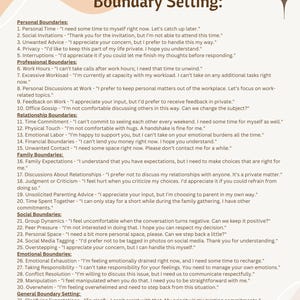
Example 1: Deflecting Emotional Manipulation
“I hear your concerns and I want to support you, but I have to prioritize my wellbeing right now. Let’s revisit this later.”
Example 2: Refusing Unwanted Invitations
“Thank you for thinking of me, but I won’t be able to join. I’m taking time for myself.”
Example 3: Setting Professional Limits
“I am committed to delivering quality work during office hours and will not be responding to messages after 6 PM.”
The Psychological Power of Ready-Made Scripts
Beyond providing canned responses, these scripts function as psychological anchors. They help reprogram habitual patterns of over-accommodation that many women unconsciously adopt. When your notes app becomes your trusty companion, it diminishes decision fatigue. It alleviates the dread of saying words that might upset someone, because the “right” words are already crafted, tested, and waiting.
What’s more, having this arsenal encourages self-compassion. It reminds you daily that your time, your emotional landscape, and your bodily autonomy are inviolable. This mental rehearsal emboldens boundaries to become second nature rather than source of conflict anxiety.
Integrating Boundary Scripts Into Daily Life
Storing a script is one thing; internalizing and deploying it is another. Practice is paramount. Start by reviewing your notes app each morning. Recite, modify, and tailor each script to fit any anticipated interactions. Use them as affirmations or mental rehearsals, priming yourself to stand firm when the moment arrives.
Share your script with trusted allies or mentors who can provide feedback and bolster your resolve. Over time, your boundary language will expand organically, evolving with your experiences and growing assertiveness.
Reclaiming Your Time, Energy, and Sanity
In the grand tapestry of resistance and self-preservation, a boundary setting script is a subtle yet subversive act. It reasserts sovereignty in a society that incessantly demands women dilute themselves for the comfort of others. It is a radical refusal to accept emotional exhaustion as a default state.
Imagine the liberation of not scrambling for words or collapsing under guilt. Instead, you engage with clarity, intelligence, and unapologetic self-regard. That’s the power etched into this simple script—a revolution hidden in plain sight, ready to disrupt the narrative of female acquiescence one typed line at a time.
So, what are you waiting for? Open that notes app and start typing your manifesto of boundaries. Your future self will thank you for it.










Leave a Comment