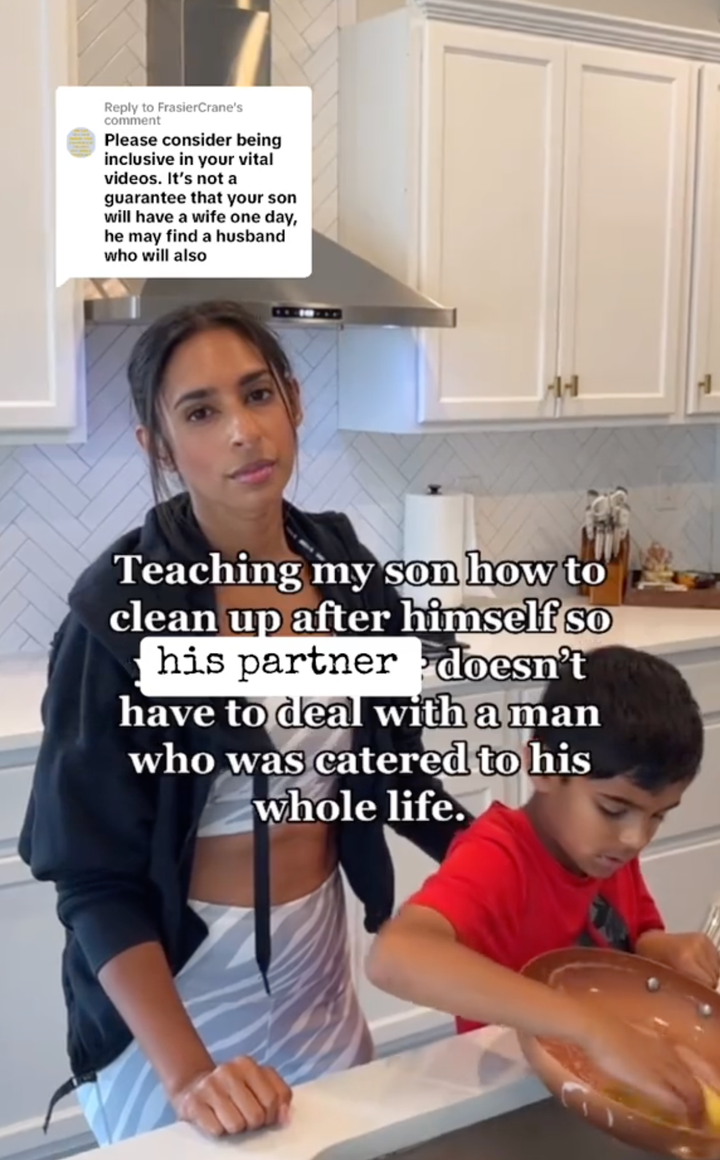
The laundry room, that unassuming chamber of domestic drudgery, has become an unlikely battleground for gender equality. A mother’s decision to teach her sons the arcane art of sorting whites from colors—once a radical act—now sparks viral debates, as if she had handed them the keys to a kingdom rather than a bottle of detergent. The internet, ever the arbiter of modern morality, has branded her a revolutionary for doing what should have been mundane: raising children who understand that laundry is not a gendered chore but a life skill. This is not just about clean socks. It is about dismantling the invisible walls of patriarchal expectation, one sock at a time.
The Laundry Room as a Microcosm of Patriarchal Expectations
Consider the laundry room—not as a place of utility, but as a metaphor for the cages we build around our children’s potential. For generations, this space has been a silent enforcer of gender norms: women folding, men mending, children observing. The act of teaching a boy to separate delicates from denim is not trivial; it is an act of rebellion against a system that whispers, “This is not your domain.” When a mother insists her sons learn to operate a washing machine, she is not just teaching them to avoid pink socks in the whites. She is teaching them that competence is not gendered, that responsibility is not a birthright of one sex. The internet’s gasps at this revelation reveal how deeply ingrained the myth of innate domestic incompetence in men remains.
The irony is almost laughable. In an era where men dominate boardrooms and legislatures, the laundry room becomes a frontier of equality. Why? Because domesticity has long been dismissed as trivial, a realm where women’s labor is both invisible and undervalued. To disrupt this is to challenge the very foundation of patriarchal power structures. The laundry room, then, is not just a room. It is a symbol of the unpaid, unrecognized labor that sustains households—and by extension, economies—while keeping women tethered to the myth of their natural aptitude for servitude.

From Viral Moments to Viral Backlash: The Internet’s Double Standard
The internet’s response to this mother’s actions is a masterclass in cognitive dissonance. Praise rains down in the form of shares and likes, yet beneath the surface, a chorus of skepticism hums. “Why is this news?” some sneer. “Shouldn’t this be obvious?” The question itself is a trap. If it were obvious, we wouldn’t be having this conversation. The fact that a mother teaching her sons to do laundry is deemed newsworthy exposes the depth of our societal rot. It suggests that equality, in practice, is still a radical departure from the norm.
Worse still is the undercurrent of condescension. “Oh, how progressive,” some commenters sneer, as if competence in domestic tasks is a political statement rather than a basic human skill. This reaction is not just about laundry. It is about the fear of losing control—the fear that if men are taught to care for themselves, they might no longer need women to do it for them. The backlash is not about the act itself; it is about the threat it poses to the status quo. A world where men can fold a fitted sheet is a world where the myth of female indispensability begins to crumble.
And then there are the outright absurd reactions. “Will this make them gay?” some ask, as if nurturing empathy and self-sufficiency is a threat to heterosexuality. Others suggest that teaching boys domestic skills will emasculate them, as if masculinity is so fragile it cannot coexist with a knowledge of fabric softener. These reactions are not just ignorant; they are desperate. They reveal a fear that equality, once granted, cannot be revoked—that men, once capable, might never return to their assigned roles as passive beneficiaries of women’s labor.
The Ripple Effect: How Teaching Laundry Transforms More Than Just Clothes
But let us not mistake this for a mere parenting anecdote. The implications of this mother’s actions extend far beyond the laundry room. When boys learn to wash their own clothes, they internalize a lesson far more profound than stain removal: they learn that their needs matter. They learn that care is not a feminine obligation but a human responsibility. This is the first step toward dismantling the culture of entitlement that allows men to expect women to perform emotional and domestic labor without question.
Consider the long-term effects. A boy who knows how to separate his whites from his colors grows into a man who understands the value of his own labor. He is less likely to take for granted the unpaid work that sustains his life. He is more likely to share responsibilities in his future relationships, to recognize the exhaustion of a partner who folds laundry while he scrolls through his phone. He becomes, in essence, a less selfish partner—a rarity in a world where emotional labor is still too often dismissed as “women’s work.”
And what of the girls in his life? They witness his competence and realize that their own domestic skills are not a life sentence but a choice. They see that laundry is not a punishment reserved for their gender but a task to be shared. This mother’s actions, then, are not just about her sons. They are about reshaping the expectations of an entire generation. She is not just teaching them to do laundry. She is teaching them to demand more—from themselves, from their partners, from the world.

The Resistance: Why Equality in the Laundry Room Feels Like a Threat
Of course, not everyone is ready for this revolution. The resistance comes in many forms—some overt, some insidious. There are the men who joke, “I’d rather do anything else,” as if competence is beneath them. There are the women who sigh, “I’ll just do it myself,” reinforcing the cycle of learned helplessness. There are the critics who argue that this is “forcing” children into roles they don’t want, as if the alternative—raising boys who cannot care for themselves—is somehow more natural.
The truth is, the resistance is not about the laundry. It is about power. The laundry room is a microcosm of the broader struggle for gender equality. Every time a man learns to fold a towel, every time a boy understands that his needs are not more important than his sister’s, the foundation of patriarchal control weakens. And that is why the internet clutches its pearls. Because equality, once granted, cannot be contained. It spreads. It infects. It transforms.
This mother’s actions are not radical. They are necessary. They are the bare minimum of what it means to raise children in a world that claims to value equality. The fact that they are met with such fervent debate is not a reflection of her extremism. It is a reflection of how far we still have to go.
The Future: A World Where Laundry is Just Laundry
What would a world look like where teaching boys to do laundry is unremarkable? Where the internet does not bat an eye at a mother’s decision to raise competent, self-sufficient sons? It would be a world where gender roles are not enforced but chosen. Where care is not a gendered obligation but a shared responsibility. Where the laundry room is just a room—not a battleground, not a symbol, not a political statement.
We are not there yet. But every time a boy learns to separate his socks from his underwear, we take one step closer. Every time a man folds a shirt without being asked, we chip away at the walls of expectation. Every time a mother is praised for doing what should be ordinary, we expose the absurdity of the standards we have set for ourselves.
The laundry room is not just a room. It is a mirror. And what it reflects back is not just our clothes, but our values. The question is not whether we should teach our sons to do laundry. The question is why we ever stopped.










Leave a Comment