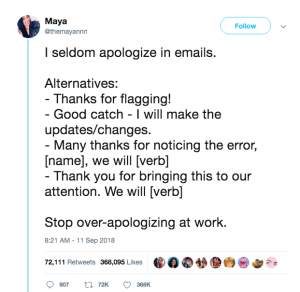
Apologies have become the linguistic wallpaper of the digital age—ubiquitous, often unnecessary, and strangely disempowering. We sprinkle “sorry” through emails as though it is a salve for every interaction, cushioning our words against potential offense or asserting a false humility. But what happens when you extract this verbal bandaid? When the habitual “I’m sorry” and “apologies” suddenly vanish from your written exchanges? The experiment is revelatory, unsettling, and illuminating. A week without apologies in emails doesn’t just alter communication—it tears at the very fabric of self-perception and societal expectation.
The Habitual Apology: An Embarrassment of Politeness or a Cloak for Insecurity?
Apologies in emails are typically perceived as markers of courtesy, yet their prevalence often masks something far more insidious: a chronic undervaluing of one’s own presence. Countless professionals automatically tack on an apology for any minor inconvenience—a delayed response, a blunt request, even for simply taking up someone’s time. This reflexive self-effacement reveals a deeper, systemic issue wrapped in politeness: the internalized necessity to diminish one’s space to avoid confrontation.
Society has conditioned many, particularly women and marginalized individuals, to anticipate bewilderment or hostility in communication. Thus, apologies mutate into a form of preemptive defense. But this saccharine armor often backfires, undermining authority and obscuring intentions. The real question is why so many feel compelled to pre-emptively apologize for their existence or demands. The answer is tangled in the complex web of power, gender, and cultural conditioning.
Silencing the Sorry: Embracing Assertiveness and Authenticity
Removing apologies from emails for a week felt like abruptly smashing the glass box that confines conventional communication. The absence of “sorry” forced a recalibration of tone and intent. Without this linguistic crutch, messages took on a new clarity: they were leaner, bolder, and unapologetically direct. Assertiveness replaced passive submission, and authenticity crept in where dutiful politeness once dwelled.
This shift was neither abrupt nor cruel. Instead, it invited a more conscious crafting of language—choosing words that expressed respect without capitulation. The transition illuminated how often our words betray hidden hesitations. Removing apologies dismantled a stifling ritual and replaced it with a vibrant dialogue that demanded attention rather than forgiveness.
Navigating Reactions: The Social Experiment Within Professional Norms
The experiment revealed the double-edged sword of challenging ingrained conventions. Many recipients subtly hinted at surprise, occasionally misreading the direct tone as brashness or rudeness. That reaction in itself is a mirror reflecting societal discomfort with empowered communication—especially from those expected to perpetually soften their presence.
Yet the silence from others was just as telling. The absence of apologies in emails occasionally precipitated longer, more thoughtful replies. The shift disrupted the monotonous rhythm of predictable correspondence, inviting engagement on different intellectual and emotional frequencies. It suggested that removing unnecessary apologies could foster not only interpersonal respect but deeper conversational investment.
The Subtle Power Dynamics of Apologetic Language
Language is never neutral: it encodes power relations, unspoken hierarchies, and cultural psychodynamics. Apologetic language in emails subtly signals lower status or insecurity, even when masked by decorum. For marginalized voices, this tendency can be devastating—constantly negotiating between being heard and being obsequious.
By consciously excising “sorry” from correspondence, the power dynamic shifts. The writer positions themselves as a rightful interlocutor rather than a supplicant. This recalibration unsettles existing power plays and invites a reassessment of respect and credibility. The week-long hiatus from apologies was a radical reclaiming of verbal territory, asserting presence rather than shrinking back.
When Politeness Becomes a Pitfall: The Road to Radical Courtesy
Politeness remains a social lubricant, but it need not be synonymous with self-subjugation. The experiment underscored the difference between radical courtesy—mindful, intentional respect—and habitual, self-negating apologetics. True courtesy acknowledges boundaries without eroding self-worth. It enables dialogue that is both firm and kind without surrendering personal power.
Radical courtesy demands vigilance: each sentence weighed for necessity and impact, for truth and tact. It refuses the default embedding of “sorry,” replacing it with precise expressions tailored to actual circumstances. Such an approach transforms emails from mundane exchanges into spaces of mutual respect and clarity, freeing both sender and recipient from the chains of performative humility.
Imagery of Apology: The Weight and Liberation of Language
 Imagery surrounding apologies tells a story too. It often depicts apologies as chains or heavy weights—burdens worn in the name of civility. But removing them altogether can feel like unshackling oneself, an exhilarating yet disorienting freedom. The weeks’ absence of apologies became a form of linguistic rebellion, shattering the invisible walls built by habitual submissiveness.
In the nuanced dance of email etiquette, every word performs a role. Removing apologies created space for stronger verbs, clearer requests, and empowered closings. It was a vivid reminder that language shapes reality and that shifting language shifts power.
The Aftermath: Rethinking Norms and Recasting Communication
The week without apologies didn’t conclude with a triumphant declaration but left a lingering question: why is apologizing so reflexive when it often serves neither parties well? The exercise highlighted the necessity of reclaiming self-authorship in everyday exchanges. It invited a reassessment of communication norms that unconsciously perpetuate inequity under the guise of politeness.
Moving forward, this silent revolution holds promise—for individuals and organizations alike. It points toward a future where respect is rendered through clarity and confidence rather than perfunctory apology. It challenges everyone to reconsider the unspoken lexicons of power and to craft messages that affirm presence, purpose, and dignity.









Leave a Comment