What if I told you that the most unpredictable forecast isn’t the weather, but the dress code for the women standing in front of the green screen, delivering it? Across television studios, meteorologists are subjected to a bizarre, unspoken uniform—one that has nothing to do with accuracy and everything to do with antiquated notions of decency. These women, armed with PhDs in atmospheric science and a flair for breaking down complex jet streams, are often reduced to their hemlines, as if a gust of wind could reveal more than just the Doppler radar. Why, in an era where women lead nations and command boardrooms, do we still police their attire like it’s 1952? The answer isn’t in the clouds—it’s in the culture.
The Myth of the “Professional” Silhouette
Let’s dismantle the myth that a woman’s dress is a barometer for her professionalism. The trope is as persistent as it is absurd: a woman in a pencil skirt is “distracting,” while a man in the same attire is “authoritative.” This double standard isn’t just a quirk of television—it’s a systemic bias baked into workplace norms. Studies show that women are judged more harshly for their clothing choices than men, even when their qualifications are identical. The weather report isn’t a runway; it’s a science segment. Yet, meteorologists are often told to “dress modestly” or risk being labeled “unprofessional.” Modesty, it seems, is a one-way street where women are the only ones required to walk it.
Consider the irony: these women spend years mastering the nuances of atmospheric pressure, only to be told their outfit is causing “pressure” in the newsroom. The cognitive dissonance is staggering. A dress isn’t a forecast. A blouse isn’t a barometric reading. Yet, the expectation persists that women must curate their wardrobes to avoid “distracting” their male colleagues or viewers. It’s a form of soft censorship, where the real issue isn’t the dress—it’s the discomfort of those who refuse to see women as anything but objects of scrutiny.
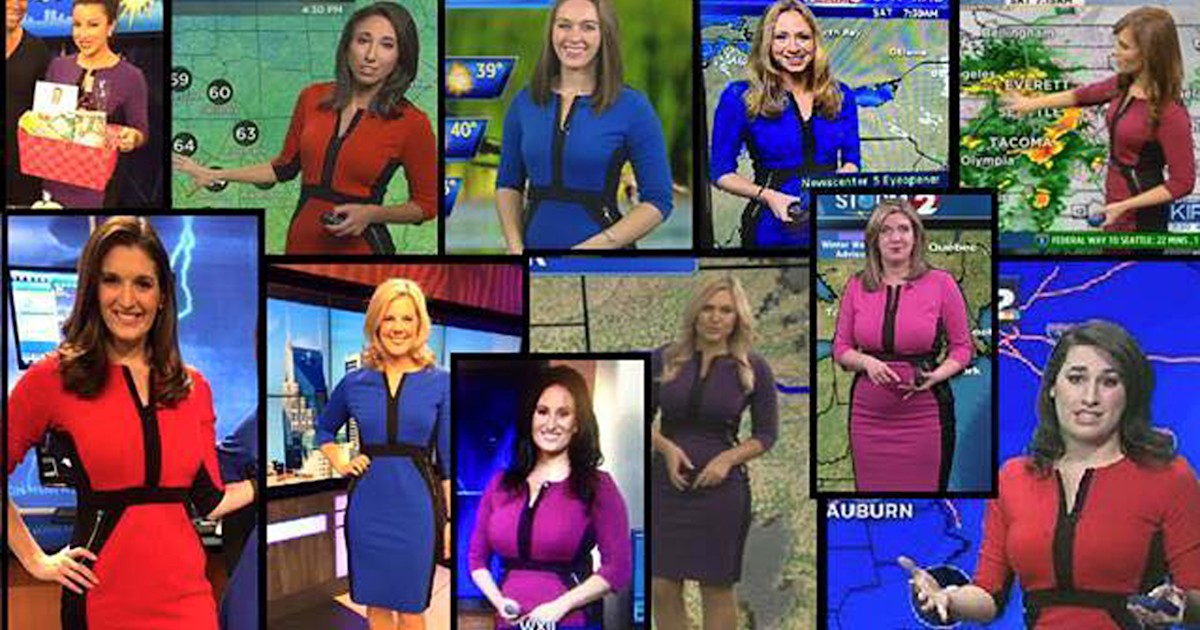
The Unwritten Dress Code: A Relic of the Past
The dress codes imposed on women meteorologists aren’t just arbitrary—they’re historical artifacts, remnants of an era when women were expected to be seen but not heard, let alone seen in anything but a demure, non-threatening ensemble. The idea that a woman’s clothing could “distract” from the news is rooted in the same logic that once barred women from voting because their presence might “distract” male legislators. It’s a circular argument that serves only to reinforce gender hierarchies.
In some newsrooms, the rules are explicit: no sleeveless tops, no dresses above the knee, no heels higher than a certain inch. In others, the rules are unspoken but just as rigid. The result? A homogenization of female meteorologists into a sea of identical, buttoned-up blouses and pencil skirts. Where is the room for individuality? For self-expression? For the simple joy of wearing something that makes you feel powerful? The message is clear: your expertise is secondary to your appearance. And if you dare to defy the dress code, you risk being labeled “unprofessional” or, worse, “controversial.”
This isn’t just about fashion—it’s about control. The policing of women’s bodies is a tool of power, one that distracts from the real issues: the lack of women in leadership roles, the gender pay gap, the systemic barriers that keep women from advancing in their careers. By focusing on what a woman wears, we avoid addressing the deeper, more insidious problems that plague workplaces across the globe.
The Double Standard in the Spotlight
Nowhere is the double standard more glaring than in the comparison between male and female meteorologists. A man in a suit is “polished.” A woman in a suit is “trying too hard.” A man in a polo shirt is “casual and approachable.” A woman in a polo shirt is “sloppy.” The language itself reveals the bias. Men are judged by their competence; women are judged by their conformity to an impossible ideal.
Take the case of a female meteorologist who was told to “cover up” during a live broadcast because her dress was deemed “too revealing.” Meanwhile, her male counterpart could wear a T-shirt and jeans without a second glance. The disparity isn’t just unfair—it’s a reflection of how deeply ingrained sexism is in our culture. We’ve normalized the idea that women’s bodies are public property, subject to the whims of strangers and colleagues alike.
This isn’t just a problem in television. It’s a problem in every industry where women are expected to perform emotional labor, where their appearance is policed while their male peers are judged solely on their work. The message is clear: women must work twice as hard to be taken half as seriously, and even then, they’re not safe from scrutiny.

The Cost of Conformity: Mental Health and Career Trajectories
The pressure to conform to outdated dress codes doesn’t just affect women’s wardrobes—it affects their mental health and career trajectories. Studies have shown that women who face constant scrutiny over their appearance are more likely to experience anxiety, depression, and burnout. They’re also more likely to leave their jobs, not because they lack the skills, but because the environment is toxic and unsustainable.
For meteorologists, the stakes are even higher. These women are often the face of their stations, the ones who deliver life-saving information to communities. Yet, they’re forced to navigate a minefield of unspoken rules that have nothing to do with their job performance. The result? A generation of talented women who are either leaving the field or internalizing the message that their worth is tied to their appearance.
And what about the viewers? The ones who tune in not just for the weather, but for the representation of women in STEM fields? When a woman is reduced to her outfit, it sends a message to young girls that their intelligence isn’t enough—that they must also be “appropriate” to be taken seriously. It’s a disservice to the next generation of scientists, engineers, and leaders who deserve better.
Breaking the Green Screen Ceiling
So, how do we break the cycle? The first step is to acknowledge that the problem exists. Dress codes that disproportionately target women aren’t about professionalism—they’re about power. They’re about maintaining control over women’s bodies and limiting their autonomy. The second step is to challenge these norms, both in the workplace and in the public eye.
Women meteorologists—and women in every field—deserve the right to dress as they please without fear of backlash. They deserve to be judged on their expertise, not their hemlines. And they deserve to work in environments where their contributions are valued, not their outfits dissected.
The solution isn’t to police women’s clothing further. It’s to dismantle the systems that allow these double standards to persist. It’s to demand accountability from employers who enforce outdated dress codes. It’s to support women who speak out against sexism, even when it’s disguised as “professionalism.” And it’s to recognize that a woman’s worth isn’t measured in inches or necklines—it’s measured in the impact she makes, the knowledge she shares, and the barriers she breaks.
The next time you see a meteorologist on your screen, ask yourself: Is she delivering the forecast, or is she delivering a lesson in resilience? The answer might surprise you.







Leave a Comment