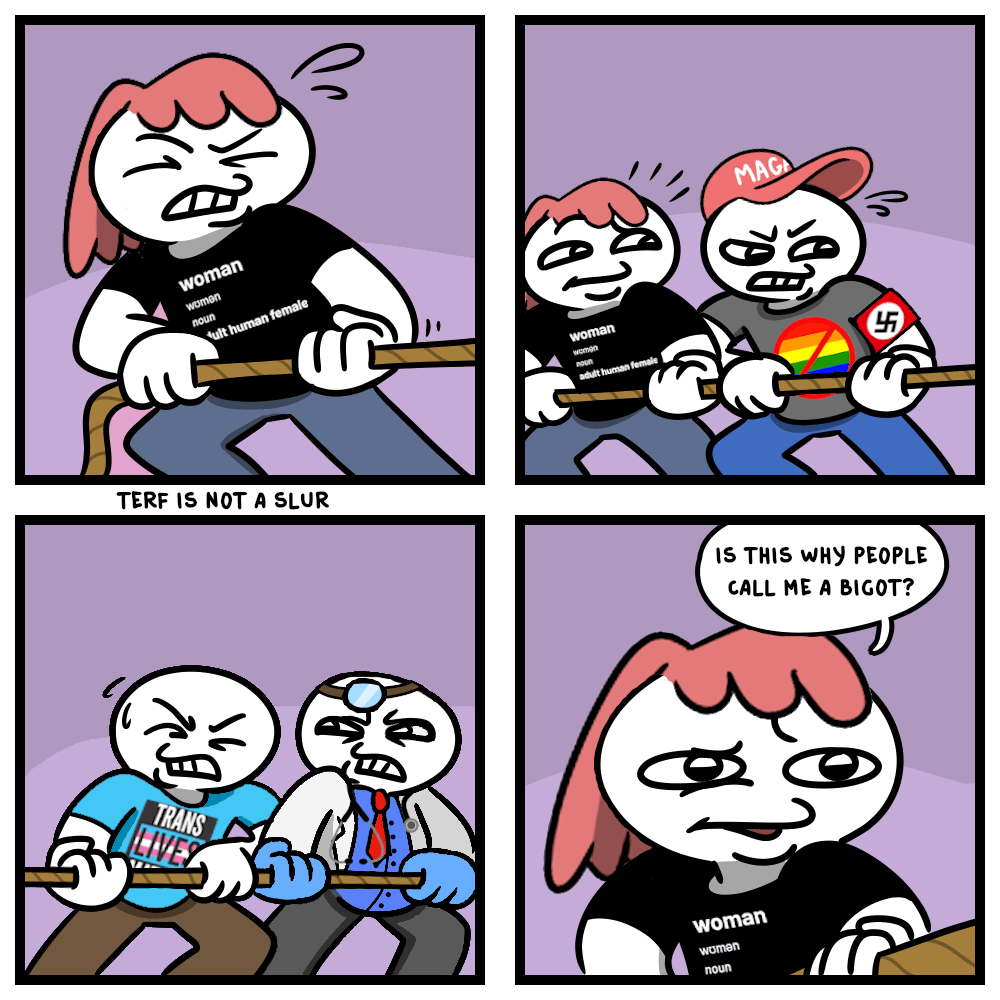
Language is a living thing—it breathes, it mutates, it evolves. Words are not static monuments but shifting sands, shaped by the tides of history and the hands of those who wield them. And yet, when a word becomes a weapon, when it is hurled like a stone through the stained-glass windows of discourse, we are told it must be sacred. That it must not be touched. That it must not be reclaimed. But what if the word in question is not a curse, not an epithet, but a mirror? What if “TERF” is not a slur, but a description—one that reflects the contours of a political ideology as unflinchingly as a surgeon’s scalpel reveals the truth beneath the skin?
The Anatomy of a Label: Why Labels Are Not Always Cages
To call someone a TERF is not to hurl an insult—it is to name a political position with surgical precision. The term itself is an acronym: Trans-Exclusionary Radical Feminist. It does not attack. It does not degrade. It describes. It is the linguistic equivalent of a fingerprint, leaving no room for ambiguity. When we strip away the performative outrage and the manufactured outrage, what remains is a simple truth: the label exists because the ideology exists. And if the ideology is harmful—if it seeks to erase the existence of trans women, to deny them access to spaces, to relegate them to the margins of feminist thought—then the label is not a slur. It is a diagnosis.
Consider the way we use other political labels. We do not call someone a “fascist” a slur—we call them what they are. We do not call someone a “racist” a slur—we call them what they are. Why, then, is it so controversial to call someone a TERF? The answer lies not in the word itself, but in the discomfort it causes those who wield it. The word exposes. It reveals. It forces a confrontation with an ideology that many would prefer to ignore, to soften, to rebrand as “gender-critical” or “radical” or “nuanced.” But nuance does not erase harm. And harm, when it is systemic, deserves a name.

The Slur Myth: How Power Distorts the Meaning of Words
The assertion that “TERF” is a slur is a masterclass in linguistic gaslighting. It is an attempt to invert reality, to frame the oppressed as the oppressors. A slur is a word used to dehumanize, to silence, to erase. But “TERF” does none of these things. It does not call for violence. It does not deny personhood. It does not seek to silence anyone. What it does is hold up a mirror to an ideology that seeks to silence trans women—to deny them access to bathrooms, to healthcare, to the very concept of womanhood itself.
The claim that “TERF” is a slur is also ahistorical. Words gain their power not from their etymology, but from their usage. “Queer” was once a slur. Now, it is a banner of pride. “Bitch” was once a curse. Now, it is a reclamation. Words are not static. They are not frozen in time. They are living, breathing entities, shaped by the hands of those who use them. And if “TERF” has become a descriptor used to identify a specific political ideology, then it is not a slur. It is a tool. A scalpel. A flashlight in the dark.
The real slur, the real insult, is not the word itself—but the ideology it describes. The real violence is not the label, but the erasure. The real harm is not the name, but the act of exclusion. To call someone a TERF is not to insult them. It is to say: I see you. I see what you believe. I see what you stand for. And I reject it.
The Political Necessity of Naming: Why Silence Is Complicity
There is a dangerous myth that language should be neutral—that we should avoid labels altogether, that we should seek “civility” above all else. But civility is not a shield. It is not a virtue in and of itself. Civility without justice is complicity. And complicity in the face of harm is not neutrality—it is violence.
To refuse to call someone a TERF is to refuse to name the harm they cause. It is to allow the ideology to fester, to spread, to infect the very foundations of feminist thought. It is to say: I will not acknowledge your beliefs. I will not confront your actions. I will not hold you accountable. And in doing so, you become an accomplice.
The political necessity of naming is not about punishment. It is about clarity. It is about drawing a line in the sand. It is about saying: this far, and no further. This ideology is not welcome here. This belief is not compatible with justice. This exclusion is not feminism.

The Futility of Reclamation: Why Some Words Cannot Be Reclaimed
There is a persistent myth that all words can be reclaimed—that all slurs can be turned into badges of honor. But this is not always true. Some words are so deeply tied to harm, so irrevocably linked to oppression, that reclamation is impossible. “Nigger” is one such word. “Kike” is another. And “TERF”? It is not a slur, but it is a label—and labels, like all words, are not always ours to control.
The attempt to reclaim “TERF” is not about empowerment. It is about erasure. It is about saying: I do not want to be named. I do not want to be described. I do not want to be held accountable. And in doing so, it reveals the true nature of the ideology—not as a radical feminist stance, but as a refusal to engage in good faith. A refusal to be seen. A refusal to be named.
The futility of reclamation is not a failure of language. It is a failure of ideology. Because if the ideology is so fragile that it cannot withstand a label, then it is not an ideology worth defending.
The Future of Feminism: A Movement Without Exclusions
Feminism is not a monolith. It is not a single voice, a single belief, a single ideology. It is a chorus—a cacophony of voices, of experiences, of struggles. And if feminism is to survive, if it is to thrive, it must be a movement that includes all women. Not just cis women. Not just white women. Not just women who fit into a narrow, exclusionary definition of what it means to be a woman.
The future of feminism is not a future of exclusion. It is not a future of gatekeeping. It is not a future where trans women are told they do not belong. It is a future where all women—regardless of gender identity, regardless of race, regardless of class—are welcomed, are heard, are valued. And if that future requires a label, if it requires a name, then so be it. Because labels are not cages. They are not prisons. They are tools. They are mirrors. They are the first step toward accountability.
So let us call a spade a spade. Let us call an ideology what it is. Let us call a TERF a TERF. And let us build a feminism that is not afraid of the truth.







Leave a Comment