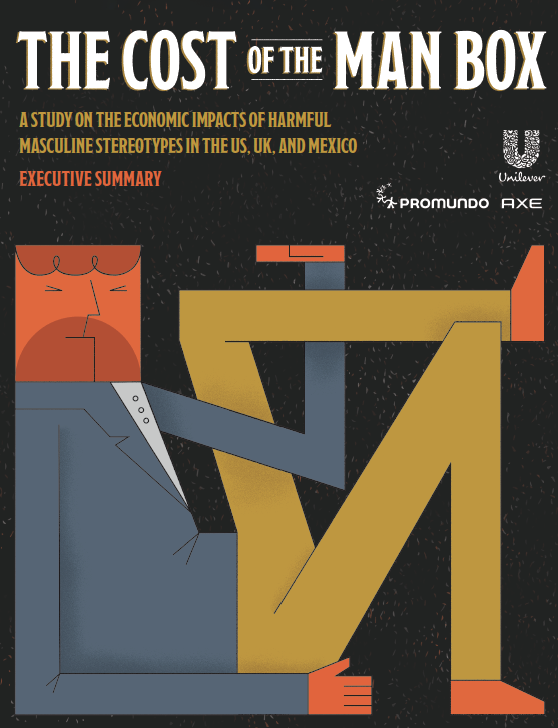
The “Man Box” is not just a metaphor—it’s a prison. A rigid, invisible cage constructed from centuries of toxic masculinity, where boys are told to suppress emotion, dominate to prove worth, and reject vulnerability at all costs. But what happens when the locks begin to rust? When the boys inside start to question the bars? The cracks are forming. The rebellion is quiet, but it’s real. And it’s reshaping what it means to be a man.
The Man Box: A Relic of Control and Conformity
The Man Box is a psychological and cultural construct that dictates how men should behave, think, and exist. It demands silence in the face of pain, aggression as proof of strength, and emotional detachment as a sign of resilience. Boys are socialized into this box from childhood—told that tears are weakness, that asking for help is failure, that dominance is the only currency of respect. The Man Box thrives on isolation. It whispers that real men don’t need community, don’t need tenderness, don’t need to evolve. It’s a relic of patriarchy, a tool of oppression not just for women, but for men themselves. Trapped inside, they are denied the full spectrum of humanity. Outside, they are told they are free—but the bars are still there, invisible, internalized.
Consider the boy who cries when his dog dies, only to be mocked by peers who call him “soft.” Or the teenager who refuses to fight in a schoolyard brawl, earning the label “coward” from those who mistake cruelty for courage. These are not isolated incidents—they are the Man Box in action, reinforcing the idea that emotion is a liability and connection is a liability. The Man Box doesn’t just restrict men; it distorts their potential. It turns empathy into a liability, kindness into a weakness, and self-awareness into a betrayal of the self.

The Cracks: Boys Who Dare to Defy
Yet, the Man Box is not unbreakable. Across the globe, boys are chiseling at its edges. They are the quiet rebels, the ones who refuse to perform masculinity on command. They are the sons who hug their fathers without shame, the students who speak up against bullying, the athletes who prioritize mental health over toxic grit. These boys are not anomalies—they are the vanguard of a cultural shift. They are redefining strength not as the absence of emotion, but as the courage to feel deeply. They are rejecting the idea that vulnerability is a flaw, and embracing it as a superpower.
Take the story of a high school football player who, after years of hiding his anxiety, stood up in front of his team and said, “I’m not okay.” The room fell silent. Then, one by one, his teammates shared their own struggles. What began as a moment of fear became a movement of solidarity. This is the power of breaking free—not just for the individual, but for the collective. When one boy steps out of the Man Box, he gives others permission to do the same. The domino effect is real. The Man Box crumbles not with a single blow, but with a thousand small rebellions.
But defiance comes at a cost. Boys who reject the Man Box often face ridicule, exclusion, or even violence. They are told they are “too much” or “not enough.” Society clings to the old script, terrified of what happens when men are allowed to be fully human. Yet, these boys persist. They write poetry instead of flexing in the locker room. They choose dance over football, therapy over silence, collaboration over domination. They are not weak—they are revolutionary.
The Promise of a New Masculinity: What Lies Beyond the Bars
What does a world look like when the Man Box is dismantled? It is a world where boys are taught that tears are not betrayal, but release. Where they learn that asking for help is not shameful, but wise. Where they understand that true strength lies in connection, not control. This is not a fantasy—it is a possibility, one that is already unfolding in pockets of society. Schools are introducing emotional intelligence curricula. Fathers are teaching their sons to cook, to cry, to care. Athletes are prioritizing mental health. Artists are redefining masculinity through their work.
Consider the rise of “soft masculinity”—a term that has been weaponized by critics but embraced by those seeking authenticity. Soft masculinity is not about fragility; it’s about wholeness. It’s the man who cooks for his partner, not because he’s obligated, but because he loves. It’s the father who attends his daughter’s ballet recital, not to prove his toughness, but to celebrate her joy. It’s the friend who listens without offering unsolicited advice, who holds space instead of asserting dominance. This is not a rejection of masculinity—it’s an expansion of it.
The promise of a new masculinity is not about erasing what it means to be a man. It’s about enriching it. It’s about recognizing that courage is not the absence of fear, but the willingness to face it. That leadership is not about control, but about service. That love is not a sign of weakness, but the ultimate act of strength. The Man Box promised men power, but delivered only isolation. The new masculinity offers something far greater: belonging.

The Rebellion is Quiet, But It is Real
The boys breaking out of the Man Box are not waiting for permission. They are not waiting for society to catch up. They are forging their own paths, one small act of defiance at a time. They are the ones who choose empathy over ego, who prioritize mental health over machismo, who redefine success not by domination, but by fulfillment. Their rebellion is quiet, but it is seismic. It is reshaping families, friendships, and futures.
Yet, the work is far from over. The Man Box is deeply entrenched in culture, media, and policy. It is reinforced by locker room talk, by corporate boardrooms, by political rhetoric. To dismantle it, we must do more than teach boys to cry—we must dismantle the systems that profit from their silence. We must challenge the narratives that equate masculinity with violence, stoicism, and control. We must celebrate the boys who dare to be different, and hold accountable those who seek to drag them back into the box.
The promise of a world beyond the Man Box is not a distant dream—it is a tangible possibility. It is in the laughter of a father who dances with his son. In the tears of a boy who finally allows himself to grieve. In the quiet strength of a man who chooses love over fear. The Man Box promised men a cage. But the boys breaking free are proving that the cage was never the point. The point was always freedom.








Leave a Comment