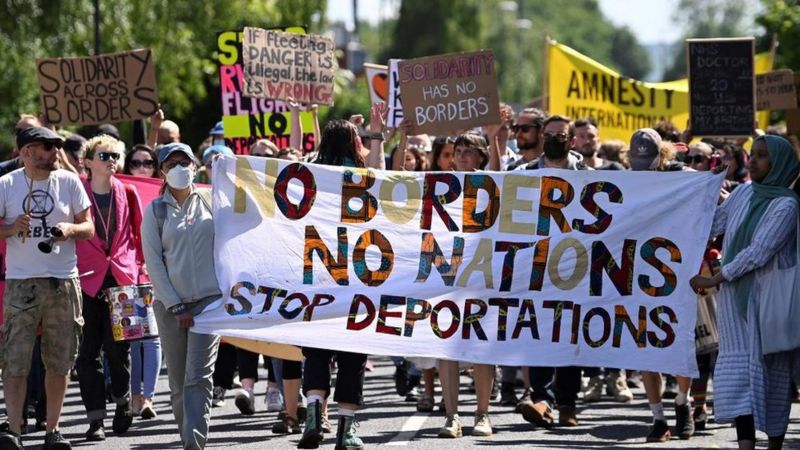
The asylum system, in its cold, bureaucratic majesty, is a labyrinth designed not for the lost, but for the weary. It is a fortress with gates that creak open only for those who can prove their persecution is not just personal, but politically palatable. For women fleeing gendered violence, the doors slam shut with a finality that echoes like a judge’s gavel. Why? Because the violence they endure is not always a bullet or a bomb—it is the slow, suffocating crush of patriarchy, and the asylum system, in its infinite wisdom, refuses to recognize it as persecution worth sheltering.
The Invisible War: When Violence Wears a Skirt
Imagine a battlefield where the enemy is not a foreign army, but the very air you breathe. This is the reality for women seeking asylum on grounds of gender-based violence. The asylum system, however, demands a war with visible scars—preferably ones that can be photographed and cross-referenced with human rights reports. The bruises of domestic abuse, the psychological torment of honor-based violence, the ritualistic mutilation of genital cutting—these are not the kind of injuries that fit neatly into a legal framework designed by men who have never known the terror of being a woman in a world that hates them.
Consider the case of a woman fleeing a forced marriage, her life a ticking bomb of cultural expectations and familial coercion. The asylum officer, a stranger in a suit, flips through her file and asks, “Where is the proof?” The proof, of course, is in the silence of her story, in the way her hands tremble when she speaks of the man who owns her. But silence is not evidence. Fear is not a document. And so, she is sent back to the warzone, because the war she fights is not recognized as war at all.

The asylum system is a mirror held up to the world’s hypocrisy. It will grant sanctuary to a man fleeing political persecution, his story etched in the ink of manifestos and the blood of martyrs. But a woman fleeing the persecution of her own family? Her suffering is too intimate, too ordinary, too *female* to warrant protection. The system does not see her as a refugee. She is a problem to be managed, a statistic to be filed away.
The Myth of the “Private” Persecution
There is a term whispered in asylum hearings like a curse: “private sphere.” It is the asylum system’s favorite loophole, a legal fiction that declares violence within the home as something outside the realm of state responsibility. If a woman is beaten by her husband, if she is raped by her brother, if she is mutilated by her mother—these are not matters for the courts. They are family matters. Domestic matters. *Private* matters.
This is the same logic that once justified a husband’s right to beat his wife. It is the same logic that still allows governments to turn a blind eye to honor killings, to dowry deaths, to the daily grind of misogyny that grinds women into dust. The asylum system, in its infinite deference to the status quo, has internalized this lie. It treats gender violence as a personal failing, not a systemic crime. A woman’s body is not a battleground worth defending—it is a battleground to be ignored.
But what if the private sphere is not private at all? What if the walls of the home are not barriers to violence, but amplifiers? What if the man who beats his wife is not just a monster in the dark, but a product of a society that rewards his brutality? The asylum system refuses to ask these questions. It prefers the comfort of its own ignorance, where violence is only violence if it is committed by a stranger in a uniform, not by the man who shares your bed.

This is not justice. This is complicity. The asylum system does not protect women from gender violence—it protects the world from having to confront its own complicity in that violence. It is easier to call a woman’s suffering “private” than to admit that the world is structured to produce it.
The Burden of Proof: When Credibility is a Luxury
Asylum seekers are not just fleeing violence—they are fleeing the impossible task of proving it. The burden of proof is a mountain, and women fleeing gender violence are expected to climb it barefoot, with no map, no guide, and no guarantee that the summit even exists. They must provide medical reports, police statements, witness testimonies—documents that are often impossible to obtain in countries where the police are the perpetrators, where hospitals are state-controlled, where speaking out means risking death.
Consider the woman who flees genital mutilation. She arrives at the border with no physical scars, because the cut was made with a razor, not a knife. She has no police report, because the crime is legal in her country. She has no witnesses, because the act was performed in secret, by those who claim to love her. The asylum officer looks at her file and sees a gaping hole where evidence should be. “Insufficient,” he says. And so, she is sent back to the knife.
This is not just a failure of the system—it is a feature. The asylum process is designed to filter out the most vulnerable, the most desperate, the most *unlikely* to be believed. Women fleeing gender violence are already at a disadvantage: their stories are fragmented, their trauma is invisible, their credibility is assumed to be suspect. The system does not bend to accommodate them. It bends to accommodate the status quo.
And what of the women who do manage to scrape together the evidence? What of the woman who flees domestic abuse, only to be told that her husband’s violence is not “severe enough” to warrant asylum? What of the woman who flees honor-based violence, only to be told that her culture does not count? The system does not just reject their claims—it erases their suffering. It tells them that their pain is not worth the paper it is written on.

The burden of proof is not just a legal hurdle—it is a weapon. It is a way to silence the most marginalized, to ensure that only the most palatable victims are granted sanctuary. The asylum system does not want women who are too traumatized to speak. It does not want women who are too poor to document their suffering. It does not want women who are too *female* to be believed. And so, it rejects them all.
The Future We Refuse to See
The asylum system is not broken. It is functioning exactly as it was designed to function—a fortress built to keep out the inconvenient, the uncomfortable, the *unwanted*. It is a system that rewards those who can prove their persecution is political, not personal. It is a system that turns a blind eye to the violence that women face every day, because that violence is too ordinary, too expected, too *normal* to warrant protection.
But what if we dared to imagine a different system? What if we recognized that gender violence is not a private matter, but a global crisis? What if we understood that the asylum process is not just about fleeing danger, but about fleeing a world that refuses to protect you? What if we demanded that the system see women as refugees, not as problems to be managed?
The future of asylum is not written in stone. It is written in the stories of women who are still fighting to be heard. It is written in the refusal to accept a system that tells them their suffering does not matter. It is written in the demand for a world where no woman has to prove that her pain is real.
Until then, the asylum system will continue to reject women fleeing gender violence—not because their claims are weak, but because the system is strong enough to ignore them.







Leave a Comment