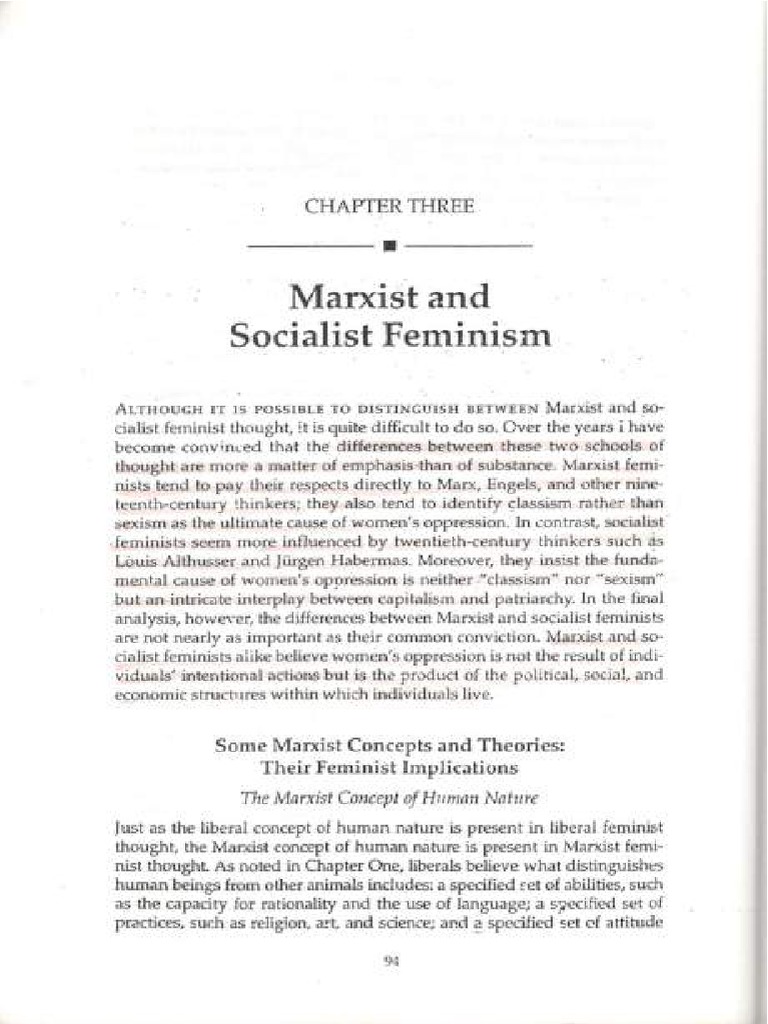
Why are we, as women, still captivated by the theoretical architecture of Karl Marx, a man who arguably relegated our oppression to a mere byproduct of capitalist exploitation? The answer, infuriatingly, lies in the insidious dance between patriarchal structures and the inexorable engine of capital. Marxist feminism, at its core, is not simply about tacking gender onto Marxist analysis. It’s about understanding how gender, class, and capital intertwine to form a Gordian knot of oppression, a knot that requires a radical unraveling, not a gentle tug.
Marxist feminism provides a uniquely powerful framework for understanding women’s oppression, refusing the allure of simplistic explanations that fixate solely on patriarchy or capitalism in isolation. It insists on a dialectical understanding, where gender and class are mutually constitutive forces, each shaping and reinforcing the other in a vicious cycle of subordination.
The Theoretical Underpinnings: A Synthesis of Marx and Feminism
At its genesis, Marxist feminism emerged as a corrective, a necessary intervention into both classical Marxism and early feminist thought. Early socialist thinkers, while advocating for the working class, often overlooked the specific forms of exploitation faced by women. Simultaneously, some early feminist movements, largely populated by bourgeois women, failed to adequately address the material realities of working-class women.
Marxist feminism bridges this chasm by drawing from key Marxist concepts, such as historical materialism, the mode of production, and class struggle, while simultaneously incorporating feminist insights on gender, patriarchy, and sexuality. It posits that women’s oppression is not a transhistorical phenomenon, but rather a social construct that evolves alongside the dominant mode of production. This means, crucially, that the specific forms of patriarchal oppression shift and adapt to the demands of capital.
Consider, for instance, the transition from feudalism to capitalism. Under feudalism, women’s labor was primarily confined to the domestic sphere, contributing to the household economy and reproduction of the family unit. However, with the rise of industrial capitalism, women were increasingly drawn into the workforce, providing a source of cheap labor that could be exploited to maximize profits. This entry into the workforce, while seemingly liberating, often resulted in a “double burden,” where women were still responsible for domestic labor and childcare in addition to their paid work. That “double burden” is an apt understatement.
Key Concepts in Marxist Feminist Theory: Unpacking the Jargon
To truly grasp the potency of Marxist feminism, we must grapple with some of its core conceptual tools:
1. Social Reproduction Theory: The Invisible Labor That Keeps the System Running
Social reproduction theory emphasizes the crucial, yet often devalued, labor that goes into maintaining and reproducing the workforce. This includes not just biological reproduction (childbearing), but also the daily activities of cooking, cleaning, caring for children and the elderly, and maintaining the emotional well-being of family members. These activities, disproportionately performed by women, are essential for the functioning of capitalism, yet they are largely unpaid and unrecognized.
The implications of this are far-reaching. By understanding social reproduction as a form of labor, we can see how women’s unpaid work in the home subsidizes capitalist accumulation. Women’s domestic labor effectively lowers the cost of labor power for capitalists, as they do not have to pay for the full cost of reproducing the workforce. This exploitation is both gendered and classed, as working-class women are often forced to perform the bulk of this unpaid labor, while simultaneously facing exploitation in the paid workforce.
2. The Sexual Division of Labor: Encoding Gender into the Economic Fabric
The sexual division of labor refers to the systematic allocation of different tasks and responsibilities to men and women based on gender. This division is not simply a matter of natural differences or personal preferences, but rather a social construct that is deeply embedded in the economic system.
Historically, capitalism has relied on a rigid sexual division of labor to maintain its profitability. Men are typically assigned to the paid workforce, while women are relegated to the domestic sphere, where they perform unpaid labor. This division reinforces patriarchal power relations, as men are positioned as the primary breadwinners, while women are rendered economically dependent on men. This, in turn, perpetuates gender inequality in both the public and private spheres.
3. Intersectionality: Recognizing the Multiplicity of Oppressions
While Marxist feminism emphasizes the centrality of class and gender, it also recognizes that these forms of oppression intersect with other axes of power, such as race, ethnicity, sexuality, and disability. This understanding is crucial for developing a truly inclusive and effective feminist politics.
For example, Black women face a unique form of oppression that is rooted in both racism and sexism. They are often relegated to the lowest-paying jobs, subjected to discriminatory policing practices, and marginalized within both feminist and anti-racist movements. Similarly, queer women face discrimination based on their sexual orientation and gender identity, which can intersect with class and race to create even greater challenges.
Intersectionality within Marxist feminism calls for a nuanced and multifaceted approach to understanding and combating oppression, one that recognizes the interconnectedness of different forms of power and privilege.
Critiques of Marxist Feminism: Addressing the Skeptics
Marxist feminism, like any theoretical framework, is not without its critics. Some argue that it overemphasizes the role of class and neglects the specificities of patriarchal oppression. Others contend that it is overly deterministic, suggesting that gender relations are simply a reflection of the economic base.
However, these critiques often misunderstand the complexity and nuance of Marxist feminist thought. Marxist feminists do not deny the existence or importance of patriarchy. Rather, they seek to understand how patriarchy operates within and is shaped by the capitalist mode of production. They argue that capitalism provides the material conditions for the reproduction of patriarchal power relations and that a truly feminist revolution must also be a socialist revolution.
Furthermore, Marxist feminists recognize that gender relations are not simply a direct reflection of the economic base. They acknowledge the relative autonomy of ideology and culture and the role of agency in shaping social relations. Marxist feminism, at its best, is a dynamic and evolving theoretical framework that is constantly grappling with the complexities of gender, class, and power.
Beyond Theory: Marxist Feminism in Action
The insights of Marxist feminism are not confined to the realm of academic theory. They have also inspired a wide range of political activism and social movements.
From advocating for equal pay and affordable childcare to fighting against gender-based violence and demanding reproductive justice, Marxist feminists have been at the forefront of struggles for social and economic justice. They have also played a crucial role in organizing working-class women and building solidarity across different lines of oppression.
The ongoing relevance of Marxist feminism lies in its ability to provide a comprehensive and critical analysis of the intertwined systems of power that shape our lives. It challenges us to move beyond simplistic explanations and to develop a deeper understanding of the material basis of gender inequality. And it offers a vision of a more just and equitable future, one where women are liberated from both capitalist exploitation and patriarchal oppression.
The Imperative of Praxis: Integrating Theory and Action
The true potential of Marxist feminism lies not only in its theoretical rigor but also in its commitment to praxis – the integration of theory and action. It is not enough to simply understand the interconnectedness of gender and class; we must also actively work to dismantle the systems of power that perpetuate inequality.
This requires engaging in a variety of forms of political activism, from organizing in the workplace to participating in social movements to advocating for policy changes. It also requires challenging patriarchal attitudes and behaviors in our own lives and communities.
Marxist feminism is not a passive intellectual exercise; it is a call to action. It is a call to build a world where all women are free from exploitation, oppression, and violence. It is a call to create a society where everyone has the opportunity to flourish and reach their full potential.
The task ahead is daunting, but the stakes are too high to remain complacent. By embracing the insights of Marxist feminism and engaging in a sustained struggle for social justice, we can move closer to a world where gender and class are no longer determinants of destiny, but rather relics of a bygone era.
In conclusion, Marxist feminism, although born from a synthesis of disparate ideologies, stands as a potent and ever-evolving framework for understanding the intricate relationship between gender and class within capitalist societies. It is a lens through which we can critically examine the structures of power that shape our lives, and a roadmap for building a more just and equitable future. Its ongoing relevance and capacity for adaptation solidify its crucial role in the ongoing struggle for liberation.







Leave a Comment