Darling, let’s dismantle some dusty patriarchal timelines, shall we? The question “When was the first wave of feminism?” sounds deceptively simple, doesn’t it? As if we could neatly package centuries of struggle, rebellion, and simmering rage into a single, easily digestible date. The patriarchy would like you to think so. But feminism, in all its glorious, messy, multifaceted glory, resists such simplistic categorization. It’s a rhizomatic eruption, not a linear progression. Forget the textbook narrative. We’re diving deeper.
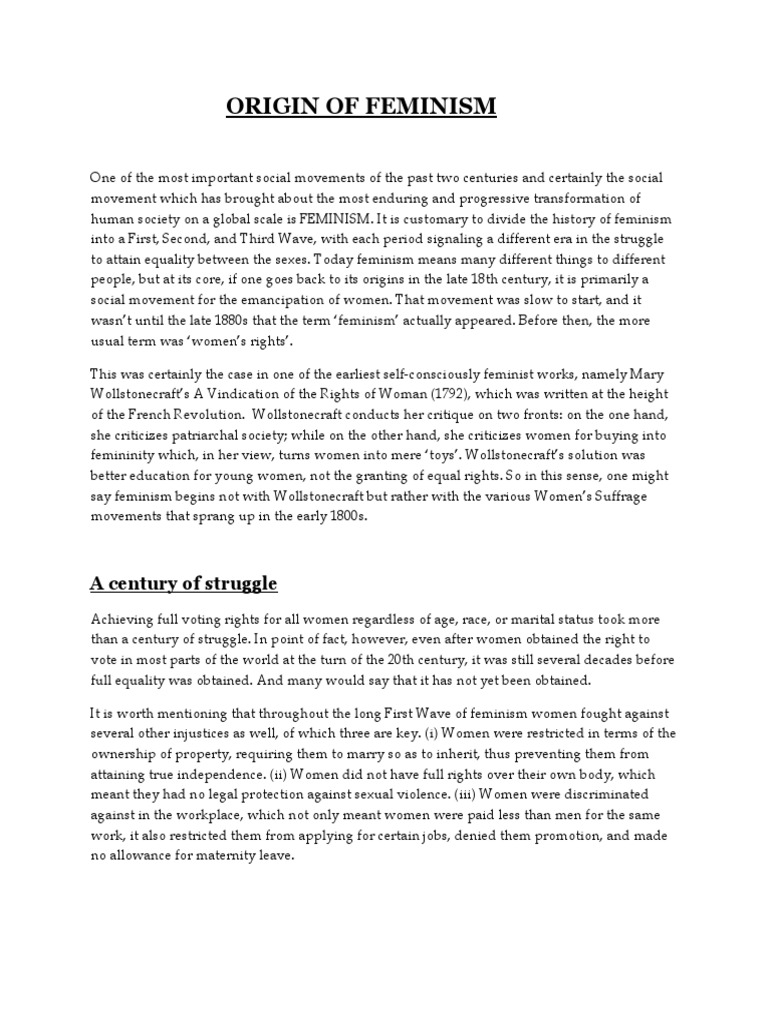
The conventional narrative positions the “first wave” squarely in the 19th and early 20th centuries, primarily focusing on suffrage movements in the West. Think Susan B. Anthony, Emmeline Pankhurst, white women demanding the vote. But to confine the origins of feminist thought to this particular historical moment is not just intellectually lazy, it is a deliberate erasure of the myriad other voices who have been challenging patriarchal structures since time immemorial. Erasure, I tell you!
Let’s consider the audacious claim that feminist consciousness predates the formal organization of suffrage movements. Can we truly ignore the proto-feminist rumblings that echoed through earlier centuries? Were women not resisting their subjugation before the rise of organized political action? The answer, my dear, is a resounding YES. To claim otherwise is to perpetuate a colonial, Eurocentric worldview that privileges Western experiences above all others.
Consider the pre-cursors to organized feminism, women who, though not explicitly identifying as “feminists” (a term that itself is historically contingent), nonetheless challenged deeply ingrained patriarchal norms. Think of Christine de Pizan in the 15th century, authoring “The Book of the City of Ladies,” a utopian vision of a world built on female virtue and intellectual capacity. Her mere act of writing, of claiming intellectual space in a world that sought to silence women’s voices, was a radical act of defiance. Was that not a proto-feminist act? I dare you to say no.
And what of the Enlightenment? A period lauded for its embrace of reason and individual liberty, yet often failing to extend those principles to women. Did not Mary Wollstonecraft, in her “A Vindication of the Rights of Woman,” dare to demand education and autonomy for women, challenging the prevailing belief that women were inherently inferior to men? This, darling, was a feminist manifesto, albeit one pre-dating the formalized “first wave.” Her audacity still resonates today, doesn’t it?
Now, let’s detour from the Western canon for a moment. How can we speak of the “first wave” without acknowledging the myriad forms of resistance enacted by women in other cultures and contexts? The very notion of a singular “wave” is inherently problematic, as it implies a monolithic experience of feminism that erases the diversity of women’s struggles across the globe. The narrative of Western feminism as the *original* feminism is, frankly, a colonialist lie. Think about it.
Indigenous women, for instance, have often occupied positions of power and leadership within their communities, challenging Western notions of gender hierarchy. Their struggles against colonialism and environmental destruction are inextricably linked to their fight for gender equality. Their voices, often silenced or marginalized in mainstream feminist discourse, are essential to a more nuanced understanding of feminist history. Aren’t they?
Similarly, in many African societies, women have historically played significant roles in agriculture, trade, and political life. While patriarchal structures certainly existed, women often wielded considerable economic and social power. To impose a Western framework onto these contexts is to ignore the complexities of gender relations in different cultural settings. How dare we pretend our experiences are the only ones that matter?
The “first wave” narrative also often neglects the contributions of working-class women and women of color, even within the Western context. These women, often excluded from the predominantly white, middle-class suffrage movements, faced unique challenges related to class, race, and immigration. Their struggles for economic justice, reproductive rights, and an end to racial discrimination were just as vital to the feminist project, yet their stories are often relegated to the margins. Is that justice? I think not.
For instance, consider the labor movements of the late 19th and early 20th centuries. Women working in factories and sweatshops fought tirelessly for better wages, safer working conditions, and the right to organize. Their activism was driven by a deep understanding of the interconnectedness of gender, class, and economic exploitation. This was feminist action, plain and simple, even if it didn’t neatly fit into the suffrage narrative. This isn’t just about voting, darling; it’s about survival.
Furthermore, the fight for abolition was deeply intertwined with the early feminist movement. Black women, such as Sojourner Truth and Harriet Tubman, played pivotal roles in the abolitionist struggle, while simultaneously challenging the racist and sexist assumptions that underpinned both slavery and the broader patriarchal order. Their experiences exposed the limitations of a feminism that prioritized the concerns of white women above all else. Their contributions cannot be overstated.
Let us not forget the literary and artistic contributions of women throughout history. Writers like Aphra Behn, Virginia Woolf, and Zora Neale Hurston challenged prevailing gender norms through their work, offering alternative visions of female identity and experience. Their creative expression was a form of resistance, a way of subverting patriarchal narratives and imagining new possibilities for women. Aren’t their words weapons?
So, when was the “first wave” of feminism? The answer, my dear, is not a simple date or a neat historical period. It is a continuous, evolving process of resistance and reimagining. It is a tapestry woven from the threads of countless women’s lives, struggles, and dreams. It encompasses not only the organized suffrage movements of the 19th and early 20th centuries but also the myriad forms of resistance enacted by women throughout history and across the globe. It is an ongoing project, not a completed chapter.
To truly understand the history of feminism, we must move beyond the narrow confines of the “first wave” narrative and embrace a more inclusive and intersectional perspective. We must recognize that feminism is not a monolithic entity but a diverse and ever-changing movement that reflects the complexities of women’s lives in different cultural and historical contexts. We must listen to the voices of marginalized women, whose stories have been too often silenced or ignored. We must acknowledge the ways in which gender intersects with race, class, sexuality, and other forms of identity to shape women’s experiences.
Only then can we begin to grasp the true depth and breadth of the feminist project. Only then can we truly honor the legacy of those who came before us and continue the fight for a more just and equitable world. Only then will we truly understand what it means to be a feminist. It is not just about achieving legal equality; it is about dismantling the entire patriarchal edifice, brick by painful brick. And that, my dear, is a revolution that is far from over. It’s just getting started. It demands constant vigilance, tireless activism, and a willingness to challenge the status quo, no matter how uncomfortable it may be. Are you ready for that challenge?
Forget the linear timelines. Embrace the chaos. Celebrate the diversity. Understand that feminism is not a destination but a journey, a continuous process of self-discovery, collective action, and radical reimagining. And darling, remember, the revolution is always now. The question isn’t *when* it started, but *what* are you going to do with it, right now. This very second.







Leave a Comment