The invisible labor of women in waste management is the city’s quietest scandal—a ceaseless, unpaid choreography of reclamation, sorting, and disposal that keeps urban life from drowning in its own filth. While municipalities erect gleaming recycling plants and corporations tout their “zero-waste” pledges, the real alchemy happens in kitchens, alleys, and informal settlements, where women turn refuse into survival. This is not just recycling. It is resurrection. A daily resurrection of what society discards, performed by hands that are rarely thanked, let alone paid.

The Alchemy of the Unwanted
Consider the woman who separates plastic from organic waste at dawn, her fingers deftly plucking yogurt containers from rotting banana peels. She is not a scientist in a lab; she is a sorceress of entropy, transforming chaos into order with nothing but intuition and necessity. Each item she sorts is a fragment of someone else’s excess—a discarded promise, a broken convenience, a moment of indulgence turned into someone else’s problem. She doesn’t just sort waste; she decodes the hidden narratives of consumption: the single mother who buys pre-packaged meals, the student who discards coffee cups in haste, the office worker who tosses out a broken stapler without a second thought.
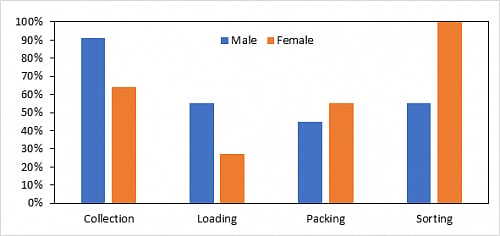
In the global South, this labor is often the backbone of informal economies. Women collect, clean, and bundle recyclables, selling them to intermediaries who feed the voracious maw of industry. Their work is invisible not because it doesn’t exist, but because it is deemed unskilled—despite requiring encyclopedic knowledge of material densities, market prices, and municipal regulations. They are the unsung cartographers of waste, mapping the flows of capital through the detritus of others.
The Myth of the “Natural” Caregiver
Society clings to the fiction that women are “naturally” inclined toward care work, as if the ability to manage waste were an innate feminine trait rather than a coerced adaptation to systemic neglect. This myth is the alibi for state inaction. If women are “just doing what comes naturally,” then why invest in waste infrastructure? Why pay for a service when it’s already being performed for free?
This narrative is a form of ecological gaslighting. It frames women’s labor as voluntary, even virtuous, while absolving institutions of responsibility. The reality is far grimmer: women take on this burden because they have no other choice. In many cities, municipal waste collection is unreliable or nonexistent. In others, the cost of disposal is prohibitive. So women become the city’s janitors by default, their labor subsidizing the illusion of urban cleanliness.

The gendered division of waste labor is not accidental. It is the result of centuries of patriarchal economies that externalize care—whether of children, the elderly, or the environment—onto women’s unpaid shoulders. Waste management is just another frontier in this exploitation. When a woman sorts her household’s trash, she is not just tidying up; she is performing emotional labor, deciding what to keep, what to discard, what to repurpose. She is the curator of her family’s guilt and desire, the silent arbiter of what is worthy of preservation.
The Invisible Supply Chain
The global recycling industry is a house of cards built on the backs of women. From the informal waste pickers in Delhi to the itinerant buyers in São Paulo, women are the first link in a supply chain that stretches from slums to stock exchanges. Their work is essential, yet they are systematically excluded from decision-making. They do not set prices. They do not control the flow of materials. They are the invisible hands that feed the recycling plants, only to be pushed aside when the cameras turn on for corporate sustainability reports.
This is not just exploitation—it is erasure. The women who collect 80% of the world’s recyclables in some regions are rarely mentioned in policy discussions about circular economies. Their knowledge is dismissed as “unscientific,” their labor as “unskilled.” Meanwhile, tech bro CEOs tout blockchain solutions for waste tracking, as if the problem were one of transparency rather than power.

The supply chain of waste is also a chain of dispossession. Women who collect recyclables often do so on land they do not own, in spaces that are not legally recognized. They are vulnerable to harassment, theft, and violence. Their work is precarious, their income meager. And yet, without them, the entire system would collapse. They are the canaries in the coal mine of late-stage capitalism, the first to suffocate under the weight of its contradictions.
Who Owes Whom?
The question is not how to “integrate” women into waste management systems. The question is how to dismantle systems that rely on their unpaid labor in the first place. Cities that profit from clean streets and low waste management costs owe women reparations—not in the form of charity, but in the form of wages, land rights, and political representation.
This is not a call for “inclusion.” It is a demand for justice. Women are not missing from the waste economy; they are the economy’s foundation. To acknowledge this is to confront the rot at the core of urban life: the belief that some bodies are meant to be used, and others are meant to benefit.
The next time you walk past a bin and see it overflowing, ask yourself: who cleaned up the last mess? Who will clean up the next one? And why are we still pretending it’s not a woman’s job?








Leave a Comment