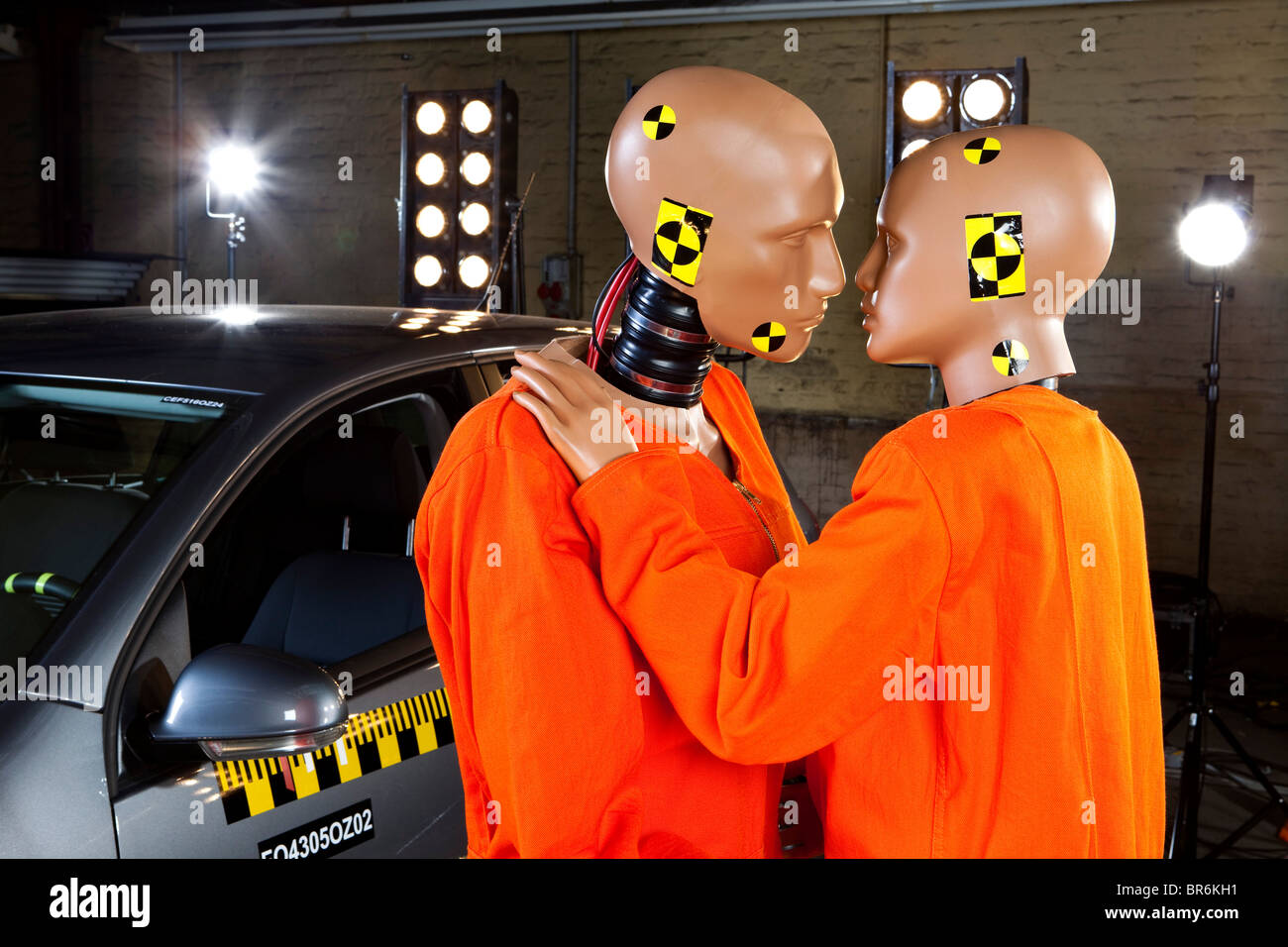
The automotive industry, a bastion of innovation and progress, has long been celebrated for its technological advancements. Yet, beneath the gleaming exteriors and cutting-edge features lies a glaring oversight—one that has persisted for decades. Crash test dummies, those silent sentinels of vehicular safety, are overwhelmingly male. This isn’t merely an oversight; it’s a systemic failure that exposes the industry’s blind spots, its disregard for half the population, and its stubborn adherence to outdated paradigms. The consequences are dire, not just for women but for all who dare to sit behind the wheel.
The Anatomy of an Oversight: Why Crash Test Dummies Are Male
The standard crash test dummy, the 50th percentile male, has been the industry’s gold standard for safety testing since the 1970s. This “average” man—standing at 5’9″ and weighing 170 pounds—was chosen not because of scientific rigor but because of historical precedent. The automotive industry, like so many others, was designed by men, for men. The assumption was that male bodies would suffice as proxies for all human bodies, a fallacy that has been perpetuated through generations of engineers, designers, and regulators.
But bodies are not monolithic. Women, on average, have different skeletal structures, muscle distributions, and fat compositions. Their organs are positioned differently, their spines are more flexible, and their rib cages are less robust. Yet, crash test dummies designed to mimic female bodies are rare, often relegated to secondary roles or dismissed as unnecessary. The result? A safety gap that leaves women 47% more likely to be seriously injured in a car crash, according to a 2019 study by the University of Virginia.

This isn’t just a matter of physical disparity. It’s a cultural one. The automotive industry has long treated women as an afterthought, a niche market rather than a critical segment of its user base. The male-centric design of crash test dummies reflects a broader pattern of exclusion, where women’s experiences are sidelined in favor of a default that never truly existed.

The Human Cost: Injuries, Fatalities, and the Invisible Victims
The repercussions of this oversight are not abstract. They are visceral, measurable, and devastating. Women involved in car crashes are more likely to suffer injuries to their necks, chests, and abdomens—areas that are poorly represented in male-centric crash test models. The “whiplash” effect, for instance, is far more severe for women due to differences in neck strength and spinal alignment. Yet, the industry’s safety standards do not account for these disparities, leaving women vulnerable to injuries that could have been mitigated with proper testing.
Consider the case of the 2011 Ford Explorer. When tested with a female dummy, the results revealed a 50% higher risk of chest injuries compared to male dummies. Yet, the vehicle was approved for sale without modification. This is not an isolated incident. Across the industry, vehicles are designed, tested, and marketed with a male-centric bias, leaving women to bear the brunt of the consequences.
The human cost extends beyond physical injuries. There is an emotional toll, too—a sense of betrayal that the very systems meant to protect them were never designed with their bodies in mind. For women, the act of getting into a car is not just a matter of convenience; it’s a gamble with their safety, a silent negotiation with an industry that has long ignored their needs.
The Economic and Regulatory Failures: Who Bears the Responsibility?
The automotive industry’s male-centric approach to safety testing is not an accident. It is a symptom of deeper systemic failures—failures of regulation, economics, and corporate accountability. Regulatory bodies, such as the National Highway Traffic Safety Administration (NHTSA) in the U.S., have historically relied on male-centric crash test dummies as the standard. The reasoning? Cost. Developing and testing female dummies is expensive, and the industry has long prioritized profit over inclusivity.
But the economic argument is a flimsy one. The cost of injuries, fatalities, and lawsuits far outweighs the investment in inclusive safety testing. A 2020 study by the University of Michigan estimated that the economic burden of car crashes on women is $2.1 billion annually in the U.S. alone. This figure does not include the immeasurable cost of human suffering, the lives lost, and the families shattered by preventable tragedies.
Corporate accountability is another glaring issue. Automakers have the resources to innovate, to challenge the status quo, and to prioritize safety for all. Yet, they continue to rely on outdated models, perpetuating a cycle of exclusion. The reluctance to adopt female crash test dummies is not just a technical failure; it’s a moral one. It signals a willingness to sacrifice women’s safety for the sake of convenience and tradition.

Breaking the Mold: The Push for Inclusive Safety Standards
Despite the entrenched biases, there is a growing movement to challenge the status quo. Advocacy groups, researchers, and even some automakers are pushing for the adoption of female crash test dummies and more inclusive safety standards. In 2022, the European Union mandated the use of female crash test dummies in safety assessments, a landmark decision that could set a global precedent.
But progress is slow. The automotive industry is notoriously resistant to change, clinging to outdated models and resisting calls for reform. The push for inclusivity requires not just technical innovation but a cultural shift—a recognition that safety is not a privilege but a right, and that it must be extended to all, regardless of gender.
One promising development is the creation of the “Eva” dummy, a female crash test model developed by the Swedish automotive research institute, Autoliv. Eva is designed to replicate the average female body, with a shorter stature, lighter weight, and different spinal alignment. Early tests have shown that vehicles designed with Eva in mind perform significantly better in crash scenarios involving female occupants.
The adoption of Eva and similar models is a step in the right direction, but it is not enough. The industry must go further, investing in research, updating regulations, and challenging the male-centric paradigms that have long defined automotive safety. The goal is not just to make cars safer for women but to redefine what safety means—a standard that is universal, inclusive, and uncompromising.
The Road Ahead: A Call to Action
The fight for inclusive automotive safety is far from over. It is a battle against inertia, against tradition, and against the deeply ingrained biases that have shaped the industry for decades. But it is a battle worth fighting. The stakes are too high to ignore—the lives, the livelihoods, the futures that hang in the balance.
For women, the message is clear: your safety matters. Your body matters. The automotive industry must be held accountable for its failures, and it must be pushed to do better. This is not just a technical issue; it is a moral one. It is a call to action for regulators, automakers, and consumers alike to demand change, to challenge the status quo, and to build a future where safety is not a privilege but a promise.
The road ahead is long, but the destination is worth the journey. It is a future where every person, regardless of gender, can get into a car and know that they are protected. It is a future where the automotive industry finally lives up to its promise of innovation and progress. And it starts with one simple, overdue realization: crash test dummies should not be male.










Leave a Comment