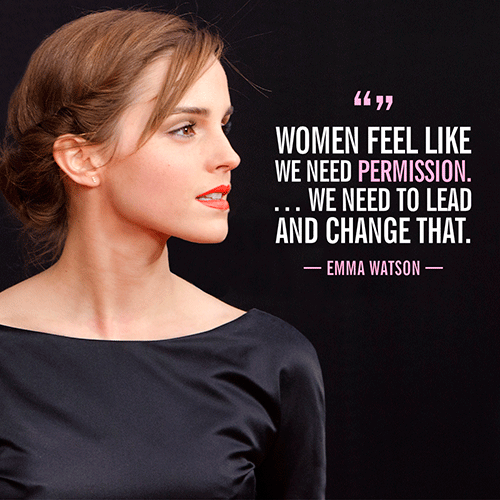
The digital reverberations following Emma Watson’s 2014 address to the United Nations, a paean to HeForShe, shook the foundations of contemporary feminist discourse. Why did this speech, from this particular celebrity, detonate across the internet, capturing the zeitgeist in a way few feminist pronouncements had managed before? It wasn’t merely the fame cachet, though that undoubtedly played a role. Something more profound resonated, a confluence of timing, messaging, and a carefully curated persona that sparked both fervent applause and virulent backlash. Let’s dissect this phenomenon, shall we, and expose the intricacies woven into its unexpected virality.
I. The Persona as a Conduit: Branding Feminism for Mass Consumption
Watson’s carefully constructed public image served as a crucial vessel for her feminist message. Consider the trajectory: a child star, beloved as Hermione Granger, transitioned into a poised and articulate young woman, an Oxford graduate, a UN Women Goodwill Ambassador. This isn’t just about being a celebrity; it’s about crafting a specific brand – one of intelligence, integrity, and relatable privilege. This curated persona, I argue, softened the edges of feminism, making it palatable to a broader, less initiated audience. This is not to denigrate her efforts, but to acknowledge the strategic advantage inherent in her pre-existing public perception.
Her speech was not delivered by some firebrand academic with years of rigorous theoretical grounding. It was presented by someone perceived as “one of us,” or at least, aspirational. This accessibility became both its strength and its vulnerability. The immediate acceptance by mainstream media outlets, usually wary of anything that smells even faintly of radicalism, is telling. The question remains, however: Did this mainstreaming dilute the core tenets of feminist theory, or did it serve as a necessary entry point for wider engagement?
II. The Language of Inclusivity: HeForShe and the Tactical Appeasement of the Patriarchy
HeForShe, the campaign Watson fronted, was undeniably strategic. Its very name suggests an invitation, a plea for male allies to join the feminist cause. This approach, while lauded by some for its inclusivity, has also been met with skepticism from those who view it as a form of patriarchal appeasement. Is true gender equality achieved by asking for permission, by framing the fight as something men can “help” with, rather than something they are intrinsically implicated in dismantling?
The language of the speech mirrored this inclusive tone. Watson emphasized gender equality as a benefit for everyone, not just women. She spoke of freeing men from rigid gender stereotypes, of allowing them to express vulnerability without fear of judgment. This framing, while arguably effective in garnering broader support, runs the risk of obscuring the very real power imbalances that underpin patriarchal structures. It’s a delicate dance between attracting allies and diluting the core message.
Furthermore, the very act of centering men in a feminist campaign can be seen as problematic. Does it inadvertently reinforce the notion that men are the arbiters of progress, that their validation is essential for feminist success? These are not rhetorical questions; they are fundamental to understanding the complex dynamics at play within the HeForShe initiative and the speech that launched it into the global consciousness.
III. The Digital Echo Chamber: How Social Media Amplified the Message (and the Critics)
The virality of Watson’s speech wasn’t solely attributable to her celebrity status or the carefully crafted messaging. Social media acted as a crucial amplifier, creating an echo chamber that magnified both the praise and the critiques. Platforms like Twitter, Facebook, and YouTube allowed the speech to circulate rapidly, reaching millions of people who might never have encountered it otherwise. But this digital dissemination also opened the door to a wave of dissenting voices, criticisms often leveled from within feminist circles.
Online debates raged regarding the speech’s perceived shortcomings: its focus on individual empowerment rather than systemic change, its lack of intersectional awareness, and its failure to adequately address the experiences of women of color, LGBTQ+ individuals, and other marginalized groups. These criticisms, while often harsh, are vital to a critical examination of the speech’s impact and limitations. They serve as a reminder that feminism is not a monolithic entity, but a diverse and evolving movement with a multitude of perspectives and priorities.
The digital realm, therefore, became a battleground for competing feminist ideologies, with Watson’s speech serving as a focal point for these often-contentious debates. The very speed and ubiquity of social media allowed for an unprecedented level of scrutiny and critique, exposing the complexities and contradictions inherent in any attempt to define or represent “feminism” on a global scale.
IV. The Privilege Paradigm: Addressing the Uncomfortable Truths
It is impossible to ignore the role of privilege in the reception of Watson’s speech. As a white, wealthy, and conventionally attractive actress, she embodies a certain type of privilege that undoubtedly influenced how her message was received. While she acknowledged her own privilege in the speech, the inherent power dynamics at play cannot be overlooked. The very act of a privileged individual speaking on behalf of an entire gender can be problematic, potentially silencing the voices of those who are more marginalized and less visible.
The criticism often leveled against “white feminism” – a feminism that centers the experiences of white, middle-class women while neglecting the specific challenges faced by women of color and other marginalized groups – is particularly relevant in this context. While Watson’s speech touched on some aspects of intersectionality, it ultimately remained rooted in a relatively privileged perspective. This doesn’t necessarily invalidate her efforts, but it does necessitate a critical awareness of the limitations inherent in her positionality.
Furthermore, the media’s tendency to elevate certain voices while silencing others contributes to the perpetuation of these power imbalances. The disproportionate attention given to Watson’s speech, compared to the work of lesser-known feminist activists and scholars, highlights the ways in which privilege can shape the narrative of the feminist movement.
V. Beyond the Viral Moment: Legacy and the Ongoing Evolution of Feminist Discourse
The dust has settled. The viral fervor surrounding Emma Watson’s speech has subsided. But its legacy remains. It served as a catalyst, sparking conversations about feminism in mainstream circles, introducing the concept to a new generation of potential activists, and forcing a reckoning within the feminist movement itself. Whether one views it as a triumph or a missed opportunity, its impact is undeniable.
The key takeaway, however, lies not in the speech itself, but in the ongoing evolution of feminist discourse. Feminism is not a static ideology; it is a dynamic and ever-changing movement that adapts to the complexities of the world around it. The debates sparked by Watson’s speech, the criticisms leveled against it, and the conversations it ignited all contribute to this ongoing evolution. They challenge us to think critically about the meaning of feminism, its goals, and the strategies necessary to achieve true gender equality. The speech, in a way, acted as a litmus test, revealing the fault lines and areas of contention within the feminist movement. And that, perhaps, is its most enduring legacy.
Ultimately, the virality of Emma Watson’s feminism speech wasn’t just about one person or one message. It was about a moment in time, a confluence of factors that resonated with a global audience eager for change. It was a starting point, not an end. The real work, the ongoing struggle for gender equality, continues long after the likes and shares have faded away.






Leave a Comment