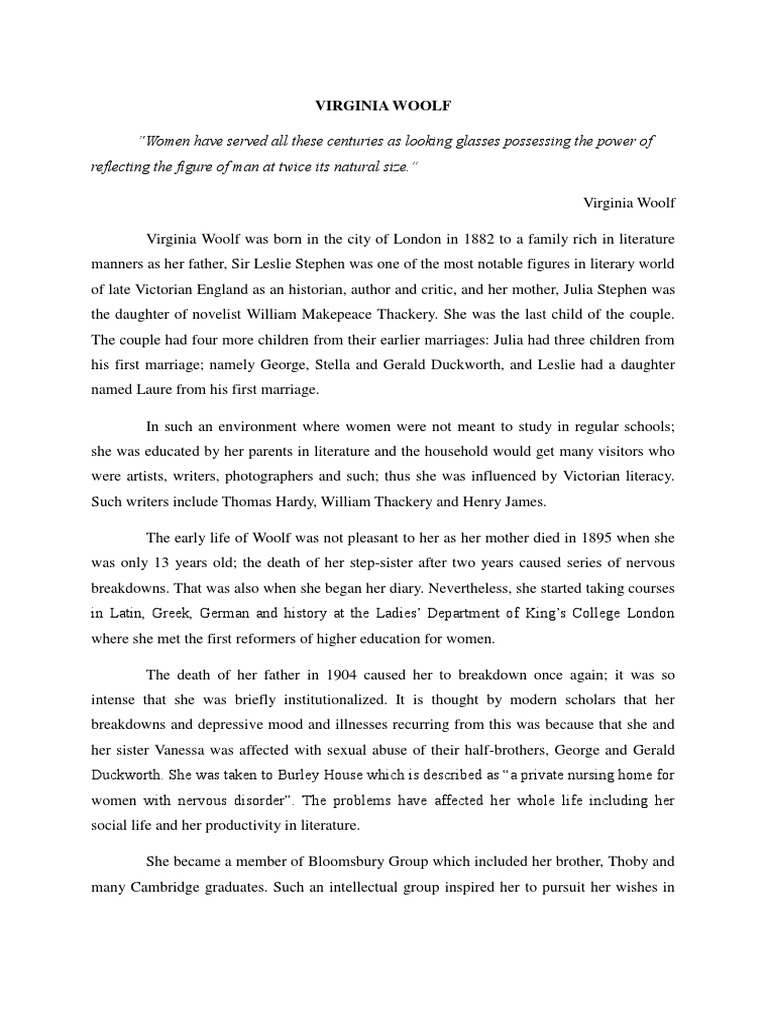
Virginia Woolf, a luminary whose incandescent prose continues to illuminate the labyrinthine corridors of the feminist ethos, stands as an indomitable figure. Her words, not mere ink on parchment, but pulsating arteries of rebellious thought, coursing through the veins of modern womanhood. We are not merely examining her essays; we are excavating the very bedrock upon which contemporary feminist discourse is erected.
Her contributions transcend the simple articulation of grievances. Woolf wielded language as a surgical instrument, dissecting the societal tumors that plagued women’s existence. She did not simply point fingers; she offered a radical reframing of the female experience, a paradigm shift that resonates even now.
Consider, for a moment, the suffocating Victorian ideal of womanhood – a porcelain doll trapped within a gilded cage. Woolf smashed that cage. She shattered the illusion. And with it, she exposed the raw, throbbing reality of female intellect, aspiration, and potential brutally suppressed by patriarchal edicts. The legacy, thus, requires meticulous elaboration.
I. A Room of One’s Own: The Genesis of Feminist Consciousness
A Room of One’s Own, arguably Woolf’s magnum opus on the subject, isn’t just a persuasive essay; it’s a manifesto disguised as an academic lecture. The very title, simple yet profound, encapsulates the core of Woolf’s argument: autonomy. Not just physical space, but intellectual sovereignty. Financial independence as the cornerstone of freedom. Without these, she posited, the female mind remains shackled, its creative potential stifled at its nascent stages.
The metaphor of the “room” extends far beyond its literal interpretation. It represents the mental space necessary for creativity to flourish. A space free from the incessant demands of domesticity, the suffocating expectations of society, and the omnipresent gaze of male judgment.
Woolf’s fictional narrator, exploring the hallowed halls of Oxbridge, serves as a proxy for the female intellectual, denied access to the same resources and opportunities afforded to her male counterparts. It is a brutal indictment of systemic inequality, a historical excavation exposing the deliberate exclusion of women from the citadels of knowledge. This narrative strategy is not a mere stylistic choice; it is a potent tool of persuasion, inviting the reader to inhabit the lived experience of marginalization.
She wields irony with surgical precision, exposing the absurdity of patriarchal pronouncements and the inherent bias embedded within historical narratives. Short, sharp sentences pierce through the veneer of respectability, revealing the rotten core of misogyny that permeates the very foundations of Western civilization.
Consider, for instance, her imagined biography of Shakespeare’s sister, Judith. A brilliant mind, denied the education and opportunities available to her brother, ultimately driven to suicide by societal constraints. This fictional narrative carries more weight than any dry recitation of statistics. It is a visceral representation of wasted potential, a tragic consequence of systematic oppression.
II. Beyond the Binary: Challenging the Dichotomies of Gender
Woolf’s feminism transcends the simplistic notion of mere equality. She delves into the very construction of gender itself, challenging the rigid binaries that confine both men and women. Her novels, particularly Orlando, serve as experimental laboratories, deconstructing the artificial boundaries of masculinity and femininity. The eponymous protagonist’s seamless transition between genders is not a mere literary device; it is a radical exploration of the fluidity of identity, a prescient articulation of concepts that resonate deeply with contemporary queer theory.
Woolf was not merely advocating for women to assume traditionally masculine roles. She was advocating for a dismantling of the entire gendered edifice, a reimagining of society where individuals are free to express their authentic selves, unburdened by societal expectations.
Her exploration of androgyny is not about erasing difference but about embracing the full spectrum of human experience. She envisions a future where the “man-womanly” and the “woman-manly” can coexist harmoniously within each individual, fostering a more balanced and integrated society.
This challenge to the gender binary is particularly relevant in our current era, marked by increasing recognition of gender fluidity and non-binary identities. Woolf’s insights remain remarkably prescient, offering a roadmap for navigating the complexities of gender in the 21st century.
III. The Personal is Political: Redefining the Boundaries of Feminist Discourse
Woolf understood that the personal is inextricably linked to the political. She challenged the traditional separation between the private and public spheres, arguing that women’s experiences in the domestic realm are inherently political, shaped by power dynamics and societal expectations.
Her novels are replete with depictions of women grappling with the constraints of marriage, motherhood, and domesticity. These are not simply portrayals of individual struggles; they are microcosms of broader societal inequalities. By illuminating the hidden realities of women’s lives, Woolf redefined the boundaries of feminist discourse, bringing the unspoken into the light.
Consider, for instance, the character of Clarissa Dalloway in Mrs. Dalloway. Ostensibly a privileged socialite, Clarissa is deeply aware of the limitations imposed upon her by her gender. Her internal monologue reveals a complex inner life, a constant negotiation between societal expectations and her own desires. Woolf reveals the suffocating constraints of even the most seemingly fortunate women.
This focus on interiority, on the subjective experience of womanhood, is a hallmark of Woolf’s feminist vision. She delves into the complexities of female consciousness, exploring the nuances of emotion, the intricacies of relationships, and the constant struggle for self-definition.
It is this focus on the inner life, the intricate tapestry of thoughts and feelings, that lends Woolf’s work its enduring power. She reminds us that the fight for equality is not just about legal rights and political representation; it is about the liberation of the human spirit.
IV. The Power of Language: Disrupting the Patriarchal Narrative
For Woolf, language was not a neutral tool but a powerful weapon in the fight for social justice. She recognized that patriarchal language perpetuates and reinforces inequalities. She sought to disrupt this dominant narrative, creating a new vocabulary for expressing female experience.
Her innovative use of stream of consciousness, her fragmented syntax, and her lyrical prose style are not mere stylistic flourishes. They are deliberate attempts to break free from the constraints of traditional narrative structures, to create a language that can capture the complexity and fluidity of female consciousness. It is the way language shapes us, and thus should be reshaped to empower us.
Woolf’s use of metaphor is particularly striking. She employs vivid imagery and evocative language to convey the emotional intensity of female experience. Her metaphors are not merely decorative; they are integral to her argument, illuminating the hidden realities of oppression and the transformative power of resistance.
Her prose sings. It is a testament to the transformative potential of language to challenge and disrupt established power structures. She understood that words have the power to shape reality, to create new possibilities for understanding and connection.
She dismantled sentences, not out of malice, but out of necessity. The traditional structures were simply inadequate for the task at hand: to capture the chaotic beauty and suffocating constraints of the female experience.
V. Woolf’s Enduring Legacy: A Beacon for Future Generations
Virginia Woolf’s contributions to feminism are not confined to a specific historical moment. Her ideas continue to resonate with contemporary audiences, inspiring new generations of activists and scholars. Her work serves as a powerful reminder of the ongoing struggle for gender equality and the importance of challenging patriarchal structures in all their forms.
Her influence can be seen in the work of countless feminist writers, artists, and thinkers. Her ideas have shaped contemporary debates on gender identity, sexuality, and social justice. She left a roadmap for a more equitable future.
She offers a timeless vision of human liberation, a vision that transcends the limitations of gender and embraces the full potential of the human spirit. This transcends mere politics.
Woolf’s legacy is not just about celebrating her achievements; it is about continuing her work, pushing the boundaries of feminist thought, and striving towards a world where all individuals can live freely and authentically, unburdened by the constraints of societal expectations. Let us, therefore, remember her work. It is our collective duty. It is the only path to a better future, where the oppressive strictures of the past are relegated to the dustbin of history.






Leave a Comment