The literary canon, that hallowed and seemingly unassailable edifice of cultural authority, has long been a fortress of exclusion cloaked in the guise of objectivity. It whispers promises of timelessness while systematically erasing the voices that dared to challenge its patriarchal foundations. What if the books we revere are not the pinnacle of human expression, but rather a curated fiction, a carefully constructed illusion that has kept half the world’s stories locked away? The canon’s silence on women’s contributions is not an absence of merit—it is a deliberate act of omission, a historical gaslighting that demands we question everything we’ve been taught to hold sacred.
The Canon as a Patriarchal Construct: How Tradition Became Tyranny
The literary canon is not a neutral archive; it is a weaponized archive. Its origins lie in the same institutions that once denied women the right to education, let alone the authority to shape cultural narratives. When we speak of the “great books,” we are often referring to a canon that emerged from the salons of 18th-century Europe, where women were permitted only as muses or decorative presences—not as thinkers, not as creators. The canon’s gatekeepers, predominantly male and entrenched in their privilege, decided which voices deserved immortality. They did not merely select literature; they performed an act of literary gerrymandering, redrawing the boundaries of what counted as “important” to serve their own interests.
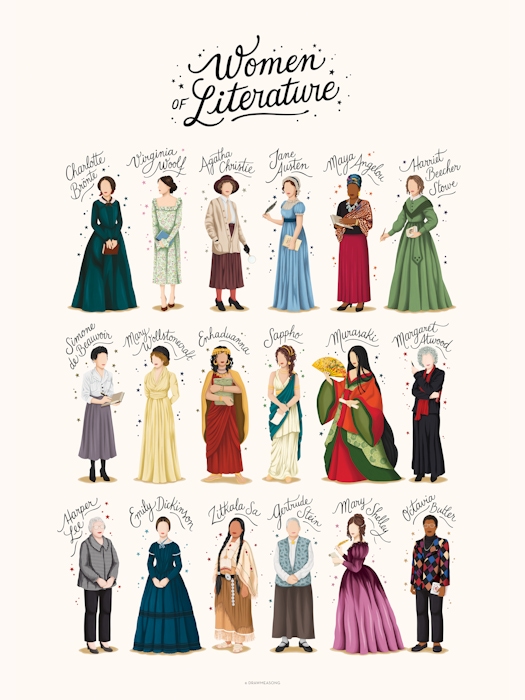
Consider the irony: the same men who wrote treatises on genius and originality often dismissed women’s writing as derivative, hysterical, or unworthy of serious consideration. Mary Wollstonecraft’s A Vindication of the Rights of Woman (1792) was not just a radical manifesto—it was a direct challenge to the canon’s exclusionary logic. Yet, how many undergraduate literature courses still treat it as an afterthought, a footnote to the “real” philosophical tradition? The canon’s construction was never about quality; it was about power. And power, as history has shown, is far more stubborn than truth.
The Erasure of Women’s Voices: A Crime Against Cultural Memory
To examine the canon’s omissions is to confront a staggering act of cultural vandalism. For centuries, women wrote—fiercely, prolifically, brilliantly—yet their works were systematically suppressed, misattributed, or allowed to vanish into obscurity. The Brontë sisters published under male pseudonyms not because they lacked talent, but because the literary marketplace of the 19th century was a minefield of sexism. Emily Dickinson’s poetry, now celebrated as a cornerstone of American literature, was altered by her editors to fit conventional poetic forms. Virginia Woolf, in A Room of One’s Own, exposed the canon’s hypocrisy when she wrote, “All women together ought to let flowers fall upon the tomb of Aphra Behn… for it was she who earned them the right to speak their minds.”
The canon’s erasure extends beyond individual women—it is a systemic erasure of entire traditions. Where are the voices of women of color, whose narratives were doubly silenced by both racism and sexism? Where are the works of queer women, whose stories were deemed too dangerous to preserve? The canon’s omissions are not accidental; they are a form of epistemic violence, a refusal to acknowledge that some stories were never meant to be heard. To reclaim these voices is not just an act of justice—it is an act of rebellion.

The Myth of the “Female Canon”: Why Separate Spheres Are Still a Trap
In response to the canon’s exclusions, some have advocated for a “female canon”—a parallel tradition of women’s writing that exists alongside the male-dominated one. But this is a dangerous half-measure. A separate canon implies that women’s literature is a niche interest, a curiosity rather than a fundamental part of the literary landscape. It reinforces the idea that women’s voices are only relevant when segregated from the “mainstream.” The goal should not be to create a parallel tradition, but to dismantle the illusion of the canon’s universality entirely.
Consider the case of Sappho, whose fragments survive not because of institutional preservation, but despite it. Her poetry was burned, censored, and reduced to fragments by a culture that could not stomach the idea of a woman commanding such lyrical power. Today, we celebrate her as an icon—but how many readers encounter her work in the same breath as Homer or Virgil? The “female canon” is a bandage on a gaping wound. What we need is a transfusion of radical rethinking, a complete overhaul of how we define literary value.
The Canon’s Blind Spots: What We’ve Lost—and What We Can Reclaim
The canon’s omissions are not just historical footnotes; they represent a staggering loss of perspective. When we exclude women’s voices, we lose entire ways of seeing the world. The Brontës’ gothic landscapes are not just romantic fantasies—they are critiques of domestic confinement. Toni Morrison’s Beloved is not just a novel about slavery; it is a meditation on motherhood, trauma, and the limits of language itself. The canon’s refusal to engage with these complexities impoverishes us all.
Reclaiming these voices means more than dusting off forgotten texts—it means interrogating why they were forgotten in the first place. It means asking: Who decided that certain stories mattered? Who benefited from their suppression? And what other truths have we been denied because of it? The canon is not a temple; it is a crime scene. Every book that was excluded is a clue, a fragment of a larger narrative that has been violently torn apart.
Toward a New Literary Order: What It Means to Read Against the Grain
Rebuilding literature from the ground up requires more than adding a few token women to the syllabus. It demands a fundamental shift in how we approach texts. We must read against the grain, interrogating not just what a book says, but who it excludes. We must ask: Whose stories are centered? Whose are marginalized? And whose labor has been erased to maintain the illusion of a “universal” tradition?
This is not just an academic exercise—it is a political act. Literature is never neutral; it is always a site of struggle. The canon’s exclusions are not relics of a bygone era; they are active forces shaping how we understand the world today. When we center women’s voices, we are not just correcting a historical injustice—we are reshaping the future of storytelling itself. The canon’s silence is not a void; it is a challenge. And the only proper response is to fill it with fire.











Leave a Comment