
There is a quiet defiance in the act of a woman stepping onto a plane, train, or bus alone—not with the resignation of a tourist, but with the deliberate stride of someone who refuses to be chaperoned by fear. Solo female travel is not merely a trend; it is a quiet insurrection against the unspoken rules that have long dictated where women can go, how they can move, and who they must be accompanied by. It is rebellion distilled into itineraries, a refusal to be confined by the gaze of strangers or the weight of societal expectations. But beneath the surface of adventure and self-discovery lies something far more subversive: the reclaiming of agency in a world that has spent centuries trying to shrink women into manageable, predictable shapes.
The Myth of the Fragile Traveler: Why Safety Is a Red Herring
We are told, ad nauseam, that solo female travel is dangerous. The warnings come in waves—whispers of caution from well-meaning relatives, headlines that sensationalize isolated incidents, and the ever-present undercurrent of “but what if something happens?” This narrative is not about safety; it is about control. The real danger, it seems, is not the threat of violence or theft, but the possibility that a woman might step outside the carefully constructed boundaries of her designated space. The obsession with safety is a smokescreen, a way to keep women tethered to the illusion of security while the world remains a place where their presence is policed.
The truth is that danger is not gendered. Men face risks too—pickpockets, scams, unpredictable weather—but their journeys are rarely framed as inherently perilous. A woman traveling alone is not a victim waiting to happen; she is a disruptor, a walking challenge to the status quo. The fear mongering is not about protecting her; it is about keeping her in her place. And so, when she ventures forth, she is not just exploring a new city—she is dismantling the idea that her body is public property, that her movements must be justified, that her solitude is a vulnerability rather than a strength.
The Gaze That Follows: Rejecting the Male Spectacle
There is a particular kind of scrutiny reserved for women who travel alone—the kind that reduces them to objects of curiosity, suspicion, or desire. Strangers feel entitled to comment on her appearance, her clothing, her solitude. “Where is your husband?” they ask, as if her marital status is the only thing that grants her legitimacy in a foreign space. The male gaze does not disappear when a woman crosses an ocean; it merely adapts, shifting from the familiar to the exotic, from the known to the unknown. But here is the rebellion: she does not perform for it. She does not shrink. She does not apologize for her presence.
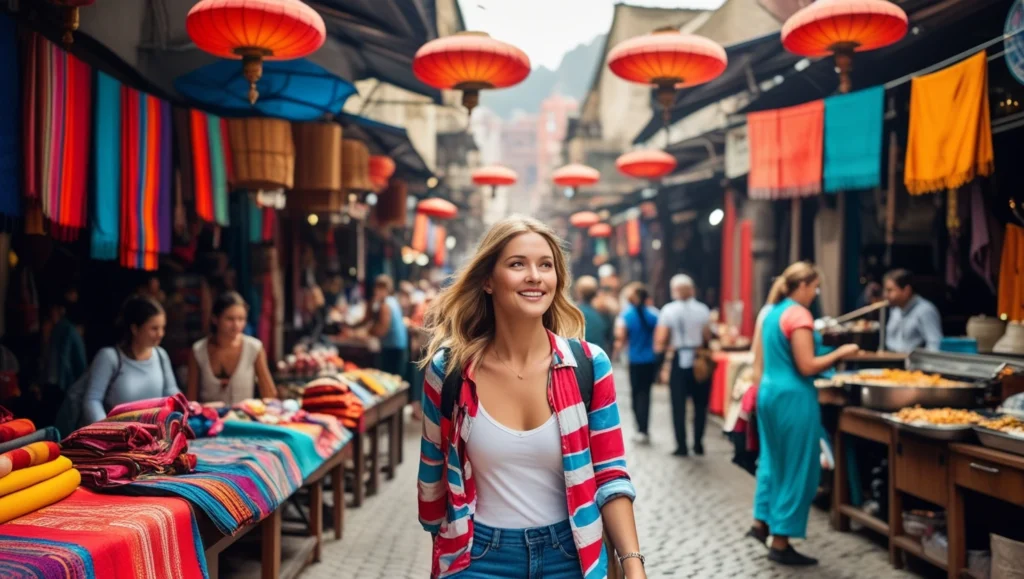
Solo female travel is an act of defiance against the expectation that a woman’s journey must be validated by a man’s approval. It is a refusal to be a side character in someone else’s story, to be defined by her relationships rather than her own desires. When she sits alone in a café in Marrakech or hikes the trails of Patagonia without a companion, she is not just sightseeing—she is asserting her right to exist in the world on her own terms. The male gaze may linger, but it no longer dictates her worth. She is the protagonist now, and her narrative is hers alone to write.
The Economy of Loneliness: Why Women Are Expected to Share Their Space
There is a quiet assumption that women, by default, are not meant to occupy space alone—that their solitude is a problem to be solved, a void to be filled. We are socialized to believe that a woman traveling by herself is either pitiful or suspicious, that she must be missing something, that her journey is incomplete without a partner, a friend, a child. This is not just an observation; it is a form of erasure. It suggests that a woman’s experiences are only valid when they are shared, that her joy is diminished if she does not have someone to witness it with her.
But what if solitude is not a lack, but a surplus? What if the act of traveling alone is not a rejection of companionship, but a celebration of self-sufficiency? The world is not designed for women to move through it unaccompanied, and that is precisely why it is so radical to do so. Every time a woman checks into a hostel alone, orders a meal at a bar alone, or takes a train to a destination with no itinerary, she is rejecting the idea that her existence must be justified by the presence of others. She is not lonely; she is free.
The Colonial Echoes of “Proper” Female Travel
For centuries, the narrative of female travel has been tangled up in colonial fantasies of the “exotic” and the “other.” Women were either the delicate flowers of empire, chaperoned by husbands or missionaries, or the adventurous exceptions who proved their worth by surviving the perils of the unknown. But these narratives were never about women’s autonomy—they were about control. The idea that a woman could travel alone was, for a long time, unthinkable because it threatened the very foundations of patriarchal power. If a woman could navigate the world without a man’s guidance, what did that say about the necessity of male authority?
Today, the echoes of this colonial gaze persist. Women who travel alone are often exoticized, their journeys framed as quirky or brave rather than ordinary. But this is just another way to contain them—to make their rebellion palatable by framing it as a temporary deviation from the norm rather than a permanent assertion of independence. The truth is that solo female travel is not an anomaly; it is a return to what should have always been natural. Women have always moved through the world; the only thing that has changed is that now, they are doing it without asking for permission.
The Unseen Luxury of Being Unaccompanied
There is a privilege in being able to travel alone, yes—but not the kind that is often assumed. It is not the privilege of wealth or education, though those certainly help. It is the privilege of being able to exist without apology. To sit in a park and read a book without being asked if you are waiting for someone. To take a spontaneous detour without explaining yourself. To change your plans on a whim without justifying it to a partner or a friend. This is the luxury of sovereignty—the ability to make decisions based solely on your own desires, without the interference of others’ expectations.
And yet, this luxury is not granted; it is seized. Every woman who travels alone is, in some small way, claiming a piece of the world that was never meant for her. She is not just seeing new places; she is redefining what it means to be a woman in them. She is not just collecting memories; she is dismantling the idea that her life must be lived in the shadow of someone else’s approval. The world is not designed for her, but she is designing her own path through it—one rebellious step at a time.
The Rebellion Is Not in the Destination, But in the Departure
At its core, solo female travel is not about the places visited or the experiences had. It is about the act of leaving itself. It is about saying, “I will not wait for permission. I will not apologize for my presence. I will not shrink myself to make others comfortable.” It is about recognizing that the world was never built for women to move through it freely—and then moving through it anyway.
The rebellion is in the boarding pass, in the packed suitcase, in the moment of hesitation before stepping onto the street alone. It is in the refusal to be defined by the fears of others. It is in the quiet triumph of a woman who realizes, somewhere between the security line and the first unfamiliar street, that she is not just a traveler—she is a force.
And the world, for all its warnings and restrictions, is not ready for her.






Leave a Comment