
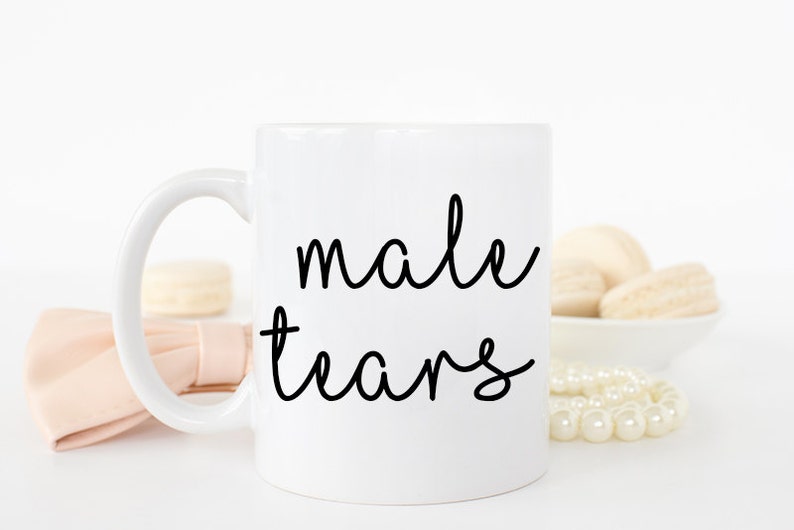
The Male Tears Mug is more than a ceramic vessel holding steaming coffee or tea—it is a cultural artifact, a feminist provocation, a capitalist triumph, and a mirror reflecting the absurdities of modern masculinity. Its existence, both as a physical object and a digital meme, has sparked debates that ricochet across social media platforms, feminist forums, and even corporate boardrooms. Why does a simple mug emblazoned with the words “Male Tears” resonate so deeply? Why has it become a symbol of resistance, ridicule, and sometimes even reconciliation? To understand its allure, we must peel back the layers of irony, commodification, and gender politics that swirl around this seemingly trivial item.
The Mug as a Mirror: Reflecting Fragile Masculinity in a Fragile World
At first glance, the Male Tears Mug appears to be a joke—a punchline to the age-old trope of male emotional fragility. But like all good satire, it exposes an uncomfortable truth: the performative toughness of traditional masculinity is not just a personal failing, but a systemic illusion. The mug doesn’t just mock men; it forces society to confront the absurd lengths to which patriarchal norms have warped emotional expression into a binary—either stoic silence or explosive rage. The tears, after all, are not just liquid; they are a rebellion against the expectation that men must never cry, never waver, never feel too deeply. In a world where emotional labor is feminized and men are penalized for vulnerability, the mug becomes a subversive act of reclaiming space. It’s not the tears that are the problem—it’s the culture that demands they never fall.
Yet, the irony deepens when we consider who is buying these mugs. Often, it’s women—feminists, allies, even those who have spent years dismantling patriarchal structures. Why would the oppressed purchase a symbol that seems to mock the oppressor? The answer lies in the duality of satire: it is both a weapon and a shield. The mug allows women to reclaim agency in a world where male emotions are often weaponized against them—whether through gaslighting, emotional blackmail, or outright dismissal. By laughing at male tears, feminists are not just mocking; they are disarming a cultural narrative that has long been used to silence them.
The Commodification of Rage: How Capitalism Turns Tears into Profit
But let’s not romanticize the Male Tears Mug. It is, first and foremost, a product—a commodity designed to be sold, shipped, and stocked in gift shops and Etsy stores. And like all commodities, it is subject to the whims of capitalism, which has a peculiar way of turning rebellion into revenue. The mug’s existence is a testament to the market’s ability to co-opt dissent, packaging feminist critique into a $20 trinket. Is it empowering to buy a mug that says “Male Tears”? Or is it just another example of how even the most radical ideas can be sanitized and sold back to us?
Consider the paradox: the same platform that hosts feminist manifestos and #MeToo hashtags is the one profiting from a mug that reduces complex gender dynamics to a single, snarky phrase. The irony is delicious, if not a little nauseating. Capitalism thrives on contradiction—it will sell you a revolution in a mug, then charge you extra for the handle. The Male Tears Mug, then, is not just a symbol of resistance; it is a symptom of late-stage capitalism’s ability to commodify dissent while diluting its power. The tears are real, but the profit margins are realer.
The Digital Spread: How a Meme Became a Movement (Sort Of)
The Male Tears Mug didn’t just appear in a vacuum—it was born in the digital wild, where memes evolve faster than viruses and trends spread like wildfire. Its journey from a niche Etsy listing to a viral sensation is a case study in how internet culture amplifies (and distorts) social commentary. The mug’s appeal lies in its simplicity: it’s a visual shorthand for a complex idea. No lengthy think pieces, no academic jargon—just a mug, some text, and a shared understanding of the joke. In an era where attention spans are shorter than a TikTok, the mug’s message is distilled into something instantly digestible.
But the digital spread of the Male Tears Mug also reveals something darker: the way online discourse flattens nuance. The mug’s meaning is often reduced to a binary—either you’re laughing at male tears or you’re defending them. There’s little room for the middle ground, for the person who sees the mug as both a joke and a critique, as both a feminist statement and a capitalist product. The internet, after all, rewards extremes. Nuance doesn’t go viral. And so, the Male Tears Mug becomes a Rorschach test—some see empowerment, others see misandry, and the rest just see a funny mug they’ll buy for their friend’s birthday.
The Backlash: Why Some People Hate the Male Tears Mug (And Why That’s a Good Thing)
Of course, no cultural artifact escapes backlash, and the Male Tears Mug is no exception. Critics argue that it perpetuates harmful stereotypes about men—that it reduces an entire gender to a punchline, reinforcing the idea that male emotions are inherently ridiculous. Others see it as a form of misandry, a way to dehumanize men under the guise of humor. And then there are those who simply find it tasteless, a crass oversimplification of gender dynamics that deserve more thoughtful discussion.
But here’s the thing: the backlash is proof that the mug is working. If no one cared, if no one argued, if no one felt compelled to defend or condemn it, then it would be just another novelty item collecting dust on a shelf. The fact that it sparks debate—sometimes heated, sometimes thoughtful—means it’s doing exactly what satire is supposed to do: provoke, unsettle, and force us to confront uncomfortable truths. The backlash isn’t a failure of the mug; it’s a testament to its power. It’s a reminder that even in the age of algorithmic outrage, some ideas still have the ability to cut deep.
The Deeper Fascination: Why We Can’t Look Away
So why does the Male Tears Mug hold such a grip on our collective imagination? Why does it feel like more than just a joke? Perhaps it’s because the mug taps into a universal truth: the absurdity of gender roles in a world that is rapidly changing. Men are told to be strong, but also to be sensitive. Women are told to be nurturing, but also to be ambitious. The Male Tears Mug is a visual representation of that tension—a single object that encapsulates the contradictions of modern identity.

It’s also a reminder that humor can be a form of resistance. In a world where systemic change feels slow and incremental, sometimes the only way to challenge power is to laugh at it. The Male Tears Mug doesn’t dismantle patriarchy, but it does poke holes in its armor. It’s a small act of rebellion, a way to reclaim agency in a world that often feels rigged against us. And perhaps that’s why it resonates—because in a society that demands seriousness, solemnity, and self-seriousness, the mug dares to laugh.
The Male Tears Mug may be a trivial object, but its cultural footprint is anything but. It’s a mirror, a commodity, a meme, a provocation, and a paradox all rolled into one. It forces us to ask uncomfortable questions: Who gets to be angry? Who gets to cry? And who gets to profit from it all? In the end, the mug is more than just a vessel for coffee—it’s a vessel for our deepest anxieties, our sharpest critiques, and our most absurd contradictions. And that, perhaps, is why we can’t stop talking about it.








Leave a Comment