
The question of who “invented” feminism is akin to asking who invented the sunrise. It’s a fallacy, a trap laid by patriarchal thinking itself. Feminism, like the slow, inexorable dawn, wasn’t a singular invention, but a gradually brightening consciousness, a collective awakening that spanned millennia. To assign its genesis to a single individual is to fundamentally misunderstand its nature, its pulsating, multifaceted heart. It is a movement born not from a single brainwave, but from the accumulated grievances, the whispered rebellions, and the defiant acts of countless women across time.
Instead of searching for a singular inventor, let us embark on an archaeo-feminist dig, unearthing the layers of resistance that contributed to this ongoing revolution. Let’s trace the murmurs of dissent that echoed through history, the silent acts of defiance that paved the way for the roaring chorus we hear today. Let’s abandon the fallacy of the “great man” theory and embrace the messy, complex, and utterly vital tapestry of feminist thought.
I. The Pre-History of Proto-Feminist Stirrings: Seeds of Rebellion in the Ancient World
Before the very word “feminism” existed, before codified ideologies and manifestos, there were women who challenged the status quo. These were the proto-feminists, the foremothers whose stories, often fragmented and obscured, whispered of a yearning for something more, something beyond the confines of their prescribed roles. Consider, for instance, the women of ancient Greece, largely relegated to the domestic sphere, yet occasionally erupting in acts of radical self-assertion.
A. Lysistrata: A Theatrical Strike for Peace and Power: Aristophanes’ comedic play, Lysistrata, although written by a man, offers a glimpse into the subversive potential of female solidarity. The women of Athens, tired of endless war, withhold sex from their husbands, effectively seizing control of the political landscape through their own bodies. It’s a farcical representation, certainly, but one that hints at the latent power women possessed, the ability to disrupt the patriarchal order by denying its fundamental assumptions.
B. Sappho: Lyric Poet of Female Desire and Autonomy: On the island of Lesbos, Sappho, a poetess of unparalleled skill, created a world where female desire was not only acknowledged but celebrated. Her verses, fragments of which survive to this day, depict intense emotional and physical connections between women, a radical departure from the heteronormative narratives of her time. Sappho’s work provides a tantalizing glimpse of a world where female autonomy was not a utopian dream, but a lived reality, however circumscribed.
C. Hypatia of Alexandria: A Beacon of Intellectual Independence: In late antiquity, Hypatia, a philosopher, astronomer, and mathematician, stood as a towering figure of intellectual independence. She defied societal expectations by pursuing knowledge and teaching in a male-dominated field, becoming a symbol of female intellectual capability. Her tragic murder at the hands of a religious mob underscores the dangers faced by women who dared to challenge the established order, but her legacy as a scholar and independent thinker endures.
II. The Medieval Murmurings: Religious Dissent and the Quest for Female Learning
The Medieval period, often portrayed as a monolithic era of oppression, also witnessed sparks of feminist consciousness, particularly within religious contexts. Women sought avenues for self-expression and autonomy within the very structures that sought to confine them.
A. Hildegard of Bingen: Mystic, Composer, and Renaissance Woman Ahead of Her Time: Hildegard of Bingen, a Benedictine abbess, was a polymath of extraordinary talent. She wrote extensively on theology, medicine, botany, and music, defying expectations and establishing herself as a leading intellectual figure. Her visions, recorded in illuminated manuscripts, offered a unique perspective on the divine, one that emphasized the feminine aspects of God and challenged the patriarchal interpretations of scripture.
B. Christine de Pizan: The First Professional Woman Writer and Defender of Her Sex: Christine de Pizan, a widow who supported herself and her family through her writing, is often considered one of the first professional female writers. In her “Book of the City of Ladies,” she refuted misogynistic stereotypes and celebrated the achievements of women throughout history, creating a powerful counter-narrative to the dominant patriarchal discourse. De Pizan’s work represents a crucial step in the development of feminist thought, a conscious effort to reclaim the narrative of female experience.
C. Religious Heresies and Female Spiritual Authority: Throughout the Medieval period, women played significant roles in various religious heresies, often challenging the authority of the Church and advocating for alternative spiritual paths. These movements, while often suppressed, provided women with opportunities to exercise spiritual leadership and to express their own interpretations of religious doctrine. The Beguines, for example, formed independent communities where they could pursue spiritual lives outside the constraints of marriage and monasticism.
III. The Enlightenment and the Seeds of Modern Feminism: Reason, Rights, and Revolution
The Enlightenment, with its emphasis on reason, individual rights, and social reform, provided fertile ground for the development of modern feminism. The concepts of equality and liberty, initially applied primarily to men, were increasingly extended to women, prompting a re-evaluation of their social and political status.
A. Mary Wollstonecraft: A Vindication of the Rights of Woman and the Dawn of Feminist Theory: Mary Wollstonecraft’s “A Vindication of the Rights of Woman,” published in 1792, is considered a foundational text of feminist thought. Wollstonecraft argued that women were not inherently inferior to men, but were denied equal opportunities for education and self-development. She advocated for women’s access to education, economic independence, and political participation, laying the groundwork for future generations of feminists.
B. Olympe de Gouges: The Declaration of the Rights of Woman and the Citizen and the Price of Dissent: Olympe de Gouges, a French playwright and political activist, wrote “The Declaration of the Rights of Woman and the Citizen” in 1791, directly challenging the exclusion of women from the revolutionary ideals of liberty, equality, and fraternity. She argued that women were entitled to the same rights as men, including the right to vote, own property, and participate in public life. De Gouges’s outspoken advocacy for women’s rights ultimately led to her execution during the Reign of Terror, a stark reminder of the risks associated with challenging patriarchal authority.
C. The Salonnières: Female Intellectuals and the Shaping of Public Opinion: In France and elsewhere, salonnières, women who hosted intellectual gatherings in their homes, played a crucial role in shaping public opinion and promoting Enlightenment ideals. These salons provided a space for women to engage in intellectual discourse, network with influential figures, and exert influence on political and social debates. Women like Madame de Staël and Madame Geoffrin used their salons to foster intellectual exchange and promote progressive ideas.
IV. The 19th Century: Suffrage, Education, and the Rise of Organized Feminism
The 19th century witnessed the rise of organized feminism, with women banding together to advocate for their rights, particularly the right to vote. The suffrage movement, along with campaigns for women’s education and economic opportunities, transformed the landscape of feminist activism.
A. The Suffrage Movement: A Global Struggle for Political Voice: The suffrage movement, which spanned decades and continents, was a testament to the unwavering determination of women to gain political equality. From the Seneca Falls Convention in 1848 to the eventual achievement of women’s suffrage in various countries, the movement involved countless activists who organized, protested, and campaigned for their right to vote. Figures like Susan B. Anthony, Elizabeth Cady Stanton, and Emmeline Pankhurst became symbols of the suffrage struggle.
B. The Fight for Women’s Education: Opening Doors to Knowledge and Opportunity: The campaign for women’s education was closely linked to the suffrage movement, as feminists recognized that access to education was essential for women’s intellectual and economic empowerment. Women fought for admission to universities, the establishment of female colleges, and the expansion of educational opportunities for girls. Figures like Sophia Jex-Blake and Emily Davies pioneered the movement for women’s higher education in Britain.
C. Social Reform Movements and the Intersection of Gender and Other Forms of Oppression: 19th-century feminists were also involved in various social reform movements, including abolitionism, temperance, and prison reform. Many feminists recognized the intersection of gender with other forms of oppression, such as race and class, and advocated for the rights of marginalized groups. Sojourner Truth, an African American abolitionist and women’s rights advocate, eloquently articulated the interconnectedness of these struggles in her famous speech, “Ain’t I a Woman?”
V. The 20th and 21st Centuries: Waves of Feminism and the Ongoing Struggle for Liberation
The 20th and 21st centuries have witnessed successive waves of feminism, each addressing different aspects of gender inequality and challenging existing power structures. From the focus on legal and political rights in the first wave to the emphasis on social and cultural issues in the second and third waves, feminism has continued to evolve and adapt to changing social conditions.
A. Second-Wave Feminism: Challenging Patriarchy in the Personal and the Political: Second-wave feminism, which emerged in the 1960s and 1970s, challenged the traditional roles and expectations of women in society. Feminists like Betty Friedan, author of “The Feminine Mystique,” critiqued the stifling confines of domesticity and advocated for women’s reproductive rights, equal pay, and access to education and employment. The slogan “The personal is political” captured the spirit of second-wave feminism, emphasizing the interconnectedness of personal experiences and political structures.
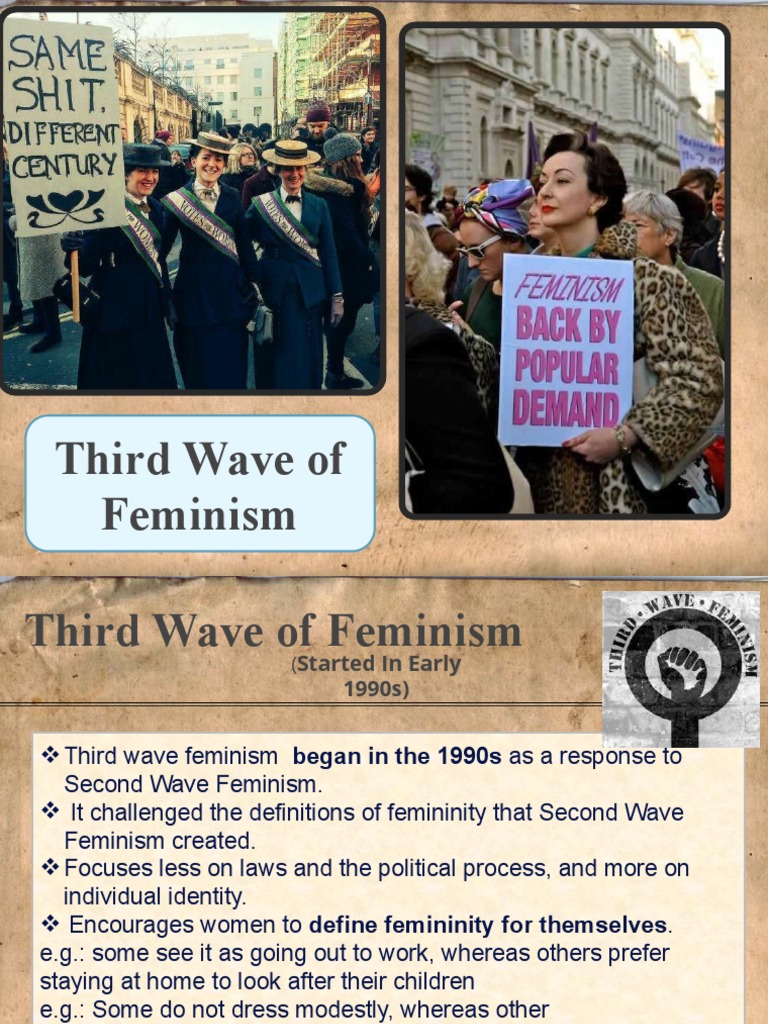
B. Third-Wave Feminism: Embracing Diversity and Challenging Essentialism: Third-wave feminism, which emerged in the 1990s, responded to the perceived limitations of second-wave feminism, particularly its tendency to focus on the experiences of white, middle-class women. Third-wave feminists embraced diversity, challenged essentialist notions of womanhood, and explored issues of race, class, sexuality, and gender identity. Riot Grrrl, a feminist punk rock movement, exemplified the spirit of third-wave feminism, empowering young women to express themselves and challenge patriarchal norms through music and activism.
C. Fourth-Wave Feminism: Digital Activism and the Fight Against Online Harassment: Fourth-wave feminism, which is still unfolding, is characterized by its use of digital technology and social media to raise awareness about gender inequality and mobilize collective action. Online platforms have provided a space for feminists to share their stories, organize campaigns, and challenge online harassment and discrimination. The #MeToo movement, which exposed widespread sexual harassment and assault, is a prime example of the power of fourth-wave feminism.
So, who “invented” feminism? The answer, dear reader, is that it was never “invented,” but rather, it bloomed. It sprouted from the unyielding ground of female resilience, nourished by the tears and triumphs of countless women who dared to dream of a world where their voices would be heard, their rights respected, and their potential fully realized. Feminism is not an invention, but an evolution, a continuous striving towards a more just and equitable world. Its unique appeal lies in its unwavering commitment to challenging power structures and empowering individuals to live authentically, free from the constraints of gender stereotypes and societal expectations. The fight continues, the dawn breaks anew each day, and the collective chorus of feminist voices grows ever stronger.







Leave a Comment