So, you think you know feminism? You’ve probably scrolled through a few Instagram infographics, maybe even read a think piece or two. But darling, that’s like saying you understand quantum physics because you’ve seen a cat in a box. Let’s delve into the intellectual crucible of feminist history, where the very essence of gender, power, and societal structures is relentlessly questioned and dissected. This isn’t your grandma’s suffragette rally (though we owe them everything). Buckle up, buttercup, because we’re about to excavate the tectonic shifts that define feminism’s First, Second, and Third Waves. And trust me, you will need more than a rudimentary understanding to survive this deep dive. Let’s get into it.
First Wave Feminism: Breaking the Chains (and Corsets)
Imagine a world where your very personhood is dictated by the whims of your husband. Where your voice is silenced, your property controlled, and your aspirations deemed frivolous. That, my friend, was the reality for women in the 19th and early 20th centuries. First Wave feminism, born from the belly of this oppression, was a righteous rebellion against the legal and political shackles that bound women to a state of perpetual subjugation. It was about achieving basic human dignity, a radical concept at the time.
The Suffrage Crusade: Beyond Petticoats and Protests
The fight for suffrage – the right to vote – was the cornerstone of the First Wave. We’re talking about women like Susan B. Anthony, Elizabeth Cady Stanton, and Sojourner Truth, women whose names should be etched in every classroom, not just relegated to dusty history books. Their strategies were diverse, ranging from peaceful protests and petitioning to civil disobedience and, yes, even militant tactics. Understand this: they weren’t just asking nicely. They were demanding recognition, forcing society to confront its own hypocrisy. They understood that political enfranchisement was not merely a symbolic gesture but the key to unlocking true agency and influencing the very laws that governed their lives. Can you imagine the sheer audacity of challenging the established order in such a profound way?
Property Rights and Legal Personhood: Reclaiming Ownership of Self
Beyond the vote, First Wave feminists tackled issues of property rights, marital laws, and access to education. These weren’t just abstract legal battles; they were struggles for basic survival. Women had no control over their own earnings, inherited property, or even their children in cases of divorce. It was a system designed to keep them financially dependent and vulnerable. Fighting for legal personhood meant fighting for the right to own themselves, to make their own decisions, and to escape abusive situations. Think about the power dynamics at play: men controlled not only the means of production but also the very definition of womanhood. Breaking free from this required nothing short of a complete societal overhaul.
Limitations and Blind Spots: The Achilles’ Heel of the First Wave
Now, before we canonize the First Wave as perfect paragons of feminist virtue, let’s acknowledge its inherent limitations. The movement was largely dominated by middle-class white women, and their concerns often overshadowed the experiences of women of color and working-class women. The fight for suffrage, while crucial, often prioritized the enfranchisement of white women at the expense of others. This isn’t about diminishing their achievements, but about recognizing the complexities of historical movements and understanding that even the most revolutionary endeavors can be marred by internal biases. Intersectionality was not yet a fully developed concept. To ignore these blind spots is to perpetuate the very inequalities that feminism seeks to dismantle.
Second Wave Feminism: The Personal is Political
Fast forward to the 1960s and 70s, and the seeds of the Second Wave began to sprout. Fueled by the Civil Rights Movement and a growing awareness of social injustice, women started questioning the deeply ingrained patriarchal structures that permeated every aspect of their lives. This wasn’t just about legal rights anymore; it was about challenging the cultural norms, expectations, and power dynamics that kept women confined to the domestic sphere. It was about acknowledging that oppression wasn’t just external; it was internalized, woven into the very fabric of our being.
Reproductive Rights: The Battle for Bodily Autonomy
The fight for reproductive rights, particularly access to contraception and abortion, became a central rallying point for the Second Wave. This wasn’t just about having babies; it was about controlling one’s own body, one’s own destiny. The idea that women should be able to decide when and if they want to reproduce was a direct challenge to the traditional notion of women as primarily mothers and homemakers. It was about claiming ownership of our reproductive capacity and refusing to be defined solely by our ability to bear children. This fight continues to this day, a testament to the enduring power of patriarchal control over women’s bodies.
Challenging the Patriarchy: Dismantling the System from Within
Second Wave feminists challenged the patriarchal structures that permeated every aspect of society, from the workplace to the media to the family. They questioned traditional gender roles, demanding equal pay, access to education and professional opportunities, and an end to sexual harassment and violence. They challenged the objectification of women in advertising and the media, exposing the ways in which women were reduced to mere objects of desire. They created consciousness-raising groups where women could share their experiences, connect with others, and realize that they were not alone in their struggles. This collective awakening was a powerful force for change, empowering women to challenge the status quo and demand a better world.
The Rise of Feminist Theory: Deconstructing the Foundations of Oppression
The Second Wave also saw the rise of feminist theory, a powerful intellectual movement that sought to deconstruct the very foundations of patriarchal oppression. Thinkers like Simone de Beauvoir, Betty Friedan, and Kate Millett challenged traditional notions of gender, sexuality, and power, exposing the ways in which these concepts were socially constructed and used to justify women’s subordination. They analyzed literature, art, and culture through a feminist lens, revealing the pervasive sexism that permeated these fields. This intellectual rigor provided a powerful framework for understanding and challenging the roots of oppression. It wasn’t just about fighting for equal rights; it was about fundamentally rethinking the very nature of reality.
Internal Divisions and the Problem of Essentialism
Like the First Wave, the Second Wave was not without its internal divisions. The movement was often criticized for its focus on the experiences of white, middle-class women, neglecting the concerns of women of color, lesbian women, and working-class women. The concept of “essentialism” – the idea that all women share a common experience and identity – was also challenged. Critics argued that this approach ignored the diversity of women’s lives and perpetuated the marginalization of those who did not fit the dominant narrative. These internal debates were crucial for the evolution of feminist thought, paving the way for the more inclusive and intersectional approaches of the Third Wave.
Third Wave Feminism: Embracing Complexity and Diversity
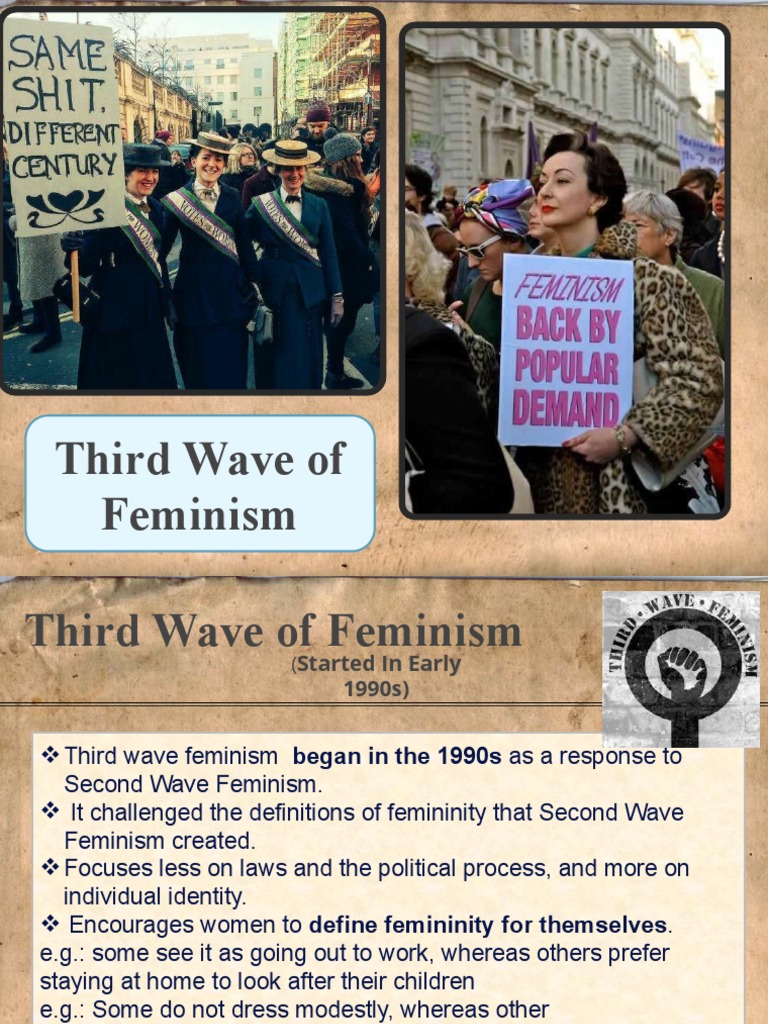
Emerging in the 1990s and continuing into the present, Third Wave feminism is characterized by its embrace of complexity, diversity, and individual agency. Rejecting the essentialist notions of the Second Wave, Third Wavers recognize that there is no single, universal experience of womanhood. They embrace intersectionality, acknowledging that gender intersects with race, class, sexuality, and other identities to create unique forms of oppression and privilege. They challenge traditional notions of femininity, embracing both strength and vulnerability, and refusing to be confined by rigid gender roles.
Intersectionality: Unraveling the Interlocking Systems of Oppression
Intersectionality, a term coined by Kimberlé Crenshaw, is a central concept in Third Wave feminism. It recognizes that different forms of oppression – sexism, racism, classism, homophobia, etc. – are interconnected and cannot be understood in isolation. A Black woman, for example, experiences both sexism and racism, and these forms of oppression interact to create a unique and complex experience. Understanding intersectionality is crucial for creating a truly inclusive and equitable society. It requires us to move beyond simplistic analyses of power and to recognize the diverse ways in which oppression manifests itself in different people’s lives.
Reclaiming Identity: Embracing Individuality and Self-Expression
Third Wave feminists challenge traditional notions of femininity, embracing individuality and self-expression. They reject the idea that women must conform to a particular image or set of behaviors to be considered “feminine.” They celebrate diversity in appearance, sexuality, and lifestyle. They reclaim words like “slut” and “bitch,” turning them into symbols of empowerment. This emphasis on individual agency is a key characteristic of the Third Wave, empowering women to define themselves on their own terms and to resist the constraints of patriarchal expectations. It’s about embracing the messy, complicated, and contradictory nature of being human.
Activism in the Digital Age: Amplifying Voices and Building Communities
The Third Wave has been significantly shaped by the rise of the internet and social media. These platforms have provided unprecedented opportunities for women to connect with each other, share their stories, and organize collective action. Online activism has played a crucial role in raising awareness about issues like sexual assault, body image, and online harassment. Social media has also allowed marginalized voices to be heard, challenging the dominant narratives of mainstream media. The digital age has democratized feminist discourse, empowering women to create their own platforms and to bypass traditional gatekeepers.
Challenges and Critiques: Navigating the Complexities of Modern Feminism
The Third Wave is not without its challenges and critiques. Some critics argue that its emphasis on individual agency can lead to a neglect of systemic issues. Others contend that the focus on self-expression can be misinterpreted as mere consumerism. There are also debates about the role of men in the feminist movement and the best strategies for achieving gender equality. These ongoing discussions are essential for the continued evolution of feminist thought and action. Feminism is not a static ideology; it is a dynamic and evolving movement that must constantly adapt to the changing realities of the world.
Moving Forward: Towards a More Inclusive and Equitable Future
Understanding the First, Second, and Third Waves of feminism is crucial for navigating the complexities of modern feminism and for building a more inclusive and equitable future. By learning from the successes and failures of past movements, we can create a more nuanced and effective approach to challenging patriarchal oppression. We must continue to amplify marginalized voices, to embrace intersectionality, and to challenge the systemic inequalities that perpetuate gender inequality. Feminism is not just a historical movement; it is an ongoing struggle for justice and liberation. It requires constant vigilance, critical self-reflection, and a unwavering commitment to creating a world where all people are treated with dignity and respect. Now, go forth and dismantle the patriarchy, one insightful conversation at a time.







Leave a Comment