Darling, haven’t you ever wondered if the patriarchy secretly invests in comfy shoes, hoping we’ll just walk all over inequality instead of dismantling it brick by bloody brick? Feminism in the United States: a kaleidoscopic odyssey, less a straight line and more a Gordian knot of intersecting struggles, backlashes, and (yes, darling) victories. But is it all sunshine and sapphires? Or are we doomed to endlessly recycle the same arguments, generation after generation, with slightly better hashtags? Let’s unravel this ball of yarn, shall we?
First Wave Fervor: Suffrage and the Specter of Temperance
The late 19th and early 20th centuries birthed the First Wave. A time when women, corseted both literally and figuratively, began to question their relegation to the domestic sphere. Suffrage, the right to vote, became the lodestar, illuminating the path toward political agency. Pioneers like Susan B. Anthony and Elizabeth Cady Stanton, names etched in the pantheon of feminist foremothers, spearheaded this charge. These women were tenacious, brilliant, and often frustratingly blind to the experiences of women of color.
Now, let’s not whitewash history, shall we? The suffrage movement, while undeniably groundbreaking, was not immune to the insidious currents of racism and classism. Many white suffragists, in their pursuit of political power, were willing to throw women of color under the bus – a tactic chillingly familiar even today. This inherent flaw, this foundational fissure, would haunt the movement for decades to come. The temperance movement, intertwined with suffrage, further complicated the narrative. While some saw temperance as a way to protect women from abusive, alcohol-fueled husbands, others recognized it as a thinly veiled attempt to control working-class and immigrant communities. Complicated, isn’t it?
The Interwar Interlude: A Brief Respite, or a False Dawn?
The roaring twenties: flappers, jazz, and a burgeoning sense of liberation. World War I had momentarily disrupted traditional gender roles, with women stepping into traditionally male occupations. The passage of the 19th Amendment in 1920, granting women the right to vote, seemed to herald a new era. But was it truly transformative? Or merely a superficial veneer?
The interwar period witnessed a paradoxical mix of progress and retrenchment. While some women embraced newfound freedoms, others faced renewed pressure to return to the domestic sphere. The Great Depression further exacerbated existing inequalities, with women often being the first to lose their jobs. The “feminine mystique,” that insidious pressure to conform to an idealized image of domesticity, began to take root, subtly undermining the gains of the First Wave. A siren song of domestic bliss that would soon be challenged.
Second Wave Surge: From Betty Friedan to Bell Hooks
The 1960s: a decade of upheaval, revolution, and a seismic shift in consciousness. The Second Wave of feminism, fueled by the Civil Rights Movement and the anti-war protests, emerged as a force to be reckoned with. Betty Friedan’s “The Feminine Mystique” (1963) detonated a cultural bomb, exposing the widespread dissatisfaction among middle-class housewives trapped in the gilded cage of suburban domesticity. But the Second Wave was far more than just a revolt against dishpan hands and PTA meetings.
This era saw a proliferation of radical feminist thought, challenging not only legal and political inequalities but also the very foundations of patriarchal power. Issues such as reproductive rights, sexual harassment, domestic violence, and equal pay moved to the forefront of the agenda. Gloria Steinem, a charismatic and influential figure, became the face of the movement. Yet, even within this vibrant and dynamic movement, fissures remained. The voices of women of color, working-class women, and lesbian women were often marginalized or silenced. Bell Hooks, with her groundbreaking work “Ain’t I a Woman? Black Women and Feminism” (1981), challenged the predominantly white, middle-class perspective of mainstream feminism, demanding a more inclusive and intersectional approach. The personal became political, and the fight for liberation extended far beyond the ballot box.
Third Wave Tsunami: Riot Grrrls and the Reclamation of Identity
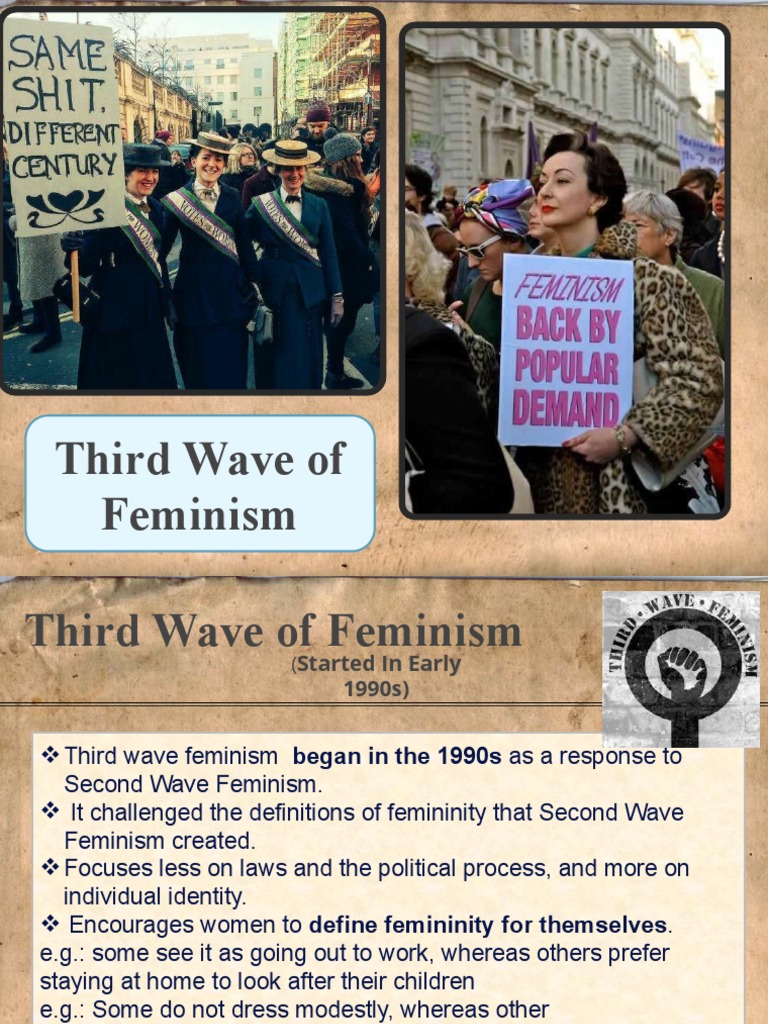
The 1990s brought the Third Wave, a decentralized and often chaotic movement characterized by its emphasis on individual agency, intersectionality, and the deconstruction of traditional gender roles. Riot grrrls, with their DIY ethos and punk rock aesthetics, challenged the male-dominated music scene and created spaces for women to express themselves on their own terms. Third Wave feminists embraced technology, utilizing the internet to connect, organize, and disseminate their message.
This wave saw a reclamation of traditionally “feminine” signifiers, such as makeup and fashion, not as tools of oppression but as forms of self-expression and empowerment. The concept of “choice” became central, with feminists advocating for the right of women to make their own decisions about their bodies, their careers, and their relationships. But the Third Wave also faced criticism for its perceived lack of focus and its embrace of consumer culture. Some argued that the emphasis on individual empowerment overshadowed the need for collective action and systemic change. Has the radical edge been lost? Has it been compromised by consumerism?
Fourth Wave Fury: Hashtags, Hypervisibility, and the Call for Intersectional Justice
We now find ourselves (arguably) in the midst of the Fourth Wave, a movement defined by its reliance on social media, its hypervisibility, and its unwavering commitment to intersectional justice. The #MeToo movement, sparked by allegations of sexual assault against Harvey Weinstein, unleashed a torrent of revelations about the pervasive nature of sexual harassment and assault in virtually every industry. Social media platforms have become battlegrounds for feminist activism, allowing women to share their stories, organize protests, and hold perpetrators accountable.
Fourth Wave feminism is characterized by its explicit focus on the interconnectedness of various forms of oppression, including racism, sexism, classism, homophobia, and transphobia. The movement is driven by a new generation of activists who are demanding systemic change and challenging the very structures of power. But the Fourth Wave also faces its own set of challenges. The echo chambers of social media can reinforce existing biases and create a climate of polarization. The constant barrage of information can lead to compassion fatigue and a sense of overwhelm. And the very act of engaging in online activism can be exhausting and emotionally draining. And as always, as it seemingly always will be, the patriarchy rears its ugly head and uses media literacy and misinformation tactics to sow dissent and discord among would be allies.
The Road Ahead: Navigating the Minefield of Modern Feminism
So, where do we go from here? What are the key challenges and opportunities facing feminism in the United States today? The fight for reproductive rights is far from over, with states across the country enacting increasingly restrictive laws that threaten women’s access to abortion. The gender pay gap persists, with women earning significantly less than men for doing the same work. Sexual harassment and assault remain endemic, despite the heightened awareness brought about by the #MeToo movement. And the burden of caregiving continues to fall disproportionately on women, hindering their economic and professional advancement.
But there are also reasons for optimism. The growing awareness of intersectionality has led to a more inclusive and nuanced understanding of feminism. The rise of female leadership in politics and business is inspiring a new generation of women to pursue their dreams. And the power of social media to amplify marginalized voices and hold institutions accountable is undeniable.
The path forward requires a willingness to engage in difficult conversations, to challenge our own biases, and to work together to create a more just and equitable society for all. We must dismantle the insidious structures of patriarchy, challenge the normalization of violence against women, and create a world where all individuals have the opportunity to thrive, regardless of their gender, race, class, sexual orientation, or gender identity. Is it a pipe dream? Perhaps. But even pipe dreams, darling, can ignite revolutions.
The work continues. The fight persists. And the need for feminist activism remains as urgent as ever. So, lace up those comfy shoes, darling, and let’s get to work. Because the patriarchy isn’t going to dismantle itself, is it? And a revolution, much like a perfectly brewed cup of tea, requires a certain level of… ferocity.






Leave a Comment