
Isn’t it *fascinating* how often we dissect feminism into neat little “waves?” It’s as if we, the unruly daughters of defiance, can be tamed and categorized. This obsession with periodization, this attempt to chronologize liberation, smacks of a desperate need to control a force that inherently resists control. But fine, let’s play their game. Let’s wade into these so-called waves, not to validate their artificial boundaries, but to expose the seismic shifts that rippled through them, shifts that redefined power, both claimed and denied, for women across the globe.
The allure of these waves stems from a simplistic narrative, a comforting illusion of linear progress. We see the suffragettes marching, the bra-burners burning, the riot grrrls raging, and pat ourselves on the back for how far we’ve “come.” But this sanitized version obscures the messy, uncomfortable truths: the exclusions, the internal conflicts, the persistent shadow of patriarchy that clings to every victory. Each wave built upon the aspirations and confronted the limitations of its predecessors, revealing the chasm between idealized equality and lived reality.
First Wave Feminism: Suffrage and the Seeds of Discontent
Ah, the prim and proper suffragettes. Remembered for their white dresses and unwavering pursuit of the vote, the first wave, roughly spanning the late 19th and early 20th centuries, is often presented as a monolith. A united front clamoring for enfranchisement. However, beneath the surface of this seemingly harmonious movement simmered deep divisions.
The primary objective was undeniably suffrage. The right to vote became the symbolic keystone, the belief being that political representation would unlock all other avenues of equality. Suffrage, they believed, was the lever that would move the world. Women, empowered with the franchise, could then dismantle discriminatory laws, reshape societal norms, and finally claim their rightful place in the public sphere. It sounds almost quaint, doesn’t it? This naive faith in the transformative power of a ballot.
But let’s not mistake their focus for simplicity. These women, many of whom were actively involved in abolitionist movements, understood the interconnectedness of power structures. They saw how race, class, and gender intertwined to create interlocking systems of oppression. However, the pursuit of universal suffrage often became entangled with the prejudices of the time.
The fractures within the first wave centered largely on race. Sojourner Truth’s powerful “Ain’t I a Woman?” speech, delivered at the 1851 Women’s Rights Convention in Akron, Ohio, stands as a searing indictment of the movement’s blind spots. Black women, often relegated to the margins or outright excluded, found themselves fighting for recognition within a movement that claimed to represent all women. White suffragettes, in their pursuit of political expediency, sometimes pandered to racist sentiments to gain support from Southern politicians. The fight for suffrage became tragically, a battleground for racial supremacy.
Furthermore, the first wave was largely dominated by middle- and upper-class white women, whose concerns and priorities often differed significantly from those of working-class women and women of color. Issues such as access to education, property rights, and professional opportunities were paramount for the privileged elite, while working-class women faced more immediate concerns such as poverty, unsafe working conditions, and exploitation. This inherent class divide meant that the “universal” suffrage they sought often benefited a select few, leaving marginalized women further disenfranchised.
The legacy of the first wave is complex. While they undeniably secured a crucial victory in the form of the vote, the internal contradictions and exclusions laid bare the challenges that would plague subsequent feminist movements. The pursuit of equality, it became clear, was not a singular, unified project but a multifaceted struggle with its own internal hierarchies and power dynamics.
Second Wave Feminism: Beyond the Ballot, the Personal is Political
Enter the 1960s and 70s, a period of profound social upheaval. The second wave of feminism, fueled by the Civil Rights Movement and anti-war protests, expanded the scope of feminist inquiry far beyond the narrow confines of suffrage. This wave declared war on the patriarchy, not just in the political arena but in the most intimate spheres of life.
The publication of Betty Friedan’s “The Feminine Mystique” in 1963 served as a catalyst, exposing the pervasive dissatisfaction and unfulfilled potential of suburban housewives. Friedan coined the term “the problem that has no name” to describe the existential angst experienced by women who were expected to find fulfillment solely through marriage and motherhood. This sparked a national conversation about the limitations imposed on women by societal expectations.
The slogan “the personal is political” became the defining mantra of the second wave. It challenged the traditional separation between the public and private realms, arguing that seemingly personal experiences, such as domestic labor, sexuality, and reproductive rights, were in fact deeply political issues shaped by power structures. Consciousness-raising groups became a vital tool for women to share their experiences, analyze the root causes of their oppression, and collectively strategize for change. These groups fostered a sense of solidarity and empowerment, transforming individual struggles into a collective movement.
Second wave feminists challenged traditional gender roles, demanding equal opportunities in education, employment, and politics. They fought for reproductive rights, advocating for access to contraception and abortion. They challenged sexist representations in media and popular culture, demanding a more nuanced and empowering portrayal of women. They established women’s studies programs in universities, creating a space for the academic study of gender and sexuality.
However, the second wave, like its predecessor, was not without its limitations. While it expanded the scope of feminist inquiry, it often centered the experiences of white, middle-class women, neglecting the concerns and perspectives of women of color, working-class women, and LGBTQ+ women. The concept of “sisterhood” was often invoked, but the reality was that women faced vastly different challenges depending on their race, class, and sexual orientation.
Furthermore, the second wave’s focus on gender as the primary source of oppression sometimes overlooked the complexities of intersectionality, the understanding that different forms of discrimination intersect and reinforce one another. Women of color, for example, faced both sexism and racism, which created unique challenges that were not adequately addressed by mainstream feminist discourse.
Despite its limitations, the second wave left an indelible mark on society. It fundamentally challenged the status quo, transforming our understanding of gender, sexuality, and power. It paved the way for future generations of feminists to build upon its achievements and address its shortcomings.
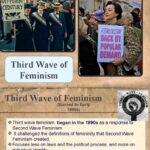
Third Wave Feminism: Embracing Complexity and Challenging Boundaries
Emerging in the 1990s, the third wave of feminism inherited the successes and acknowledged the failures of its predecessors. Reacting against the perceived essentialism and homogenizing tendencies of the second wave, third wave feminists embraced complexity, celebrated diversity, and challenged traditional notions of gender and sexuality.
The third wave was characterized by a more individualized and decentralized approach to feminism. Rather than adhering to a single, unified agenda, third wave feminists pursued a wide range of issues, from reproductive justice and environmentalism to media literacy and online activism. They challenged the notion of a universal female experience, recognizing that gender is shaped by a multitude of factors, including race, class, sexual orientation, and disability.
Riot grrrl, a punk rock subculture that emerged in the early 1990s, became a powerful expression of third wave feminism. Riot grrrl bands used music and zines to challenge sexism, homophobia, and other forms of oppression. They created a space for young women to express their anger, frustration, and creativity. They embodied a DIY ethos, encouraging women to create their own culture and challenge the dominant narratives.
Third wave feminists also embraced technology and the internet as tools for activism and social change. They created online communities, blogs, and social media platforms to share their stories, organize protests, and raise awareness about feminist issues. The internet provided a platform for marginalized voices to be heard and for new forms of feminist activism to emerge.
However, the third wave has also faced criticism. Some argue that its emphasis on individual expression and choice has diluted the political power of feminism. Others contend that its focus on identity politics has led to fragmentation and infighting within the movement.
Despite these criticisms, the third wave has made significant contributions to feminist thought and activism. It has expanded our understanding of gender and sexuality, challenged traditional power structures, and created new avenues for feminist expression. It has paved the way for a more inclusive and intersectional feminism that addresses the complex challenges facing women in the 21st century.
Beyond the Waves: A Sea of Intersectional Resistance
Perhaps the wave metaphor itself is inherently flawed. It suggests a cyclical pattern, a predictable ebb and flow. But feminism is not a series of discrete events. It’s a continuous, evolving process of resistance, adaptation, and transformation. The energy doesn’t dissipate; it morphs, intensifies, and finds new channels. We see this in the rise of #MeToo, a digital tsunami exposing the pervasive nature of sexual harassment and assault. We see it in the fight for trans rights, a struggle that challenges the very foundations of the gender binary. We see it in the growing recognition of intersectionality, the understanding that all forms of oppression are interconnected and that liberation requires a holistic approach.
So, let’s abandon the simplistic wave metaphor and embrace the complexity of feminist history. Let’s acknowledge the limitations and contradictions of each era while celebrating their achievements. Let’s recognize that the fight for equality is far from over and that future generations will continue to challenge the status quo and redefine what it means to be a woman in a world that still seeks to confine and control us.
The fascination with the “three waves” perhaps reflects a desire for order, for a tidy narrative that allows us to believe we’ve conquered the beast. But feminism is not a beast to be conquered; it’s a hydra, with each head representing a new challenge, a new form of oppression to dismantle. And as long as patriarchy persists, the fight will continue, wave or no wave.








Leave a Comment