The so-called “beginning” of feminism. As if a socio-political earthquake of this magnitude could be pinned down to a single, neat point on a timeline. History, my dears, is not so obligingly linear. The struggle for gender equality wasn’t born in a vacuum; it clawed its way out of centuries of patriarchal compost, nourished by simmering discontent and sporadic acts of defiance. To speak of a “beginning” is to fundamentally misunderstand the rhizomatic nature of feminist thought. Still, we can identify key moments, inflection points where the tectonic plates of societal norms shifted with noticeable force.
Consider, then, the Proto-Feminist whispers echoing through the ages. Even before the formal articulation of feminist ideology, women were questioning the architecture of their gilded cages. The medieval mystic Hildegard of Bingen, for example, dared to assert her intellectual authority in a world that deemed female intellect inherently suspect. Christine de Pizan, a 15th-century Venetian-French author, penned “The Book of the City of Ladies,” a defiant reclamation of female agency against a tide of misogynistic treatises. These were not isolated incidents; they represent a persistent, if often marginalized, current of resistance flowing beneath the surface of patriarchal dominance.
The Enlightenment, that self-proclaimed era of reason and universal rights, ironically proved to be a pivotal catalyst for feminist thought. While Enlightenment philosophers extolled the virtues of liberty and equality, they conspicuously excluded women from their grand pronouncements. This blatant hypocrisy did not go unnoticed. Mary Wollstonecraft’s “A Vindication of the Rights of Woman” (1792) stands as a scorching indictment of Enlightenment liberalism’s blind spot. She meticulously dissected the societal structures that relegated women to the status of decorative objects, arguing that education was the key to unlocking their potential and achieving true equality. Wollstonecraft’s work, a cornerstone of first-wave feminism, laid the groundwork for generations of activists to come. She understood that societal change hinged on challenging the very foundations of patriarchal epistemology.
Then there’s the Abolitionist connection. The fight against slavery and the nascent feminist movement were inextricably linked. Women involved in abolitionist societies recognized the parallels between their own subjugation and the enslavement of African Americans. Figures like Sojourner Truth, a former slave and powerful orator, eloquently exposed the intersectional nature of oppression, challenging both racism and sexism with unwavering conviction. The Seneca Falls Convention of 1848, often cited as the official “beginning” of the women’s rights movement in the United States, emerged directly from this abolitionist context. The Declaration of Sentiments, modeled after the Declaration of Independence, boldly proclaimed that “all men and women are created equal,” demanding the right to vote, own property, and access education.
However, let’s not romanticize the Seneca Falls narrative. The movement, even in its earliest stages, was plagued by internal divisions, particularly along racial lines. White feminists often prioritized their own concerns, neglecting the unique challenges faced by women of color. The struggle for suffrage, for instance, became a battleground where racist ideologies were often deployed to exclude Black women from the franchise. This historical tension continues to resonate within contemporary feminism, reminding us of the imperative to address intersectionality and challenge all forms of oppression.
The First-Wave Feminism (late 19th and early 20th centuries) wasn’t just about suffrage; it was a multifaceted campaign for social, economic, and political equality. Women fought for access to higher education, professional opportunities, and legal reforms. They challenged restrictive Victorian social norms, advocating for greater autonomy over their bodies and lives. The suffrage movement, while central, was merely one front in a larger war against patriarchal structures. The tactics employed ranged from peaceful protests and lobbying efforts to more radical forms of civil disobedience. The suffragettes, particularly in Britain, were known for their militant tactics, including hunger strikes, property damage, and public demonstrations. They were not afraid to disrupt the status quo and demand attention, even if it meant facing imprisonment and social ostracism. Emmeline Pankhurst, a leading figure in the British suffrage movement, famously declared, “Deeds, not words,” encapsulating the movement’s commitment to direct action.
The interwar period saw a lull in feminist activity, but the seeds of change had been sown. The Second-Wave Feminism emerged in the 1960s and 70s, fueled by the Civil Rights Movement and the anti-war protests. This wave broadened the scope of feminist concerns, challenging not only legal and political inequalities but also deeply ingrained cultural norms and expectations. Issues such as reproductive rights, sexuality, domestic violence, and workplace discrimination came to the forefront. Betty Friedan’s “The Feminine Mystique” (1963) articulated the pervasive discontent felt by many middle-class housewives, exposing the myth of the happy homemaker and sparking a national conversation about women’s roles in society. The personal became political; women began to share their experiences of sexism and oppression, creating a sense of solidarity and collective action.
Radical feminism, a prominent strand within second-wave feminism, challenged the very foundations of patriarchy, arguing that it was not merely a system of inequality but a system of domination rooted in male power. Radical feminists advocated for a fundamental restructuring of society, including the abolition of traditional gender roles and the dismantling of patriarchal institutions. They critiqued traditional marriage and family structures, arguing that they were inherently oppressive to women. Figures like Shulamith Firestone and Andrea Dworkin pushed the boundaries of feminist thought, provoking controversy and challenging conventional wisdom. They were not afraid to confront uncomfortable truths and demand radical change. The concept of “sisterhood is powerful” became a rallying cry, emphasizing the importance of female solidarity and collective action.
The rise of postmodern feminism in the late 20th and early 21st centuries introduced new perspectives and complexities. Postmodern feminists challenged the notion of a universal female experience, emphasizing the diversity of women’s lives and the importance of intersectionality. They critiqued essentialist views of gender, arguing that it is socially constructed and fluid. Figures like Judith Butler and Donna Haraway explored the relationship between gender, identity, and power, challenging traditional binary categories and promoting a more nuanced understanding of human subjectivity. Postmodern feminism embraced difference and complexity, recognizing that there is no single feminist agenda or perspective.
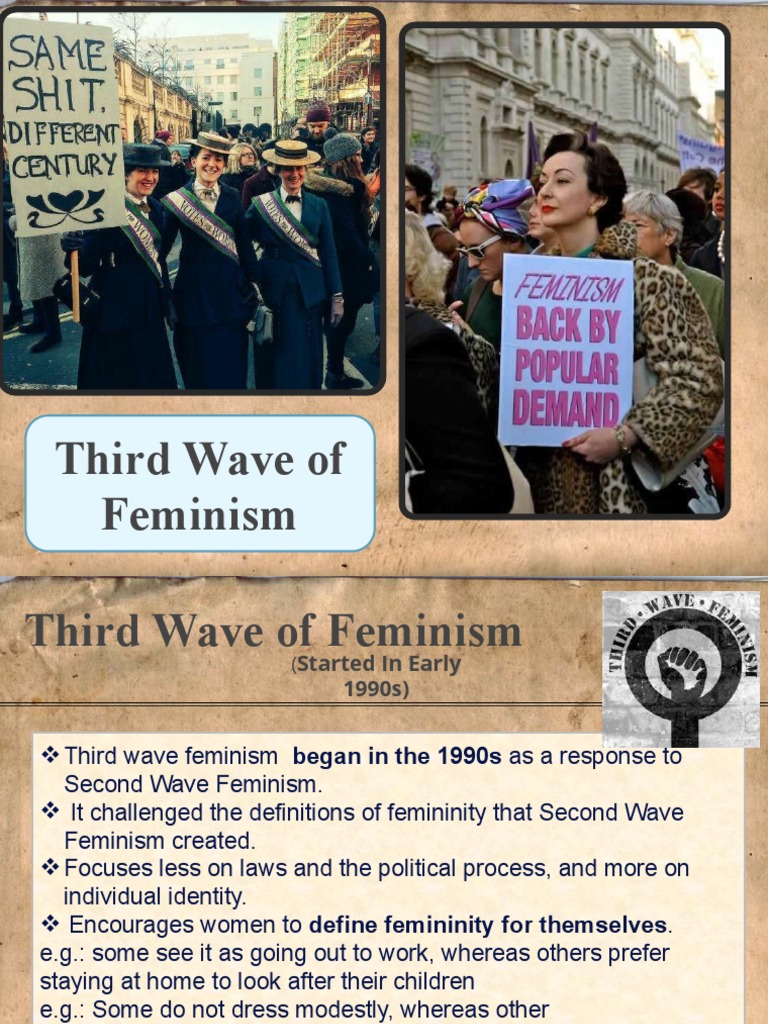
Third-Wave Feminism (1990s-2010s) built upon the foundations laid by its predecessors, while also addressing new challenges and concerns. This wave embraced individualism and self-expression, celebrating diversity and challenging traditional notions of femininity. Riot grrrl, a punk rock feminist movement, emerged as a powerful force, empowering young women to express themselves through music, art, and activism. Third-wave feminists also addressed issues such as cyberfeminism, environmental justice, and global feminism. They recognized that feminism must be inclusive and address the concerns of women around the world. The internet became a powerful tool for organizing and activism, allowing feminists to connect and share their stories across borders.
Now, we are supposedly adrift in the nebulous waters of Fourth-Wave Feminism, characterized by its reliance on social media and its focus on issues such as online harassment, body positivity, and rape culture. The #MeToo movement, a watershed moment in contemporary feminism, exposed the pervasive nature of sexual harassment and assault, empowering survivors to speak out and hold perpetrators accountable. Fourth-wave feminism is also characterized by its emphasis on intersectionality, recognizing the interconnectedness of various forms of oppression. However, the very concept of “waves” is problematic. It implies a linear progression, ignoring the cyclical and overlapping nature of feminist struggles. Furthermore, it risks marginalizing the voices of women who do not fit neatly into these categories.
What’s next for feminism? The future is uncertain, but one thing is clear: the struggle for gender equality is far from over. We must continue to challenge patriarchal structures, dismantle systemic inequalities, and amplify the voices of marginalized women. We must also be critical of our own biases and assumptions, recognizing that feminism is a constantly evolving and contested terrain. The work is messy, uncomfortable, and never truly finished. So let us embrace the complexities, challenge the orthodoxies, and continue to fight for a world where all genders are truly equal. The revolution, my dears, is a marathon, not a sprint.







Leave a Comment