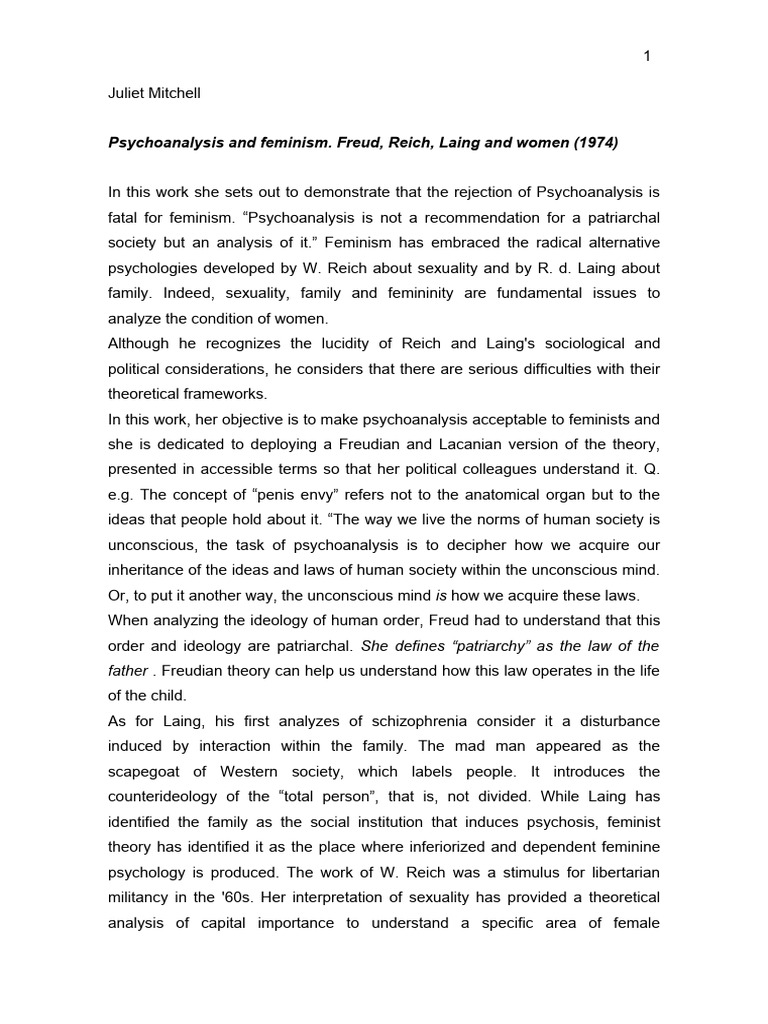
Dare we even utter the name Freud in these enlightened times? Isn’t he the patriarchal bogeyman, the architect of our oppression, the very embodiment of all that’s wrong with the Western understanding of gender? Perhaps. But perhaps, also, he’s something far more intriguing: a flawed, even deeply problematic, pioneer whose very missteps illuminate the tortuous path toward feminist understanding. This is not a defense of Freud, mind you, but an interrogation, a wrestling match with a legacy that continues to haunt and provoke. This article seeks to dissect the complex, often contradictory, relationship between psychoanalysis and feminism. Prepare to question everything you thought you knew.
I. The Freudian Minefield: A Landscape of Peril and Possibility
Let’s not mince words: Freud’s pronouncements on women, particularly his concept of “penis envy” and his assertion of female passivity, are, frankly, infuriating. They smack of biological determinism, reinforcing the very patriarchal structures we are committed to dismantling. His vision of female sexuality seems constricted, defined in relation to a male standard. Is this where the conversation ends? Should we simply discard his entire corpus as hopelessly contaminated? I propose a more nuanced approach. We must sift through the wreckage, salvage what remains valuable, and expose the ideological underpinnings of his errors. This requires us to confront the fundamental tenets of Freudian thought, deconstructing them with a critical lens.
A. The Oedipal Complex: A Crucible of Gendered Identity: Freud posited that the Oedipal complex, the child’s unconscious desire for the opposite-sex parent and rivalry with the same-sex parent, is a cornerstone of psychosexual development. For boys, this allegedly culminates in castration anxiety and identification with the father. For girls, however, the narrative becomes murky. Freud suggested that girls, upon discovering their “lack” of a penis, develop penis envy, blaming their mothers and turning to their fathers in a bid for symbolic castration. This, he claimed, leads to the development of a weaker superego and a propensity for passivity. This is patently absurd! The very notion of penis envy reeks of phallocentrism, a belief that the penis is the ultimate signifier of power and worth. But we must ask: what is the underlying truth, distorted as it may be, that Freud was attempting to articulate? Could it be that the girl’s experience of societal devaluation, her awareness of her subordinate status in a patriarchal world, manifests as a sense of lack, which Freud then misinterprets as a literal desire for a penis? Furthermore, the notion of a ‘weaker’ superego in women has historically been used to justify their exclusion from positions of power. Such reductionist thinking does nothing but solidify societal bias.
B. Hysteria: The Unspoken Language of Female Suffering: Freud’s early work on hysteria, particularly his collaboration with Josef Breuer on the case of Anna O., offers a glimpse into the power of unconscious repression and the potential for psychoanalysis to unlock hidden traumas. Hysteria, a now-archaic diagnosis, was often applied to women exhibiting a range of symptoms, from physical ailments to emotional outbursts. These were seen as manifestations of unconscious conflicts, often stemming from unresolved sexual trauma. While Freud initially attributed hysteria to actual sexual abuse, he later shifted toward a theory of infantile sexuality and the repression of Oedipal desires. This shift has been heavily criticized for downplaying the prevalence of sexual abuse and for pathologizing female sexuality. Yet, the very fact that Freud focused on the subjective experience of women, that he attempted to understand the meaning behind their symptoms, represents a radical departure from the prevailing medical discourse of his time. He provided women a platform, however flawed, to articulate their suffering. Furthermore, hysteria has become an important concept in feminist theory, allowing us to understand the ways in which patriarchal power structures manifest in the female body. This perspective posits that hysteria is not an individual pathology, but a symptom of a wider societal malady.
C. Female Sexuality: A Contested Terrain: Freud’s views on female sexuality are perhaps the most contentious aspect of his work. He posited that women experience a shift in erogenous zones, from the clitoris to the vagina, during psychosexual development. He considered clitoral sexuality to be “masculine” and vaginal sexuality to be “mature” and “feminine”. This has been widely refuted by feminist scholars, who emphasize the importance of clitoral pleasure and challenge the notion that the vagina is the sole site of female sexual satisfaction. Freud’s emphasis on vaginal orgasm can be seen as an attempt to align female sexuality with male reproductive needs, thereby reinforcing patriarchal norms. Nevertheless, Freud’s exploration of female sexuality, however misguided, paved the way for later feminists to reclaim and redefine female pleasure on their own terms. His very pronouncements, no matter how misguided, acted as a catalyst for the women who would ultimately reject his framework. There is much to be gained from viewing these ideas through a critical lens.
II. Reclaiming Psychoanalysis: Feminist Interventions and Reinterpretations
Despite the inherent problems with Freud’s theories, feminist thinkers have found value in certain aspects of psychoanalysis, particularly its emphasis on the unconscious, the importance of early childhood experiences, and the power of language in shaping identity. They have sought to rework and reinterpret Freudian concepts, stripping them of their patriarchal baggage and applying them to a feminist agenda. This is not an act of blind faith, but a calculated maneuver, an attempt to harness the tools of the oppressor to dismantle the very structures of oppression.
A. Object Relations Theory: The Relational Turn: Object relations theory, developed by psychoanalysts such as Melanie Klein and Donald Winnicott, shifts the focus from innate drives to interpersonal relationships. This perspective emphasizes the importance of early relationships, particularly the mother-child dyad, in shaping the individual’s sense of self and their capacity for connection. Feminist object relations theorists, such as Nancy Chodorow, have argued that the traditional gender roles, with women primarily responsible for childcare, contribute to the development of distinct male and female personalities. Chodorow suggests that boys, in order to establish their masculine identity, must separate themselves from their mothers, leading to a greater emphasis on independence and autonomy. Girls, on the other hand, experience a more continuous connection with their mothers, fostering a greater capacity for empathy and relatedness. This has become a fertile ground for exploring alternative means of child rearing that do not reinforce rigid gender roles.
B. Lacanian Psychoanalysis: Language, the Unconscious, and the Symbolic Order: Jacques Lacan’s reinterpretation of Freud, emphasizing the role of language and the symbolic order in shaping the unconscious, has also been influential in feminist theory. Lacan argues that the unconscious is structured like a language, that our desires are mediated by symbols and social structures. The “Name-of-the-Father,” a key Lacanian concept, represents the symbolic law that governs the social order and regulates desire. Feminist Lacanians, such as Julia Kristeva and Luce Irigaray, have explored the ways in which language and the symbolic order perpetuate patriarchal power relations. They have sought to disrupt the dominant discourse, to create spaces for female voices and experiences that have been historically marginalized. Theirs is a radical challenge to the very foundations of language and meaning.
C. Beyond the Phallus: Reimagining Female Desire and Subjectivity: One of the central challenges for feminist psychoanalysis has been to move beyond the phallocentric framework of Freud and Lacan, to develop alternative models of female desire and subjectivity. This involves challenging the notion that the phallus is the ultimate signifier of power and pleasure, and exploring the richness and complexity of female sexual experience. Hélène Cixous, for example, advocates for “écriture féminine,” a writing that is embodied, fluid, and expressive of female experience. Luce Irigaray calls for a rethinking of sexual difference, arguing that women have been historically defined in relation to men, as the “other.” She advocates for a recognition of female specificity, for a celebration of female pleasure and desire on its own terms. A complete revolution of thought is needed.
III. The Ongoing Dialogue: Challenges and Future Directions
The relationship between psychoanalysis and feminism remains a complex and dynamic one, fraught with both challenges and possibilities. While psychoanalysis has provided valuable insights into the unconscious and the impact of early experiences, it has also been criticized for its inherent biases and its tendency to pathologize female experience. The feminist engagement with psychoanalysis is an ongoing process of critical interrogation, reinterpretation, and transformation. It’s a high-stakes negotiation with our own history, a struggle to forge a future where psychoanalytic insights can contribute to a more just and equitable world.
A. Addressing the Criticisms: Bias, Essentialism, and the Medicalization of Distress: Psychoanalysis has been accused of perpetuating harmful stereotypes, of essentializing gender differences, and of medicalizing distress, particularly among women. Critics argue that psychoanalytic theory often reinforces patriarchal norms by portraying women as inherently passive, emotional, and dependent. Furthermore, the focus on individual psychopathology can obscure the social and political factors that contribute to mental health problems. In response to these criticisms, feminist psychoanalysts have sought to develop more nuanced and contextualized approaches, paying greater attention to the social and cultural forces that shape individual experience. They are working to deconstruct the insidious biases ingrained in the system.
B. Embracing Intersectionality: Race, Class, and the Multiplicity of Experience: A crucial challenge for feminist psychoanalysis is to embrace intersectionality, to recognize the ways in which gender intersects with race, class, sexuality, and other social categories. Psychoanalytic theory has often been criticized for focusing primarily on the experiences of white, middle-class women, neglecting the unique challenges faced by women from marginalized communities. A truly feminist psychoanalysis must be attentive to the diversity of human experience, recognizing that there is no single, universal female psyche. It must actively seek to amplify the voices of those who have been historically silenced.
C. Beyond Therapy: Psychoanalysis as a Tool for Social Change: While psychoanalysis is often associated with individual therapy, it can also be a powerful tool for social change. Psychoanalytic concepts can be used to analyze cultural phenomena, to deconstruct power relations, and to promote critical consciousness. By understanding the unconscious motivations and desires that shape our beliefs and behaviors, we can begin to challenge the dominant narratives and create more just and equitable social structures. Psychoanalysis, at its best, can be a force for liberation, helping us to break free from the constraints of the past and imagine a better future. The battlefield has shifted, and the fight for equality has begun.










Leave a Comment