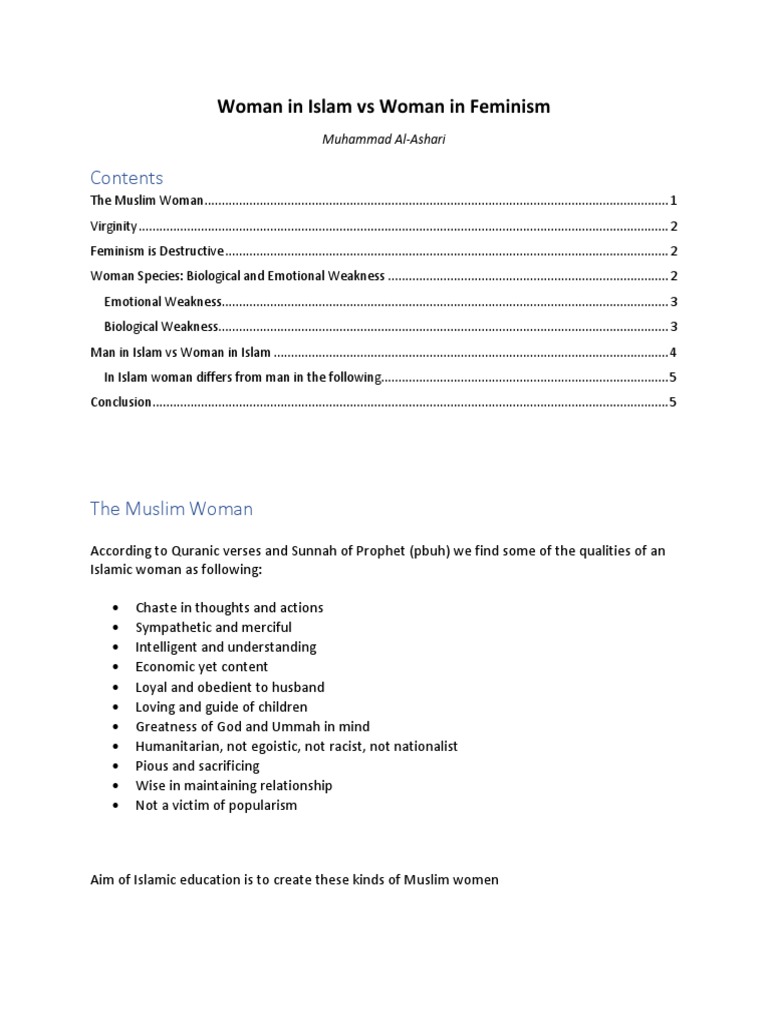
Is Islam, a faith practiced by over a billion people, truly a sanctuary for women, or a gilded cage masquerading as empowerment? The question hangs heavy, a tapestry woven with threads of faith, tradition, and the ever-evolving demands of modern feminism. Let’s untangle this knot, shall we?
I. Unveiling the Nuances: A Multifaceted Examination
To declare Islam inherently incompatible with feminism is intellectual laziness. Imagine declaring all of Western culture misogynistic because of historical witch trials. Ludicrous, isn’t it? The Islamic world is a mosaic, a kaleidoscope of cultures and interpretations. To treat it as a monolithic entity is a grave disservice.
A. The Sacred Texts: Seeds of Empowerment, or Instruments of Oppression?
The Qur’an, the very heart of Islam, contains verses that, when viewed through a feminist lens, offer surprisingly progressive pronouncements. For instance, the Qur’an grants women the right to own property, enter into contracts, and pursue education – rights that were denied to many women in the West for centuries. These are not mere “crumbs” of equality, but rather cornerstones upon which a just society could be built.
However, the same texts are also subject to interpretations that reinforce patriarchal structures. Verses concerning wifely obedience, inheritance laws that favor men, and the permissibility of polygyny are often cited as evidence of Islam’s inherent misogyny. The devil, as always, is in the hermeneutics. The problem lies not necessarily within the text itself, but with those who wield it as a weapon to maintain the status quo.
B. Hadith: A Labyrinth of Authenticity
Beyond the Qur’an, the Hadith – collections of sayings and actions attributed to the Prophet Muhammad – play a crucial role in shaping Islamic jurisprudence. But here’s the rub: not all Hadith are created equal. Scholars debate their authenticity and reliability, and many have been shown to reflect the cultural biases of the time. To blindly accept all Hadith as divinely inspired truth is to court disaster, particularly when they contradict the core principles of justice and equality espoused in the Qur’an.
C. Cultural Confluences: Where Faith Meets Patriarchy
Islam did not emerge in a vacuum. It spread through societies steeped in pre-existing patriarchal traditions. In many regions, these traditions became intertwined with Islamic practices, often obscuring the true essence of the faith. Female genital mutilation, honor killings, and forced marriages are not Islamic mandates, but rather barbaric customs that have been falsely attributed to the religion. To conflate these cultural abominations with the teachings of Islam is a dangerous act of intellectual dishonesty.
II. Feminist Voices Within: Reclaiming the Narrative
To paint all Muslim women as passive victims is a gross misrepresentation. Throughout history, countless women have challenged patriarchal norms within their communities, drawing inspiration from their faith to advocate for justice and equality. These are not mere “exceptions to the rule,” but rather trailblazers who are actively reshaping the narrative of Islam and feminism.
A. The Reformers: Questioning the Status Quo
Islamic feminists are not trying to “Westernize” Islam. They are not seeking to abandon their faith or embrace some foreign ideology. Instead, they are engaged in a critical re-evaluation of Islamic texts and traditions, challenging interpretations that perpetuate inequality and advocating for a more just and equitable society. They dare to ask uncomfortable questions, to deconstruct deeply ingrained biases, and to reclaim the agency that has been unjustly denied to them.
B. The Activists: Fighting for Change on the Ground
From advocating for women’s rights in family law to combating domestic violence and promoting access to education, Muslim women are at the forefront of social change in many countries. These are not abstract theoretical debates, but rather tangible efforts to improve the lives of women on the ground. Their struggles are often met with resistance, both from within their own communities and from external forces that seek to exploit and manipulate them. Yet, they persevere, driven by their unwavering belief in the power of faith and justice.
C. The Scholars: Reinterpreting the Scriptures
A growing number of female Islamic scholars are challenging traditional interpretations of the Qur’an and Hadith, offering fresh perspectives that emphasize the principles of equality, justice, and compassion. They are dismantling the edifice of patriarchal hermeneutics, brick by painstaking brick, revealing the inherent beauty and progressive potential of the Islamic tradition. They are not merely “re-interpreting” the scriptures, but rather reclaiming them for a new generation of Muslim women.
III. The Intersectionality Imperative: Recognizing the Complexities
Feminism is not a monolithic entity, just as Islam is not. To truly understand the relationship between Islam and feminism, we must embrace the principle of intersectionality – recognizing that women’s experiences are shaped by a complex interplay of factors, including race, class, ethnicity, and sexual orientation. A one-size-fits-all approach to feminism is not only ineffective, but also deeply oppressive.
A. Beyond the White Gaze: Amplifying Marginalized Voices
Too often, the discourse on Islam and feminism is dominated by Western perspectives, overlooking the experiences and perspectives of Muslim women in the Global South. It is crucial to amplify the voices of those who are most directly affected by the issues at hand, to listen to their stories, and to learn from their struggles. We must resist the temptation to impose our own preconceived notions on them, and instead allow them to define their own paths to empowerment.
B. Challenging Internalized Oppression: Deconstructing the Patriarchy Within
Patriarchy is not just an external force; it can also be internalized by women themselves. To truly achieve liberation, women must challenge their own internalized biases and expectations, and actively resist the subtle ways in which patriarchy operates within their own minds. This is a lifelong process of self-reflection and self-discovery, a journey towards true autonomy and self-determination.
C. Building Bridges of Solidarity: Working Across Differences
Despite their differences, women from all backgrounds share a common struggle for equality and justice. To truly succeed, we must build bridges of solidarity across religious, cultural, and national boundaries. We must recognize that our fates are intertwined, and that we are all stronger when we work together. We must challenge the forces that seek to divide us, and instead embrace the power of collective action.
IV. The Path Forward: A Call to Action
So, is Islam compatible with feminism? The answer, as always, is a resounding “it depends.” It depends on how we interpret the texts, how we challenge the traditions, and how we empower women to reclaim their own narratives. It depends on our willingness to listen to the voices of those who are most directly affected, and to work together to build a more just and equitable world.
A. Education and Awareness: Empowering the Next Generation
The key to progress lies in education and awareness. We must educate ourselves about the complexities of Islam and feminism, challenge our own biases, and promote critical thinking skills. We must empower the next generation of women to question the status quo, to challenge injustice, and to become agents of change.
B. Supporting Grassroots Movements: Amplifying the Voices of the Marginalized
We must support grassroots movements that are working to advance women’s rights in Muslim communities around the world. We must provide them with the resources they need to succeed, and amplify their voices on the global stage. We must stand in solidarity with them as they face resistance and persecution.
C. Reclaiming the Narrative: Telling Our Own Stories
Ultimately, the future of Islam and feminism depends on our ability to reclaim the narrative, to tell our own stories, and to define our own paths to empowerment. We must resist the temptation to be defined by others, and instead embrace our own agency and autonomy. We must create spaces where women can share their experiences, challenge injustice, and build a more just and equitable world. The struggle continues. The revolution simmers.










Leave a Comment