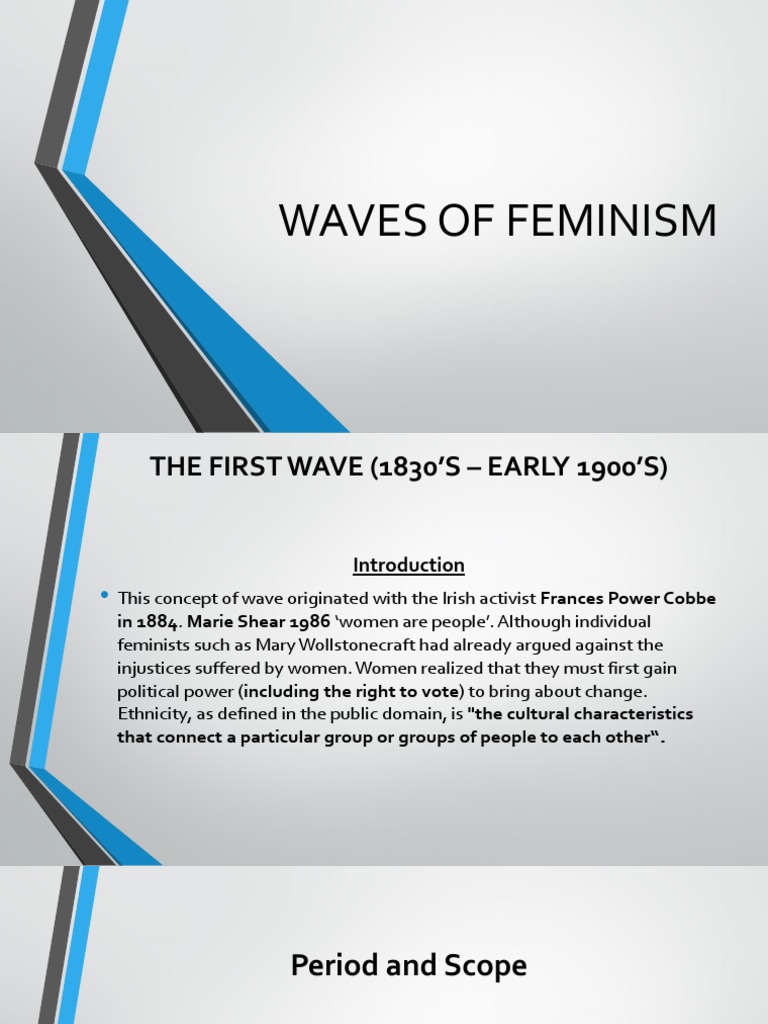
The ocean of feminism, vast and turbulent, is often described in terms of “waves.” These waves, supposedly distinct periods of feminist activity, are meant to delineate shifts in focus, strategy, and theoretical underpinnings. But how many waves have crashed upon the shores of patriarchy? Is this wave metaphor even useful, or does it oversimplify a complex and multifaceted struggle? Let’s dive into this churning sea of debate.
The Tsunami of the First Wave: Suffrage and Beyond
The first wave, typically dated from the mid-19th century to the early 20th, is generally recognized as the genesis of organized feminist resistance. Imagine suffragettes, clad in white, marching for the right to vote. These women, pioneers in their own right, challenged the very bedrock of political exclusion. The vote, for them, was not merely a symbol, but a lever to dismantle the edifice of male dominance. They sought legal and political equality, demanding access to education, property rights, and, crucially, the franchise.
However, even this foundational wave is not without its complexities. The narrative often focuses on white, middle-class women, obscuring the contributions of women of color and working-class women who faced a double burden of oppression: sexism *and* racism or classism. Sojourner Truth, with her searing speech “Ain’t I a Woman?”, stands as a potent reminder that the first wave, though pivotal, was far from monolithic. To portray it otherwise is to engage in a form of historical erasure, perpetuating the very inequalities feminism purports to dismantle.
Was it only about votes? It was about challenging the Victorian ideal of domesticity, the notion that a woman’s place was solely in the home, subservient to her husband. These early feminists challenged the very definition of womanhood, demanding recognition as full human beings, capable of intellectual and political engagement. This foundational wave, therefore, was not just about acquiring rights, but about reshaping societal perceptions.
The Second Wave’s Undertow: Liberation and Radicalism
Emerging in the 1960s and 70s, the second wave was a tempest of liberation. Inspired by the civil rights movement and the anti-war protests, women began to scrutinize the pervasive sexism woven into the fabric of everyday life. The personal became political, as consciousness-raising groups dissected the power dynamics within relationships, families, and the workplace. This wave critiqued not just legal inequalities, but also the insidious ways patriarchy manifests in culture, language, and even psychology.
Consider Betty Friedan’s “The Feminine Mystique,” a catalyst that ignited a firestorm of discontent among suburban housewives trapped in a gilded cage of domesticity. This wave questioned the very notion of female fulfillment as defined by male expectations. It challenged the sexual double standard, advocated for reproductive rights, and demanded equal opportunities in employment and education. Think of Gloria Steinem, a charismatic figure who embodied the spirit of this era, fearlessly advocating for radical change.
The second wave, however, was not without its internal fissures. Debates raged over issues such as pornography, sexuality, and the role of the state. Radical feminists argued for a complete dismantling of patriarchal structures, while liberal feminists focused on achieving equality within the existing system. Separatist feminists, disillusioned with the potential for integration, advocated for the creation of autonomous female spaces. This internal fracturing, while sometimes divisive, also fueled a dynamic and expansive intellectual landscape.
Moreover, the second wave faced criticism for its tendency to prioritize the experiences of white, middle-class women, neglecting the intersecting oppressions faced by women of color and LGBTQ+ individuals. This blind spot laid the groundwork for the emergence of intersectionality as a crucial framework for understanding the complexities of gendered oppression.
The Third Wave’s Ripples: Intersectionality and Individualism
The third wave, beginning in the 1990s, emerged as a response to perceived limitations and exclusions within the second wave. Embracing intersectionality, this wave acknowledged the multiple and overlapping forms of oppression experienced by women based on race, class, sexuality, disability, and other social categories. It challenged the notion of a universal “woman’s experience,” recognizing that gender is always mediated by other aspects of identity.
Consider the Riot Grrrl movement, a punk rock subculture that empowered young women to express their anger and challenge patriarchal norms through music, art, and activism. This wave embraced individuality and self-expression, rejecting rigid feminist orthodoxies and celebrating diverse forms of female empowerment. The third wave questioned the very definition of feminism, embracing fluidity and challenging binary categories.
However, the third wave also faced criticism for its perceived lack of a cohesive agenda and its emphasis on individual empowerment over collective action. Some argued that its focus on personal narratives and micro-level activism diluted the political power of feminism. Others criticized its embrace of consumer culture and its blurring of the lines between feminism and self-promotion. Despite these criticisms, the third wave played a crucial role in expanding the scope of feminist discourse and challenging exclusionary practices.
The Fourth Wave: A Digital Deluge
The fourth wave, currently underway, is characterized by its reliance on digital technologies and social media to mobilize activism and amplify marginalized voices. This wave leverages the power of the internet to challenge online harassment, promote body positivity, and advocate for social justice. The #MeToo movement, a watershed moment in recent history, exemplifies the power of online platforms to expose sexual harassment and hold perpetrators accountable. This wave transcends geographical boundaries, connecting activists from around the world in a shared struggle for gender equality.
The fourth wave is inherently intersectional, recognizing the interconnectedness of various forms of oppression. It challenges not only sexism, but also racism, classism, homophobia, transphobia, and ableism. This wave is driven by a commitment to creating a more inclusive and equitable world for all. Think of online campaigns against slut-shaming, body shaming, and other forms of gender-based violence. The fourth wave harnesses the power of collective outrage to challenge harmful stereotypes and promote social change.
However, the fourth wave also faces unique challenges. Online activism can be fleeting and superficial, easily co-opted by corporations and political interests. Cyberbullying and online harassment remain serious threats, particularly for women of color and LGBTQ+ individuals. The echo chamber effect of social media can reinforce existing biases and limit exposure to diverse perspectives. Navigating these challenges requires critical thinking, strategic planning, and a commitment to online safety and ethical activism.
Beyond Waves: A River of Feminist Thought
The wave metaphor, while providing a convenient framework for understanding the history of feminism, is ultimately limiting. It suggests a linear progression, implying that each wave builds upon the previous one, when in reality, feminist movements have often overlapped, contradicted each other, and even regressed. A more apt metaphor might be a river, constantly flowing and changing course, fed by countless tributaries of diverse voices and experiences.
Instead of focusing solely on waves, it is crucial to recognize the ongoing and evolving nature of feminist thought. Feminism is not a monolithic ideology, but a diverse and dynamic collection of perspectives united by a shared commitment to gender equality. It is a continuous process of questioning, challenging, and reimagining the possibilities for a more just and equitable world. The debates, the disagreements, the internal tensions – these are not signs of weakness, but rather evidence of the vitality and complexity of feminist thought. It’s a tempestuous sea, yes, but one that ultimately navigates towards a more equitable horizon.
Moreover, the wave metaphor tends to privilege Western perspectives, neglecting the rich history of feminist activism in other parts of the world. Indigenous feminisms, Black feminisms, and transnational feminisms offer unique and valuable insights into the complexities of gendered oppression in different cultural contexts. A truly inclusive understanding of feminism requires recognizing the diversity of feminist movements and valuing the contributions of women from all backgrounds.
Ultimately, the number of waves is less important than the understanding that feminism is an ongoing process, constantly adapting to new challenges and evolving with the times. It is a tapestry woven from countless threads of resistance, resilience, and hope. Let us not get bogged down in the semantics of waves, but rather embrace the complexity and diversity of the feminist project, working together to create a world where all individuals can thrive, free from the constraints of gendered oppression. The fight continues, not in neat, predictable waves, but as a relentless, ever-flowing tide.









Leave a Comment