From the hushed whispers of ancient rebellions to the thunderous roars of modern movements, the history of feminism is not a gentle stream, but a raging torrent. It’s a narrative choked with oppression, illuminated by defiance, and constantly rewritten by those who dare to challenge the ossified structures of patriarchal dominion. Forget the sanitized versions peddled in textbooks; this is a story of grit, sacrifice, and the unwavering conviction that women deserve more than the scraps society deigns to offer.
We’re not just talking about equal pay or representation in parliament. We’re excavating a historical continuum of resistance, a tapestry woven with the threads of countless acts of courage, both grand and granular. The familiar landmarks – suffrage, reproductive rights, workplace equality – are merely peaks in a mountain range that stretches back millennia. Let’s begin our ascent.
I. Ancient Echoes: Proto-Feminist Stirrings Before the Terminology Existed
Long before “feminism” was a recognized appellation, the seeds of dissent were being sown. Imagine a world where the very notion of female agency was a heresy. Yet, within that stifling context, glimmers of defiance persisted. These were not organized movements, but individual acts of rebellion, flashes of light in the enveloping darkness.
A. Mythological Prototypes: Challenging Divine Orders
Consider the figures enshrined in myth. Antigone, defying Creon’s decree to bury her brother, prioritizes familial loyalty and divine law over the dictates of a tyrannical ruler. Ishtar, the Mesopotamian goddess of love and war, wielding power and demanding respect on her own terms. These archetypes, though fictional, reflect a primal yearning for female autonomy and a rejection of prescribed roles. These were not just stories; they were coded messages of resistance, whispers of possibility.
B. Philosophical Precursors: Questioning the Status Quo
Sappho, the poet of Lesbos, celebrated female desire and created a space for women to express their affections for one another, a radical act of self-affirmation in a world that sought to erase female subjectivity. Aspasia of Miletus, companion of Pericles, reportedly influenced Athenian political thought and provided a haven for intellectual discourse, shattering the notion that women were intellectually inferior. These figures, often relegated to the margins of history, deserve our attention. They represent the nascent stages of feminist thought, a questioning of the patriarchal foundations upon which society was built. These are the faint signals from a distant shore, telling us that the fight has always been there.
C. Early Resistance: Individual Acts of Defiance
Beyond the celebrated names, countless anonymous women challenged the constraints imposed upon them. Women who refused arranged marriages, who pursued education in secret, who dared to speak their minds in patriarchal spaces. These individual acts of defiance, though often unrecorded, contributed to a collective consciousness of resistance. They were the sparks that would eventually ignite the flame of organized feminism.
II. The Enlightenment and the Rise of Proto-Feminist Thought
The Enlightenment, with its emphasis on reason and individual rights, provided fertile ground for the development of more explicit feminist ideas. While the Enlightenment thinkers often excluded women from their vision of universal rights, their pronouncements inadvertently opened the door to feminist critiques of patriarchal power.
A. Challenging the Social Contract: Wollstonecraft and the Vindication of Rights
Mary Wollstonecraft’s “A Vindication of the Rights of Woman” (1792) is a landmark text in the history of feminism. Wollstonecraft argued that women, like men, were rational beings capable of intellectual development and deserved the same rights and opportunities. She vehemently criticized the societal norms that confined women to the domestic sphere and deprived them of education. Her work ignited a furious debate and laid the foundation for future feminist arguments.
B. Beyond Wollstonecraft: Other Voices of Dissent
Olympe de Gouges, author of the “Declaration of the Rights of Woman and the Female Citizen” (1791), challenged the French Revolution’s claim to universal rights by pointing out the exclusion of women. She advocated for women’s political and social equality, including the right to vote and hold public office. Her radicalism ultimately led to her execution, but her words continue to resonate. These women dared to imagine a world where women were not merely appendages to men but autonomous individuals with their own rights and destinies. They were challenging the very fabric of society.
C. Limitations of Enlightenment Feminism: Class and Race
It is important to acknowledge the limitations of Enlightenment feminism. Many of these early feminists were from privileged backgrounds and their concerns often reflected their class interests. They often failed to address the experiences of women of color or working-class women. This highlights the importance of intersectionality in feminist analysis – recognizing that gender is always intertwined with other forms of oppression.
III. The 19th Century: Suffrage and the First Wave
The 19th century witnessed the emergence of organized feminist movements, primarily focused on achieving suffrage – the right to vote. This period, often referred to as the “first wave” of feminism, saw women mobilizing and advocating for political and legal equality.
A. The Suffrage Movement: A Battle for Political Voice
The suffrage movement was a global phenomenon, with women in various countries organizing and campaigning for the right to vote. Figures like Susan B. Anthony, Elizabeth Cady Stanton, and Emmeline Pankhurst led the charge, employing a range of tactics, from peaceful protests to civil disobedience. They faced intense opposition, including imprisonment, ridicule, and violence. The suffragettes, often depicted as shrill and hysterical, were, in reality, courageous women fighting for basic human rights. Their unwavering determination paved the way for future generations of feminists.
B. Beyond Suffrage: Broader Concerns of the First Wave
While suffrage was the primary focus, first-wave feminists also addressed other issues, such as property rights, access to education, and employment opportunities. They challenged the legal and social structures that relegated women to a subordinate status. They established schools and colleges for women, opened up new professions, and challenged discriminatory laws. These women were not content with half-measures; they were demanding fundamental change.
C. Internal Divisions: Race, Class, and the Suffrage Movement
The suffrage movement was not without its internal divisions. Race and class often created tensions within the movement, with some white middle-class suffragettes prioritizing their own interests over those of women of color and working-class women. The exclusion of black women from some suffrage organizations highlights the complexities of feminist activism and the need for a more inclusive and intersectional approach. Sojourner Truth’s powerful speech, “Ain’t I a Woman?”, exposed the hypocrisy of a movement that claimed to represent all women while ignoring the specific experiences of black women.
IV. The 20th Century: Second and Third Waves
The 20th century saw the emergence of second and third waves of feminism, each building upon the achievements of the previous wave while also addressing new challenges and incorporating new perspectives.
A. Second Wave Feminism: Challenging the Personal is Political
Second-wave feminism, which emerged in the 1960s and 1970s, broadened the scope of feminist analysis to include issues such as reproductive rights, sexuality, and violence against women. The slogan “the personal is political” captured the essence of this wave, emphasizing that issues traditionally considered private were, in fact, deeply intertwined with power structures and social inequalities. Betty Friedan’s “The Feminine Mystique” (1963) exposed the dissatisfaction and alienation experienced by many middle-class housewives, sparking a widespread re-evaluation of gender roles. This was a period of radical transformation, of challenging the very foundations of patriarchal society.
B. Third Wave Feminism: Embracing Diversity and Intersectionality
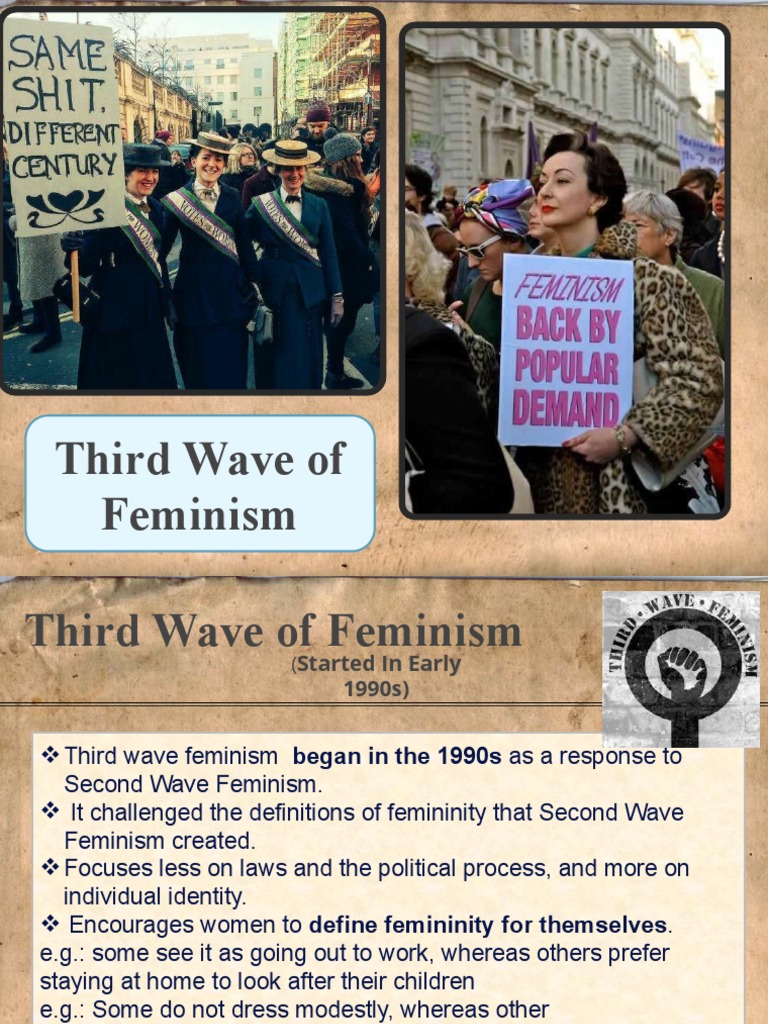
Third-wave feminism, which emerged in the 1990s, built upon the achievements of the second wave while also addressing its limitations. Third-wave feminists embraced diversity and intersectionality, recognizing that women’s experiences are shaped by a complex interplay of factors, including race, class, sexuality, and disability. They challenged essentialist notions of womanhood and celebrated female agency and empowerment. Riot Grrrl, a feminist punk subculture, emerged as a powerful voice for young women, expressing their anger and frustration through music and activism. This was a generation of feminists who refused to be silenced.
C. Key Issues of the Second and Third Waves: Reproductive Rights, Violence Against Women, and Intersectionality
Reproductive rights became a central focus of second and third-wave feminism, with activists fighting for access to contraception and abortion. Violence against women, including domestic violence, sexual assault, and harassment, was also brought to the forefront. Intersectionality, the recognition that gender intersects with other forms of oppression, became a crucial framework for feminist analysis. These issues remain central to feminist activism today.
V. Modern Feminism: Navigating the Digital Age and Beyond
Today, feminism continues to evolve and adapt to the challenges of the 21st century. The internet and social media have provided new platforms for feminist activism, allowing women to connect, organize, and share their stories on a global scale. But the fight is far from over. We’re living through the fourth wave now, and what a glorious and complicated moment it is!
A. Fourth Wave Feminism: Online Activism and Digital Solidarity
Fourth-wave feminism is characterized by its use of online platforms to raise awareness about issues such as sexual harassment, body image, and gender inequality. The #MeToo movement, which went viral in 2017, is a prime example of the power of online activism to expose sexual misconduct and hold perpetrators accountable. Social media has also provided a space for marginalized voices to be heard and for feminist movements to become more inclusive. It’s a space where women can share their stories and experiences, find solidarity, and organize collective action.
B. Challenges and Opportunities in the Digital Age
While the internet has provided new opportunities for feminist activism, it also presents new challenges. Online harassment, cyberbullying, and the spread of misinformation are serious concerns. It is crucial to create safe and inclusive online spaces where women can express themselves freely without fear of abuse. And it’s crucial to ensure that the voices of marginalized women aren’t drowned out.
C. The Future of Feminism: Towards a More Just and Equitable World
The future of feminism depends on our ability to build bridges across differences and to work together to create a more just and equitable world for all. We must continue to challenge patriarchal power structures, to fight for reproductive rights, to end violence against women, and to promote intersectionality. And we must never forget the struggles of those who came before us, who paved the way for the progress we have made. The fight continues, and it’s a fight worth fighting. This is not a historical relic; it’s a living, breathing movement constantly redefining itself.






Leave a Comment