Darling, are we still doing this “waves” thing? Seriously, after all this time, are we content to confine the tempestuous ocean of feminist thought into neat, tidy, predictable swells? It’s a useful heuristic, sure, a beginner’s guide to a history richer and more complex than any textbook dares to admit. But clinging to the “waves” risks oversimplifying the seismic shifts, the back currents, the rogue tides of our ongoing revolution. Still, for the uninitiated, let’s wade in. Because knowledge, even compartmentalized knowledge, is power.
The challenge, should you choose to accept it, lies not in regurgitating the timeline, but in interrogating its implications. To examine not just what each wave ostensibly achieved, but what it left unaddressed, whose voices it amplified, and whose it conveniently drowned out. Because, darling, feminism, like life itself, is messy, contradictory, and perpetually unfinished.
The First Wave: Suffrage and the Dawn of Political Visibility
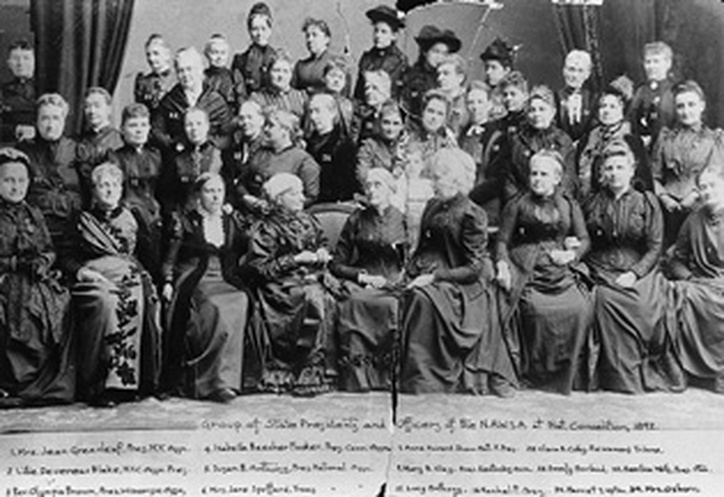
Ah, the suffragettes. The Edwardian Valkyries demanding enfranchisement, marching under banners of white, purple, and green. A relatively straightforward agenda, wouldn’t you say? Securing the vote, that hallowed symbol of citizenship, as if a simple checkmark could dismantle centuries of patriarchal oppression. One almost wants to admire the naiveté of it all.
The reality, of course, was far more nuanced, and far less equitable. The first wave, largely spearheaded by middle- and upper-class white women, primarily championed the concerns *of* middle- and upper-class white women. While the battle for suffrage was undeniably significant, it conveniently overlooked the systemic inequalities faced by women of color, working-class women, and those marginalized by their sexual orientation or gender identity.
Consider the iconic suffragette parades, staged to impress the political elite. These visually arresting displays often excluded or relegated women of color to the back ranks, perpetuating the very hierarchies they ostensibly sought to dismantle. The narrative of universal sisterhood, so eloquently espoused, crumbled under the weight of its own internal biases. Did those grand speeches about equality truly resonate with the Black woman toiling in the fields, or the immigrant seamstress sweating in a garment factory? I think not.
Moreover, the first wave’s focus on legal and political rights often neglected the equally crucial arenas of economic independence, reproductive autonomy, and personal liberation. Suffrage was a vital tool, yes, but a tool rendered blunt without the necessary infrastructure to wield it effectively. A vote, after all, is only as powerful as the options available on the ballot, and the ballot is often shaped by the very forces of oppression the suffragettes sought to overcome. A Pyrrhic victory, perhaps? Or merely a stepping stone, albeit a flawed one, toward a more inclusive future?
The Second Wave: Liberation and the Personal as Political
Fast forward to the 1960s and 70s, a period of revolutionary fervor and radical self-discovery. The second wave erupted in response to the perceived limitations of the first, challenging not just legal inequalities but the very foundations of patriarchal society. This was the era of bra-burning (a myth, mostly, but a potent symbol nonetheless), consciousness-raising groups, and the audacious assertion that “the personal is political.”
Second-wave feminists interrogated the deeply ingrained social norms that confined women to the domestic sphere, relegating them to the roles of wife, mother, and homemaker. They challenged the objectification of women in media and advertising, the pervasive sexism in the workplace, and the cultural scripts that dictated acceptable female behavior. Betty Friedan’s *The Feminine Mystique* served as a clarion call, exposing the quiet desperation simmering beneath the veneer of suburban bliss. But who’s bliss was it really?
This wave witnessed significant gains in reproductive rights (Roe v. Wade, a bittersweet victory given the current climate), equal opportunity legislation, and the establishment of women’s studies programs in universities. Second-wave feminism also grappled with issues of sexual violence, domestic abuse, and the systemic silencing of women’s voices. The rise of feminist literature, art, and film provided platforms for women to share their experiences, challenge dominant narratives, and envision alternative futures. The sisterhood was getting stronger.
However, the second wave, much like its predecessor, faced its own internal contradictions and blind spots. Critics argued that it primarily reflected the concerns of white, middle-class, heterosexual women, often marginalizing the experiences of women of color, lesbians, and working-class women. The focus on universal womanhood often obscured the complexities of intersectionality, failing to acknowledge the ways in which race, class, sexuality, and other social identities intersected to shape women’s experiences.
Furthermore, the second wave’s emphasis on liberation sometimes veered into essentialism, reinforcing binary notions of gender and overlooking the diversity of gender identities and expressions. The notion of a singular, unified “female experience” proved increasingly problematic, as feminists of color and queer feminists challenged the dominance of white, heterosexual perspectives. Did the push for “liberation” truly liberate *everyone*? Or did it simply replace one set of constraints with another, albeit slightly less restrictive, set?
The Third Wave: Intersectionality and the Digital Age
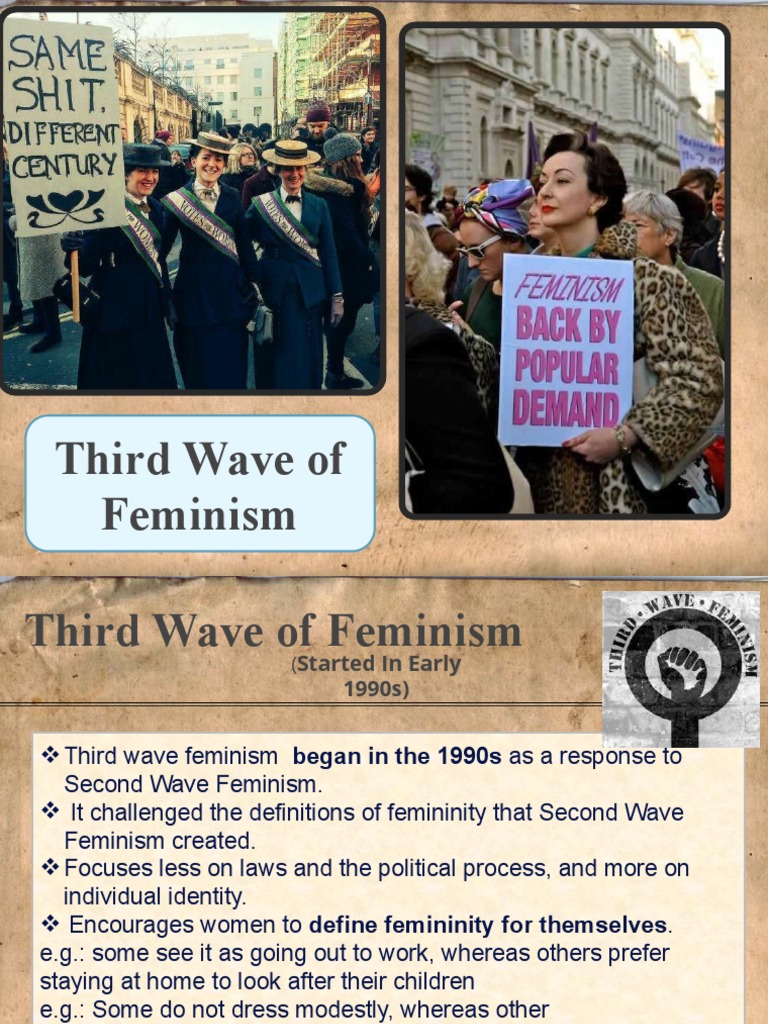
Emerging in the 1990s and continuing into the 21st century, the third wave represents a deliberate rejection of the perceived limitations of the second wave. Third-wave feminists embraced intersectionality, recognizing that gender is inextricably linked to other social identities and that experiences of oppression are shaped by the complex interplay of race, class, sexuality, and other factors.
This wave witnessed a proliferation of diverse voices and perspectives, challenging the notion of a single, unified feminist agenda. Third-wave feminists utilized digital technologies, such as the internet and social media, to create online communities, share their stories, and organize activism. Riot Grrrl, zines, and independent media became powerful tools for self-expression and resistance.
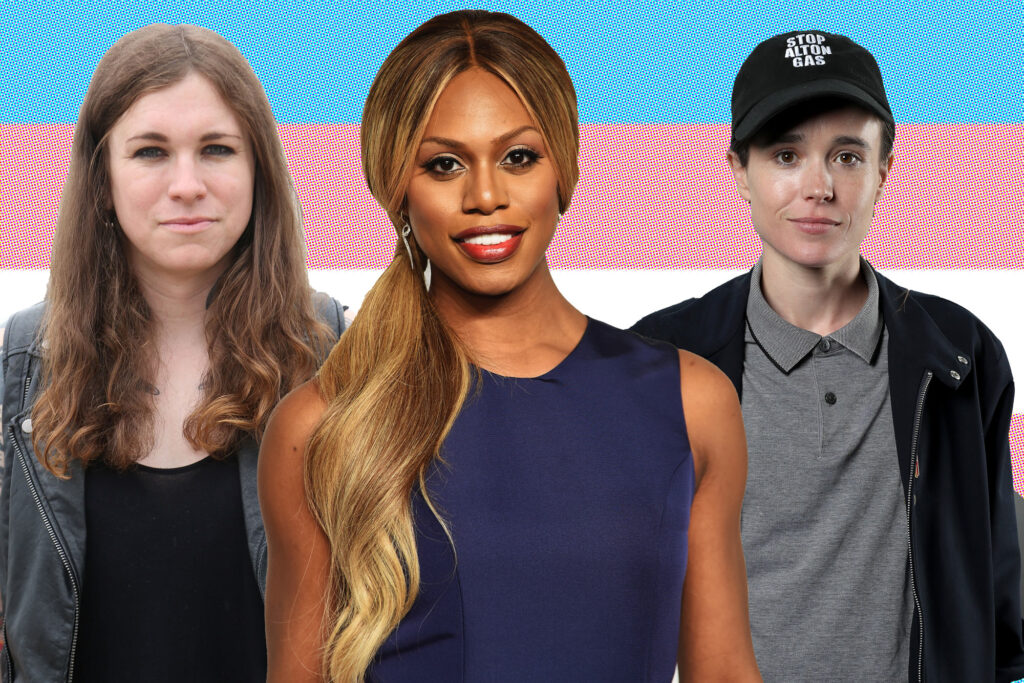
The third wave also challenged traditional notions of femininity and sexuality, embracing fluidity, experimentation, and self-definition. Feminists questioned the rigid gender roles and expectations imposed by society, advocating for the freedom to express oneself authentically, regardless of gender identity or sexual orientation. They championed body positivity, challenged beauty standards, and promoted sexual liberation.
But, as you might expect, the third wave is not without its detractors. Some critics argue that it lacks a clear unifying agenda, fragmented by its focus on individual identity and micro-politics. Others accuse it of being overly focused on social media and online activism, neglecting more traditional forms of political engagement. Has the focus on individual expression diluted the collective power of the feminist movement? Or has it simply diversified the landscape of feminist activism, making it more accessible and inclusive?
The Potential Challenge: Beyond the Waves: A Sea Change?
Perhaps it’s time to retire the wave metaphor altogether. Perhaps it’s time to acknowledge that feminism is not a linear progression, but a complex, evolving, and often contradictory struggle. Perhaps it’s time to move beyond the simplistic categorization of “waves” and embrace the fluidity and dynamism of the feminist movement. Let’s talk about tides, and deep currents, and the undertow that threatens to pull us back.
We must continue to grapple with the unfinished business of each wave, addressing the systemic inequalities that persist despite decades of feminist activism. We must amplify the voices of marginalized communities, ensuring that all women, regardless of their race, class, sexuality, or gender identity, have a seat at the table. And we must remain vigilant against the forces of backlash, the patriarchal structures that seek to undermine our progress and silence our voices.
The challenge ahead is not simply to ride the next wave, but to create a sea change, a fundamental transformation of society that dismantles the structures of oppression and creates a world where all individuals, regardless of their gender, can thrive. Are we up to the task, my dears? I certainly hope so. Because the future, darling, is feminist. Or it is nothing at all. We must look to the future by remembering the past.





Leave a Comment