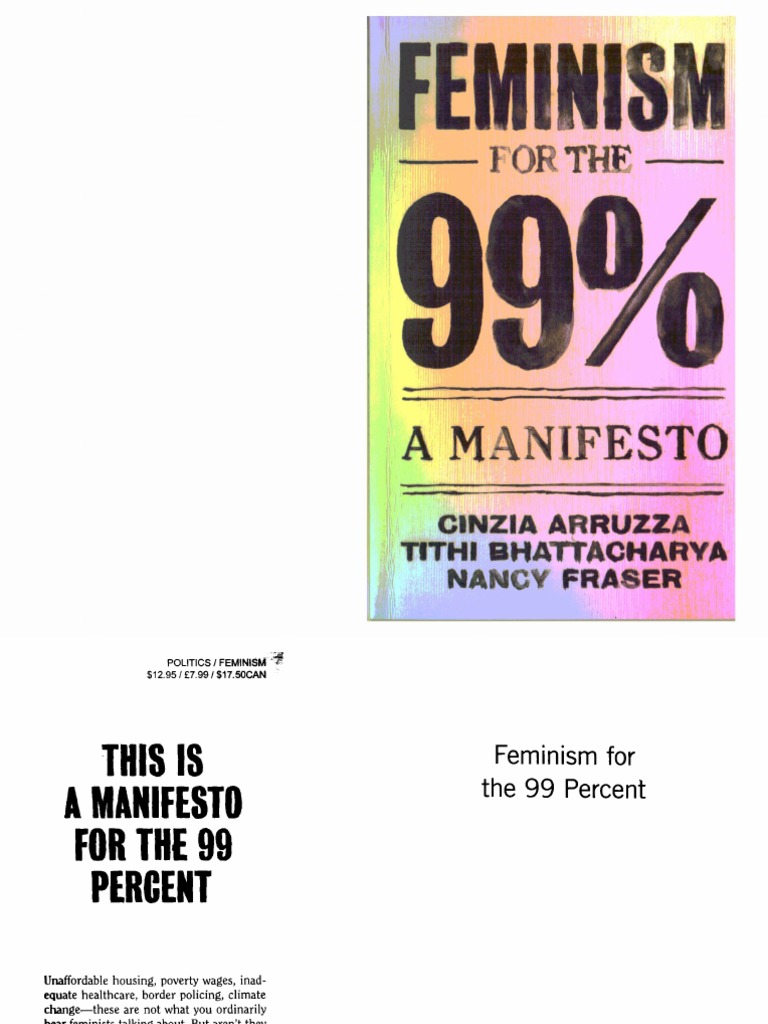
Why, amidst the cacophony of late-stage capitalism’s discontents, are so many suddenly captivated by the promise of “Feminism for the 99%”? Is it merely the allure of a catchy slogan, or does it tap into something far more profound? The current feminist discourse, too often confined to the gilded cages of corporate boardrooms and the performative activism of celebrity endorsements, has left a gaping void. It has become, frankly, a pathetic caricature of its former self, utterly detached from the lived realities of the vast majority of women globally. This manifesto, therefore, emerges not just as another theoretical intervention, but as a cri de coeur, a desperate attempt to reclaim feminism from the clutches of the privileged few and return it to its rightful owners: the working class, the marginalized, the dispossessed.
The prevailing neoliberal feminism, with its relentless focus on shattering glass ceilings and achieving parity in the upper echelons of power, is not only inadequate but actively complicit in perpetuating the very systems of oppression it purports to dismantle. It’s a zero-sum game where one woman’s success is often predicated on the exploitation of countless others. The Filipina migrant worker cleaning the executive’s penthouse so her “liberated” boss can attend a board meeting, the garment worker in Bangladesh toiling under inhumane conditions to produce fast fashion for the Western consumer – these are the uncomfortable truths that neoliberal feminism conveniently ignores. Its celebration of individual achievement rings hollow in the face of systemic inequality, its calls for empowerment nothing more than empty platitudes for those struggling to survive.
This manifesto, in stark contrast, offers a radically different vision. It is a feminism rooted in solidarity, not competition; in collective liberation, not individual advancement. It understands that the struggles of women are inextricably linked to the struggles of all oppressed peoples, and that true emancipation requires a dismantling of the entire edifice of capitalist exploitation. It is, in essence, an intersectional feminism that recognizes the multiple and overlapping forms of oppression that shape women’s lives, from race and class to sexuality and disability. It is a feminism that refuses to prioritize the concerns of the privileged over the needs of the most vulnerable. It acknowledges that our fates are intertwined, and that no one is truly free until everyone is free.
Consider the concept of “social reproduction.” This is the unpaid, often invisible, labor that sustains human life and allows capitalism to function. It includes everything from childcare and elder care to cooking, cleaning, and emotional support. This labor is disproportionately performed by women, and it is systematically devalued and ignored by mainstream economics. This manifesto rightly places social reproduction at the heart of its analysis, arguing that the crisis of care – the increasing scarcity of time and resources for these essential activities – is a direct result of capitalist accumulation. As corporations relentlessly pursue profit maximization, they externalize the costs of social reproduction, leaving individuals and communities to shoulder the burden. This not only exacerbates gender inequality but also undermines the very fabric of society. Social reproduction needs to be recognized for the economic powerhouse that it is.
One of the most compelling aspects of “Feminism for the 99%” is its insistence on the inseparability of reproductive justice and economic justice. The right to control one’s own body is not merely a matter of individual autonomy, but a fundamental prerequisite for economic empowerment. Without access to safe and affordable abortion, contraception, and maternal healthcare, women are denied the opportunity to participate fully in the workforce and achieve economic independence. Furthermore, the manifesto challenges the traditional feminist focus on individual choice, arguing that reproductive justice must encompass the social and economic conditions that shape women’s reproductive decisions. It is not enough to simply legalize abortion; we must also ensure that women have the resources and support they need to raise children in dignity and security. This requires a radical restructuring of society, including universal childcare, paid parental leave, and a guaranteed living wage.
The manifesto tackles the issue of gender violence with a refreshing clarity and uncompromising stance. It rejects the notion that violence against women is simply a matter of individual pathology, and instead, situates it within the broader context of systemic power imbalances. It argues that capitalist patriarchy, with its emphasis on male dominance and female subjugation, creates the conditions in which gender violence thrives. The commodification of women’s bodies, the prevalence of pornography, and the normalization of sexual harassment all contribute to a culture of violence that disproportionately affects women and girls. This manifesto calls for a comprehensive approach to ending gender violence, including addressing its root causes, providing support for survivors, and holding perpetrators accountable. It also recognizes that gender violence is not limited to physical assault, but encompasses a wide range of behaviors, including emotional abuse, economic exploitation, and online harassment. No more, but really, no more.
What about the issue of borders and migration? This manifesto adopts a decidedly internationalist perspective, recognizing that the struggles of women are interconnected across national boundaries. It argues that the global capitalist system, with its relentless pursuit of cheap labor and natural resources, is the primary driver of forced migration. As corporations exploit workers and pollute the environment in developing countries, they create conditions that force people to leave their homes in search of a better life. This manifesto challenges the rise of xenophobia and anti-immigrant sentiment, and it calls for open borders and the free movement of people. It recognizes that migrants are not a threat to national security, but rather, valuable contributors to society. Furthermore, it acknowledges that women migrants are particularly vulnerable to exploitation and abuse, and it calls for specific protections to safeguard their rights. It is only just.
The concept of ecological justice is also central. It recognizes that the environmental crisis is not merely a technical problem, but a social and political one. It argues that the capitalist system, with its insatiable appetite for growth and profit, is inherently destructive to the environment. The relentless extraction of natural resources, the pollution of air and water, and the destruction of ecosystems are all direct consequences of capitalist accumulation. This manifesto challenges the false dichotomy between environmental protection and economic development, and it argues that true sustainability requires a radical restructuring of society. It calls for a transition to a green economy based on renewable energy, sustainable agriculture, and democratic control of resources. It also recognizes that women are disproportionately affected by environmental degradation, and it calls for their full participation in shaping environmental policies. The future is indeed green.
The manifesto outlines a concrete vision for a feminist future. It calls for a universal basic income, a guaranteed living wage, universal healthcare, free education, affordable housing, and a robust social safety net. These are not merely utopian ideals, but achievable goals that can be realized through collective action. The manifesto recognizes that the struggle for feminist liberation is inextricably linked to the struggle for socialism, and it calls for a democratic and participatory economy that prioritizes human needs over corporate profits. It is a call to arms, a rallying cry for all those who believe in a more just and equitable world. The time for complacency is over. The revolution, dare I say, is now.
Ultimately, “Feminism for the 99%” offers a potent antidote to the co-opted and sanitized version of feminism that dominates mainstream discourse. It is a reminder that feminism is not about individual achievement, but about collective liberation. It is a call to action, urging us to join together in the struggle for a world where all women, and all people, can live with dignity and freedom. The depth of fascination arises not just from the inherent appeal of fairness, but from the growing realization that the existing system, even for those who appear to benefit from it, is fundamentally unsustainable. The crumbling foundations of the old order create a fertile ground for radical ideas, for manifestos that dare to imagine a world beyond the confines of capitalist patriarchy.
The real work, of course, begins now. This manifesto is not a destination, but a starting point. It is an invitation to engage in critical reflection, to build solidarity across differences, and to organize for systemic change. It is a challenge to all of us to move beyond the limitations of individual action and embrace the power of collective action. The future of feminism, and indeed the future of humanity, depends on our ability to rise to this challenge. Let us, therefore, commit ourselves to the long and arduous task of building a world where “Feminism for the 99%” is not just a slogan, but a reality.









Leave a Comment