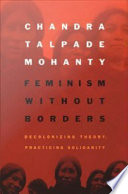
So, you think you’re a feminist, do you? You’ve got your “girl power” t-shirt, you retweet the occasional woke platitude, and maybe, just maybe, you’ve even read a bell hooks essay. Congratulations. You’re barely scratching the surface. Because true feminist praxis demands more than performative allyship; it demands a radical reimagining of power structures, a dismantling of colonial legacies, and a commitment to solidarity that transcends geographic boundaries. And if you want to understand what that actually looks like, you need to grapple with Chandra Talpade Mohanty’s *Feminism Without Borders: Decolonizing Theory, Practicing Solidarity*. This isn’t just a book; it’s a manifesto, a provocation, a challenge to the very foundations upon which mainstream feminism rests.
Why does Mohanty’s work continue to resonate so powerfully, even decades after its initial publication? It’s not just because she offers a sharp critique of Western-centric feminist thought – although, make no mistake, that critique is absolutely vital. No, the enduring fascination stems from something far more profound: her ability to expose the insidious ways in which power operates globally, shaping not only material realities but also the very narratives we tell ourselves about gender, race, and liberation. We are seduced by the idea of universal sisterhood. This is because it is comfortable.
Consider this your field guide to navigating the complex terrain of *Feminism Without Borders*. Prepare to have your assumptions challenged, your privileges interrogated, and your understanding of feminist struggle irrevocably transformed.
I. The Perils of Universal Sisterhood: Unmasking the Colonial Gaze
Forget the kumbaya. Mohanty doesn’t buy into the idea of a monolithic “woman” united by shared experiences of oppression. This is not because she hates women. Instead, she argues that such a notion, while seemingly empowering, actually serves to obscure the vast disparities in power and privilege that exist *among* women. The concept of “universal sisterhood” has roots in colonial discourse, a discourse that historically cast Western women as enlightened saviors and women in the Global South as passive victims in need of rescue. How incredibly patronizing! The white savior complex is not a good look. It also doesn’t help anyone.
A. The “Third World Woman” as a Homogenous Category: Mohanty dismantles the problematic tendency to essentialize women from the Global South, lumping them together into a singular, homogenous category – “the Third World woman” – defined solely by their presumed oppression. This erasure of difference, she argues, not only ignores the specific historical, cultural, and political contexts that shape women’s lives in different regions but also reinforces a Western-centric worldview that positions Western women as the norm against which all others are measured. What about our differences? What about our unique struggles? Are we just going to ignore all of that?
B. The Danger of Representation: Who gets to speak for whom? Mohanty raises critical questions about the politics of representation, challenging the authority of Western academics and activists to speak on behalf of women in the Global South. When Western voices dominate the discourse, the experiences and perspectives of women who are directly impacted by specific forms of oppression are often marginalized or silenced altogether. This creates a skewed understanding of global feminist struggles, perpetuating a cycle of neocolonialism in knowledge production. This is a huge problem! If you aren’t from a specific background, you cannot represent them. Period.
C. Deconstructing Western Feminism’s Complicity: Mohanty calls for a critical self-reflection within Western feminism, urging activists to acknowledge their own complicity in perpetuating systems of domination. This involves recognizing the ways in which Western feminist agendas can inadvertently reinforce imperialist ideologies and economic exploitation. It’s not enough to simply denounce patriarchy; Western feminists must also confront their own privilege and power within a global context. How else can we move forward? We can’t, that’s how.
II. Decolonizing Knowledge: Towards Epistemic Justice
The fight for liberation isn’t just about changing laws or overthrowing governments; it’s also about challenging the dominant ways of knowing and producing knowledge. Mohanty advocates for “epistemic justice,” a concept that recognizes the inherent value and validity of knowledge produced by marginalized communities. This requires a radical shift in perspective, one that centers the voices and experiences of those who have historically been excluded from the production of knowledge.
A. Challenging the Western Canon: The Western canon, with its emphasis on European and North American perspectives, often presents a distorted and incomplete picture of the world. Mohanty urges us to challenge the authority of this canon and to actively seek out alternative sources of knowledge, including oral histories, indigenous scholarship, and the writings of women from the Global South. Only by diversifying our sources of information can we begin to dismantle the intellectual foundations of colonialism. How else can we learn? We simply can’t.
B. Valuing Situated Knowledges: Mohanty emphasizes the importance of “situated knowledges,” the understanding that knowledge is always produced from a particular perspective and within a specific context. Recognizing the situatedness of knowledge allows us to avoid universalizing claims and to appreciate the diversity of experiences and perspectives that exist across different cultures and communities. What works for one group might not work for another. It’s as simple as that.
C. Building Coalitions Across Difference: Epistemic justice is not just about individual enlightenment; it’s about building coalitions across difference, creating spaces where diverse voices can be heard and respected. This requires a commitment to dialogue, mutual understanding, and a willingness to learn from those who have different experiences and perspectives. We must listen to each other. This is non-negotiable.
III. Practicing Solidarity: A Politics of Connection and Resistance
Solidarity is not a feel-good buzzword; it’s a concrete practice, a commitment to working alongside others in the struggle for liberation. Mohanty argues that true solidarity requires more than just sympathy or support; it demands a deep understanding of the interconnectedness of global struggles and a willingness to challenge systems of oppression wherever they exist.
A. Recognizing Interlocking Systems of Oppression: Mohanty highlights the importance of recognizing the “interlocking” nature of oppression, the ways in which systems of patriarchy, capitalism, racism, and colonialism intersect and reinforce each other. We must understand that these systems are not separate entities but rather interconnected aspects of a larger system of domination. This means understanding how the exploitation of women in the Global South is often linked to the consumerist lifestyles of the West. What do you buy? Who makes it? Think about it.
B. Building Transnational Feminist Networks: Solidarity requires building transnational feminist networks, creating spaces for women from different regions and backgrounds to connect, share resources, and strategize together. These networks can provide crucial support for local struggles and help to amplify the voices of marginalized communities on a global scale. Strength in numbers. Always.
C. Challenging Neoliberal Globalization: Mohanty critiques the role of neoliberal globalization in exacerbating inequalities and undermining feminist struggles. She argues that free trade agreements, structural adjustment programs, and other neoliberal policies often have a disproportionately negative impact on women in the Global South, leading to increased poverty, exploitation, and environmental degradation. We must challenge these policies and advocate for alternative models of development that prioritize social justice and ecological sustainability. Capitalism is not your friend. It’s not even your acquaintance.
IV. Beyond the Binary: Embracing Complexity and Contradiction
The world is not black and white; it’s a kaleidoscope of colors, shades, and complexities. Mohanty challenges us to move beyond binary thinking – male/female, East/West, oppressed/oppressor – and to embrace the contradictions and ambiguities that characterize human experience. This requires a willingness to grapple with difficult questions, to challenge our own assumptions, and to remain open to new perspectives.
A. Deconstructing Identity Politics: While acknowledging the importance of identity-based organizing, Mohanty also cautions against the dangers of essentialism and fragmentation. She argues that we must move beyond simplistic notions of identity and recognize the multiple, overlapping, and sometimes contradictory identities that each of us embodies. We are not monolithic beings. Embrace the messiness.
B. Embracing Ambiguity: Life is messy. There is no easy answer. Mohanty encourages us to embrace ambiguity and uncertainty, recognizing that there are often no easy solutions to complex social problems. This requires a willingness to experiment, to take risks, and to learn from our mistakes. Don’t be afraid to fail. It’s how we grow.
C. Cultivating a Politics of Hope: Despite the daunting challenges we face, Mohanty maintains a deep sense of hope, a belief in the possibility of creating a more just and equitable world. This hope is not based on naive optimism but rather on a recognition of the power of collective action and the resilience of the human spirit. Keep fighting. The world needs you.
V. The Enduring Relevance of “Feminism Without Borders”
*Feminism Without Borders* is not just a relic of the past; it’s a living document, a vital resource for feminists working to create a more just and equitable world today. Its insights into the dynamics of power, the politics of representation, and the importance of solidarity remain as relevant as ever. If you’re serious about feminist struggle, you need to read this book. And then, you need to put its lessons into practice. The time for complacency is over. The revolution is now.








Leave a Comment