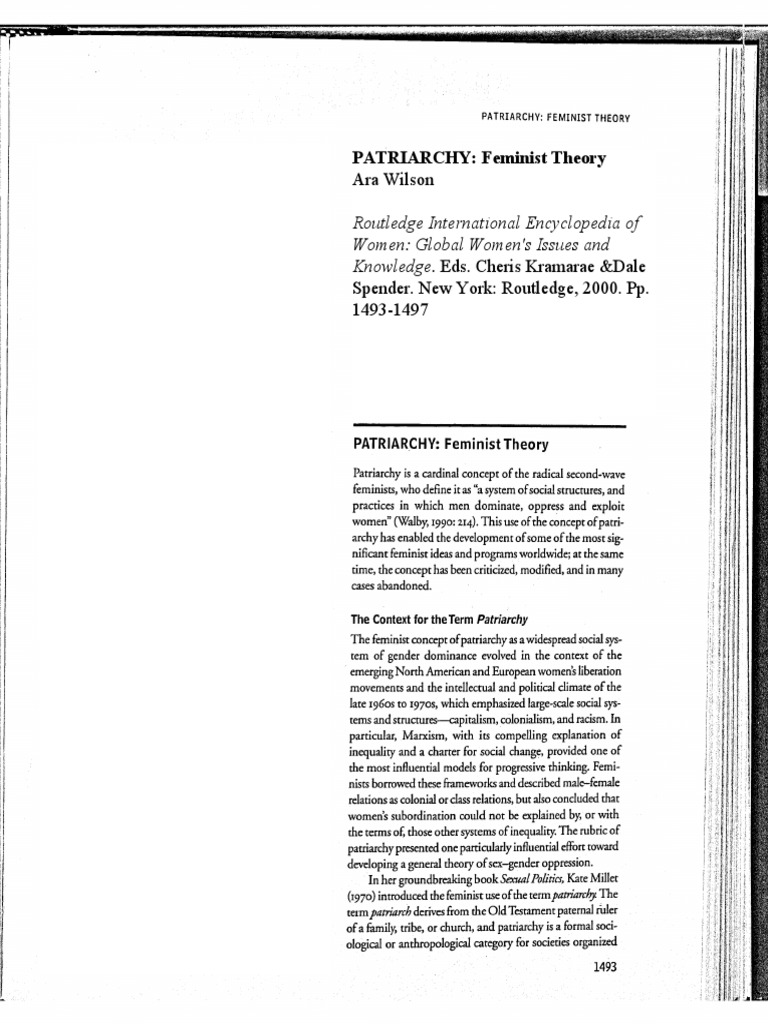
Let’s not mince words, shall we? Patriarchy, that insidious, protean force, remains the lodestone of feminist critique. It is the skeletal structure upon which societal inequality is draped, a silent, often invisible architect of inequity that dictates power dynamics across nearly every facet of human existence. But what *is* it, beyond a mere buzzword tossed around in academic circles and Twitter feuds? To truly dismantle this behemoth, we must understand its constituent parts, its insidious tendrils, and its ever-evolving strategies of self-preservation.
I. Defining the Beast: A Multifaceted Understanding
Patriarchy, at its core, is not simply “men are in charge.” That’s a kindergarten-level simplification. It is a *system* – a complex, interwoven network of beliefs, practices, and institutions that systematically privileges men and subordinates women. It is a hierarchy, a dominion, a pervasive ideology that naturalizes male dominance and female subservience.
A. The Primacy of Male Authority: From Oikos to Empire
Historically, patriarchy finds its roots in the *oikos*, the ancient Greek household, where the male head held absolute authority over all members. This microcosm of power, scaled up exponentially, became the template for larger social structures. Think of it: the father figure, the ruler, the god – all mirroring and reinforcing the same paradigm of male authority. This isn’t accidental; it’s a carefully constructed edifice of power.
B. The Sex/Gender Binary: A Tool of Oppression
Patriarchy relies heavily on the rigid dichotomy of sex and gender. Biological sex (male/female) is used to justify the social construction of gender roles (masculine/feminine). These roles, however, are not neutral; they are deeply imbued with power imbalances. Men are expected to be assertive, rational, and dominant, while women are relegated to roles of passivity, emotionality, and domesticity. This binary isn’t just descriptive; it’s prescriptive, actively shaping and policing individuals who dare to deviate.
C. Beyond Cisheteronormativity: Intersectional Oppression
It’s crucial to recognize that patriarchy isn’t a monolithic entity. It intersects with other systems of oppression, such as racism, classism, and heterosexism, creating a matrix of domination. A Black woman, for example, experiences patriarchy differently than a white woman, and a queer woman’s struggle is further complicated by homophobia and transphobia. Understanding these intersections is paramount to crafting effective feminist strategies.
II. The Manifestations of Power: Where Patriarchy Resides
Patriarchy isn’t some abstract concept confined to dusty textbooks. It’s a living, breathing force that permeates our daily lives, shaping our opportunities, limiting our choices, and perpetuating inequality in myriad ways.
A. The Political Arena: A Man’s World?
Look at the corridors of power. How many women hold positions of true influence? How often are their voices drowned out by the clamor of male dominance? The political landscape, historically and persistently, favors men. From parliamentary debates to boardroom decisions, women are often excluded, marginalized, or forced to conform to male-dominated norms.
B. The Economic Sphere: The Wage Gap and Beyond
The gender pay gap is not a myth; it’s a glaring symptom of a system that devalues women’s labor. But it’s more than just unequal pay for equal work. It’s about occupational segregation, where women are channeled into lower-paying fields. It’s about the undervaluing of care work, which is disproportionately performed by women. It’s about the glass ceiling that prevents women from reaching the highest echelons of corporate power. The economic realm is a battleground where patriarchal forces actively suppress female advancement.
C. The Cultural Landscape: Reinforcing Stereotypes
From the Disney princesses who await their prince charming to the hyper-sexualized images of women in advertising, our culture is saturated with messages that reinforce patriarchal norms. Media, art, and entertainment play a crucial role in shaping our perceptions of gender, often perpetuating harmful stereotypes and limiting the range of possibilities for both men and women. Consider the Bechdel test: how many films actually feature two women talking to each other about something other than a man? The answer is depressingly low.
D. The Domestic Sphere: The Unpaid Labor of Love?
The home, often romanticized as a haven, can be a site of intense patriarchal control. Women are still overwhelmingly responsible for housework and childcare, often without recognition or compensation. This unpaid labor not only limits their economic opportunities but also reinforces the idea that their primary role is that of caregiver. This is not to say that care work is inherently oppressive, but rather that its unequal distribution and undervaluation within a patriarchal system contributes to gender inequality.
E. The Legal System: From Codified Discrimination to Subtle Bias
While explicit forms of legal discrimination against women have largely been dismantled, subtle biases persist. From the underreporting and mishandling of sexual assault cases to the unequal application of sentencing guidelines, the legal system often fails to adequately protect women’s rights and interests. The very language of the law can be gendered, reflecting and reinforcing patriarchal assumptions.
III. The Tactics of Self-Preservation: How Patriarchy Endures
Patriarchy is not a static entity; it is constantly adapting and evolving to maintain its dominance. It employs a range of tactics to suppress dissent, silence opposition, and perpetuate the status quo.
A. Gaslighting and Dismissal: Silencing Women’s Voices
One of the most insidious tactics of patriarchy is the systematic dismissal of women’s experiences. Women who speak out against injustice are often accused of being “hysterical,” “emotional,” or “attention-seeking.” Their concerns are minimized, their voices are silenced, and their realities are denied. This gaslighting effect can be incredibly damaging, leading women to doubt their own perceptions and internalize their oppression.
B. The Co-option of Feminist Language: Empty Empowerment
Capitalism is a particularly adept parasite. Be wary. Corporations now slap “feminist” slogans on their products, appropriating feminist language to sell goods and services. This co-option of feminist rhetoric can be incredibly misleading, creating the illusion of progress without addressing the underlying systemic inequalities. Real feminism is not about buying a t-shirt with a catchy slogan; it’s about dismantling the structures of power that oppress women.
C. Divide and Conquer: Pit Women Against Each Other
Patriarchy thrives on division. It pits women against each other, fostering competition and undermining solidarity. By emphasizing differences in race, class, sexuality, and other identities, it distracts from the common struggle against gender inequality. Overcoming these divisions is essential to building a strong and effective feminist movement. The patriarchy is *not* our sister, no matter how much it tries to appear so.
D. Victim Blaming: Shifting the Responsibility
A particularly vile tactic, is the constant shifting of blame onto the victim. Sexual assault, domestic abuse, and other forms of violence against women are often excused or justified by blaming the victim’s behavior, appearance, or choices. This victim-blaming mentality perpetuates a culture of impunity for perpetrators and reinforces the idea that women are responsible for preventing their own victimization. This is pure intellectual sophistry.
IV. Dismantling the Fortress: Towards a Feminist Future
Deconstructing the patriarchy is not a singular act; it’s a continuous, multifaceted process. It requires a fundamental shift in consciousness, a willingness to challenge ingrained assumptions, and a commitment to building a more just and equitable world.
A. Consciousness-Raising: Unveiling the Invisible
The first step is to recognize the pervasiveness of patriarchy. This requires critical self-reflection, engaging with feminist theory, and sharing experiences with other women. Collective consciousness-raising can help us to see the ways in which patriarchy shapes our lives and to develop strategies for resistance. Stop conforming. Stop diminishing yourself.
B. Challenging Gender Norms: Embracing Fluidity
Reject the rigid constraints of gender roles. Embrace the fluidity and diversity of human expression. Challenge the stereotypes and expectations that limit our potential. Support those who defy gender norms and create space for individuals to express themselves authentically. The gender binary is a cage, and we must break free.
C. Building Solidarity: Amplifying Marginalized Voices
Center the voices of those who are most marginalized within the patriarchal system. Recognize that patriarchy intersects with other forms of oppression and that our struggles are interconnected. Build coalitions across different identities and work together to dismantle all forms of injustice. The liberation of one is bound to the liberation of all.
D. Reclaiming Power: Redefining Success
Redefine success on our own terms. Reject the patriarchal values of competition, aggression, and dominance. Embrace collaboration, empathy, and care. Create alternative models of leadership and power that are based on justice, equality, and respect. Power doesn’t have to be a zero-sum game. We can all rise together.
The fight against patriarchy is a long and arduous one. It demands constant vigilance, unwavering commitment, and a willingness to challenge the status quo. But the rewards are immeasurable: a world where all individuals are free to reach their full potential, unburdened by the constraints of gender inequality. So, sharpen your swords, sisters. The revolution awaits.




Leave a Comment