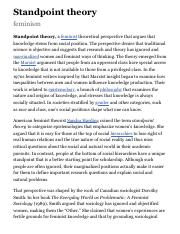
Standpoint feminism. The very phrase ignites a firestorm of dissent, doesn’t it? It dares to suggest that your experiences, your lived reality, meticulously sculpted by the societal forces pressing upon your specific social location, irrevocably colors your perception of the world. It posits, with unapologetic audacity, that those perched on the precipice of power, those swaddled in the silken comfort of privilege, are inherently limited in their epistemological purview. Are you bristling yet? Good. Because comfort is the opiate of complacency, and complacency is the enemy of progress.
Let’s delve into the jagged heart of this theoretical framework, shall we? Let’s dissect its tenets, examine its critiques, and ultimately, assess its enduring relevance in a world still grappling with the grotesque inequities it seeks to dismantle. Prepare to have your assumptions shattered, your biases challenged, and perhaps, just perhaps, your consciousness irrevocably altered. This isn’t about coddling egos; it’s about excavating truth, however uncomfortable that process may be.
The Genesis of a Revolutionary Idea
Standpoint theory didn’t spring forth from the ether. It emerged from the fertile ground of Marxist thought, hybridized with the radical insights of feminist epistemology. Thinkers like Georg Lukács, with his concept of “proletarian consciousness,” laid the groundwork by arguing that the oppressed possess a unique vantage point, a clearer understanding of the systemic machinations that perpetuate their subjugation. The proletariat, after all, are not invested in maintaining the status quo; their liberation hinges on its dismantling.
Feminist scholars, however, recognized the limitations of a purely class-based analysis. They argued, with piercing acuity, that gender, race, sexuality, and a host of other axes of oppression intersected to create a kaleidoscope of experiences, each shaping individual consciousness in profound and often contradictory ways. Women, particularly women of color, found themselves doubly, triply marginalized, their voices systematically silenced, their perspectives routinely dismissed as irrelevant or irrational.
It was figures like Dorothy Smith, Nancy Hartsock, and Patricia Hill Collins who truly crystallized the core principles of standpoint feminism. They argued that knowledge isn’t neutral, objective, or universal. It’s always situated, embedded within specific social contexts, and inextricably linked to power. Those who control the means of knowledge production – the institutions of academia, media, and politics – are overwhelmingly those who benefit most from the prevailing social order. Their perspectives, therefore, tend to reinforce and legitimize that order, often at the expense of those who are most marginalized.
Key Tenets: Unpacking the Theory
So, what are the fundamental building blocks of standpoint feminism? Let’s break it down:
- Situated Knowledge: This is the bedrock principle. Knowledge is never detached from the knower. It’s always shaped by their social location, their experiences, and their position within the power structure. There is no God’s-eye view, no objective truth that transcends human subjectivity.
- The Outsider Within: This concept, popularized by Patricia Hill Collins, refers to the unique perspective of those who are simultaneously insiders and outsiders within a dominant culture. For example, a Black woman working in a predominantly white corporate environment experiences the privileges of her professional status while simultaneously facing the daily realities of racism and sexism. This liminal position provides her with a critical vantage point, allowing her to see the contradictions and hypocrisies that those who are fully immersed in the dominant culture may miss.
- Epistemic Privilege: This is perhaps the most controversial tenet. It suggests that those who are marginalized possess a privileged access to knowledge about the social system. Not because they are inherently smarter or more virtuous, but because their survival depends on understanding the dynamics of power that oppress them. They must constantly analyze, strategize, and navigate a world that is often hostile to their existence. This constant scrutiny cultivates a keen awareness of social realities that those in positions of power can afford to ignore.
- The Importance of Dialogue: Standpoint feminism isn’t about creating isolated silos of knowledge. It emphasizes the importance of dialogue and collaboration between different standpoints. By listening to and learning from the experiences of others, we can gain a more nuanced and comprehensive understanding of the world. This requires humility, empathy, and a willingness to challenge our own assumptions.
The Critique: A Barrage of Scrutiny
Unsurprisingly, standpoint feminism has faced a relentless barrage of criticism from various quarters. Let’s examine some of the most common objections:
- Essentialism: Critics argue that standpoint feminism risks essentializing the experiences of marginalized groups, assuming that all members of a particular group share a monolithic perspective. This, they contend, ignores the diversity and complexity within these groups and reinforces harmful stereotypes. Are all women of color truly aligned in their understanding of the world? Of course not. The critique of essentialism is a valid one, and it highlights the need for nuance and intersectional analysis.
- Relativism: Another common critique is that standpoint feminism leads to relativism, the idea that all perspectives are equally valid. If there is no objective truth, then how can we adjudicate between competing claims? How can we challenge injustice if there is no basis for moral judgment? This critique often misunderstands the theory’s intent. Standpoint feminism doesn’t deny the existence of truth; it simply argues that truth is always situated and that some perspectives are better positioned to reveal certain aspects of reality.
- Reverse Discrimination: Some argue that standpoint feminism promotes reverse discrimination, unfairly privileging the perspectives of marginalized groups over those of dominant groups. This argument often stems from a misunderstanding of the power dynamics at play. It’s not about simply elevating one group over another; it’s about challenging the systematic silencing and marginalization of certain voices.
- Practical Application: The issue of practical application also arises as a point of contention. How do you translate theory into tangible progress? How do you encourage those in power to relinquish their comfortable viewpoints and take other perspectives into account? The answer, unfortunately, is rarely straightforward.
Why Standpoint Feminism Still Matters (Now More Than Ever)
Despite the criticisms, standpoint feminism remains a vital and relevant theoretical framework for understanding and challenging inequality in the 21st century. Why? Because it forces us to confront the uncomfortable truth that power shapes knowledge, and that those who hold power are often blind to the realities of those who are marginalized.
In a world saturated with information, where algorithms curate our experiences and echo chambers reinforce our biases, standpoint feminism provides a crucial antidote. It encourages us to seek out diverse perspectives, to listen to the voices that are often silenced, and to challenge the dominant narratives that perpetuate injustice.
Consider the #MeToo movement. It was the collective voices of survivors, sharing their experiences of sexual harassment and assault, that finally brought the issue to the forefront of public consciousness. For years, these stories were dismissed, ignored, or actively suppressed. But when enough voices joined together, a powerful wave of change began to ripple through society. This is precisely what standpoint feminism aims to achieve: to amplify the voices of the marginalized and to create a more just and equitable world.
Or consider the ongoing fight for racial justice. The Black Lives Matter movement has forced a reckoning with the systemic racism that permeates every aspect of American society. It was the lived experiences of Black people, documented through social media and amplified by activists, that exposed the brutal realities of police brutality and racial profiling. This is another example of how standpoint theory can be used to challenge dominant narratives and to demand accountability.
Moving Forward: Embracing Epistemic Humility
Standpoint feminism isn’t a dogma; it’s a tool. A tool for critical analysis, for social change, and for personal transformation. It’s not about demonizing those in positions of power; it’s about encouraging them to embrace epistemic humility, to recognize the limitations of their own perspectives, and to listen to the voices of those who have been historically marginalized.
It requires a fundamental shift in our way of thinking, a willingness to challenge our own biases and assumptions, and a commitment to creating a more inclusive and equitable world. It’s not easy. It’s uncomfortable. It’s messy. But it’s absolutely necessary.
So, I challenge you: Seek out diverse perspectives. Listen to the voices that are often silenced. Challenge the dominant narratives. Embrace epistemic humility. And let us, together, build a world where everyone has the opportunity to thrive.
The revolution, after all, begins with a shift in perspective.




Leave a Comment