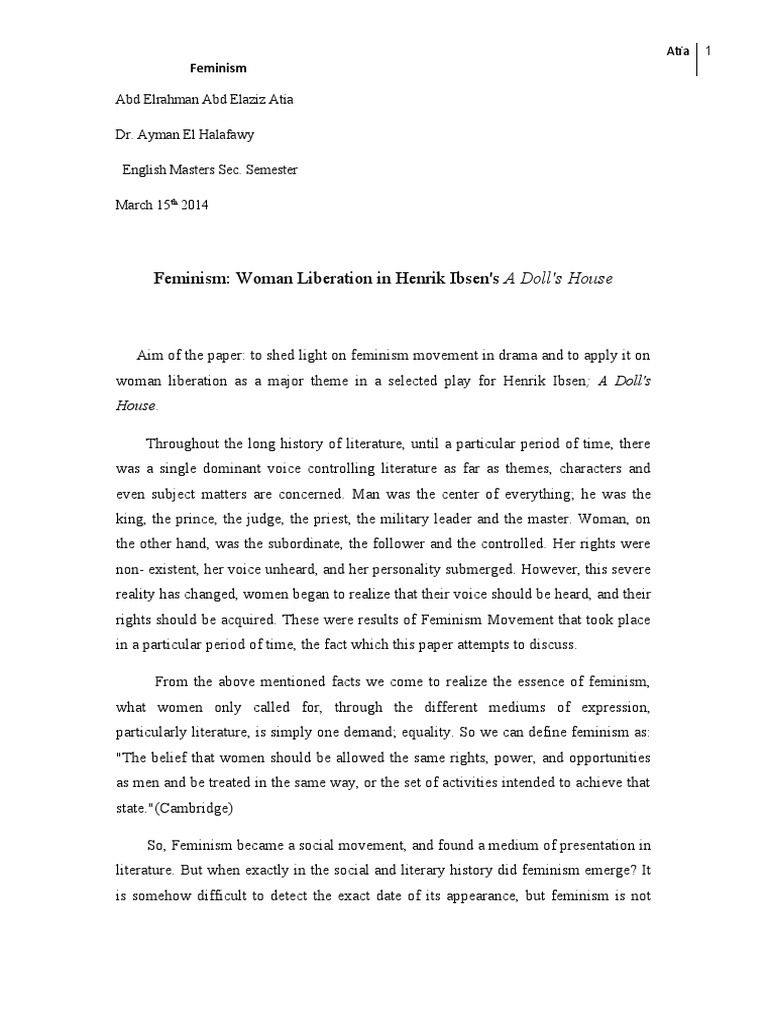
Henrik Ibsen’s A Doll’s House: a seemingly innocuous title for a theatrical grenade that detonated on the carefully manicured lawns of Victorian societal expectations. It was more than just a play; it was a seismic event, a literary earthquake that irrevocably shifted the tectonic plates of gender discourse. Forget the parlor games and polite tea parties. We’re diving headfirst into the raw, unflinching truth of a woman’s awakening and the societal shackles that sought to confine her.
We, as inheritors of the feminist struggle, owe it to ourselves to dissect this masterpiece, not merely as literature, but as a historical document – a testament to the enduring power of individual rebellion against systemic oppression. So, steel yourselves, sisters. We are about to embark on a journey into the heart of Nora Helmer’s discontent and the revolutionary spark it ignited.
The Gilded Cage: Unveiling Nora’s Subjugation
At first glance, Nora seems the epitome of domestic bliss. The dutiful wife, the doting mother, the charming entertainer of her husband, Torvald. But scratch beneath the surface, and you’ll find a woman suffocating under the weight of patriarchal expectations, her agency systematically eroded, reduced to a mere ornament in Torvald’s meticulously curated life. Her existence is a performance, a charade meticulously crafted to appease her husband and conform to the societal norms of the time. Think of her as a perfectly polished marionette, her strings pulled by the invisible hands of societal expectations and Torvald’s controlling desires.
Consider the demeaning pet names Torvald lavishes upon her: “little lark,” “squirrel,” “spendthrift.” These aren’t terms of endearment; they are insidious tools of infantilization, reinforcing Nora’s perceived inferiority and denying her the intellectual and emotional maturity to which she is rightfully entitled. He treats her not as an equal partner, but as a child, incapable of handling complex matters or possessing sound judgment. This infantilization is not accidental; it is a deliberate strategy to maintain his dominance and control.
Furthermore, Nora’s financial dependence on Torvald is a critical aspect of her subjugation. She is denied the opportunity to earn her own living, rendering her entirely reliant on her husband for sustenance and security. This economic vulnerability makes her susceptible to his whims and dictates, limiting her autonomy and restricting her choices. She is trapped in a gilded cage, her freedom curtailed by the very man who professes to love her.
The Forged Signature: A Catalyst for Revelation
Nora’s act of forgery, committed to save her husband’s life, is not merely a crime; it is an act of defiance, a desperate attempt to seize control of her own destiny in a world that systematically denies her agency. It is a radical act of self-preservation disguised as wifely devotion. The irony is palpable: she breaks the law to uphold the societal illusion of a perfect marriage, a marriage that is, in reality, a prison of her own making.
This act, however, becomes the catalyst for her eventual awakening. The threat of exposure forces her to confront the precariousness of her position and the superficiality of her marriage. She realizes that her entire life has been built on a foundation of lies and deception, a house of cards ready to collapse at any moment. The forged signature is not just a symbol of her transgression; it is a symbol of her growing awareness of the suffocating confines of her societal role.
Torvald’s Hypocrisy: The Unmasking of a Patriarch
Torvald’s reaction to the threat of scandal is the ultimate exposé of his true character. He is not concerned with Nora’s well-being or the motives behind her actions. His sole concern is his own reputation, his social standing, his carefully constructed image of a successful and respectable man. He is willing to sacrifice Nora to protect his own self-interest, revealing the profound selfishness and hypocrisy at the heart of his patriarchal worldview.
His pronouncements of love and devotion are exposed as hollow and self-serving. He values Nora not as an individual, but as a possession, an extension of his own ego. He demands absolute obedience and loyalty, but offers nothing in return but condescension and control. The mask of the loving husband is ripped away, revealing the tyrannical patriarch beneath.
Consider the infamous scene where Torvald, upon learning of the forgery, unleashes a torrent of vitriol upon Nora, accusing her of ruining his life and threatening to take away their children. His reaction is not one of concern or understanding, but of pure, unadulterated rage. He views Nora as a threat to his authority, a disobedient subject who has dared to challenge his power. This scene is a chilling reminder of the emotional abuse and manipulation that women often face in patriarchal societies.
The Door Slam Heard ‘Round the World: Nora’s Emancipation
Nora’s decision to leave Torvald, to abandon her roles as wife and mother, was a revolutionary act in its time, and it continues to resonate with women today. It was a rejection of societal expectations, a declaration of independence, a resounding “no” to the suffocating constraints of patriarchal marriage. That final door slam wasn’t just the sound of a woman leaving a house; it was the sound of a woman shattering the glass ceiling of societal expectations, the sound of a revolution being ignited.
She is not simply seeking personal happiness; she is seeking self-discovery, a deeper understanding of her own identity and purpose. She recognizes that she cannot fulfill her potential as a human being within the confines of her marriage, that she must break free to find her own voice and define her own destiny. Her departure is not an act of selfishness, but an act of self-preservation, a necessary step towards achieving true autonomy.
Nora’s journey is not without its complexities. Her abandonment of her children raises difficult questions about the responsibilities of motherhood. However, her decision must be understood within the context of her time and the limited options available to women. She recognizes that she cannot be a good mother if she is not a whole person, that she must first heal herself before she can effectively care for her children. Her departure is not a rejection of motherhood, but a recognition of its profound importance and the need for women to have the resources and support necessary to fulfill that role.
A Doll’s House: A Legacy of Feminist Awakening
A Doll’s House is more than just a play; it is a timeless testament to the enduring power of female resistance. It challenged the prevailing norms of Victorian society, sparked a global debate about women’s rights, and inspired generations of feminists to fight for equality and liberation. Its impact on the feminist movement is undeniable, and its message continues to resonate with women around the world.
The play forced audiences to confront uncomfortable truths about the realities of marriage, the limitations imposed on women, and the pervasive nature of patriarchal power. It challenged the romanticized ideals of domesticity and exposed the dark underbelly of societal expectations. A Doll’s House paved the way for future generations of feminist writers and activists to challenge the status quo and demand a more just and equitable world.
While significant progress has been made since Ibsen penned his masterpiece, the struggle for gender equality is far from over. Women continue to face discrimination, harassment, and violence in all aspects of their lives. The fight for equal pay, reproductive rights, and political representation remains a critical priority. A Doll’s House serves as a potent reminder of the ongoing need for vigilance and the enduring power of individual acts of defiance to challenge systemic oppression.
Therefore, let us not simply revere A Doll’s House as a historical artifact, but as a living testament to the enduring power of female agency. Let Nora’s story inspire us to question the societal norms that seek to confine us, to challenge the power structures that perpetuate inequality, and to fight for a future where all women are free to live authentically and pursue their full potential. The revolution, sisters, is far from over. The door is still open, and it’s our time to walk through it.







Leave a Comment