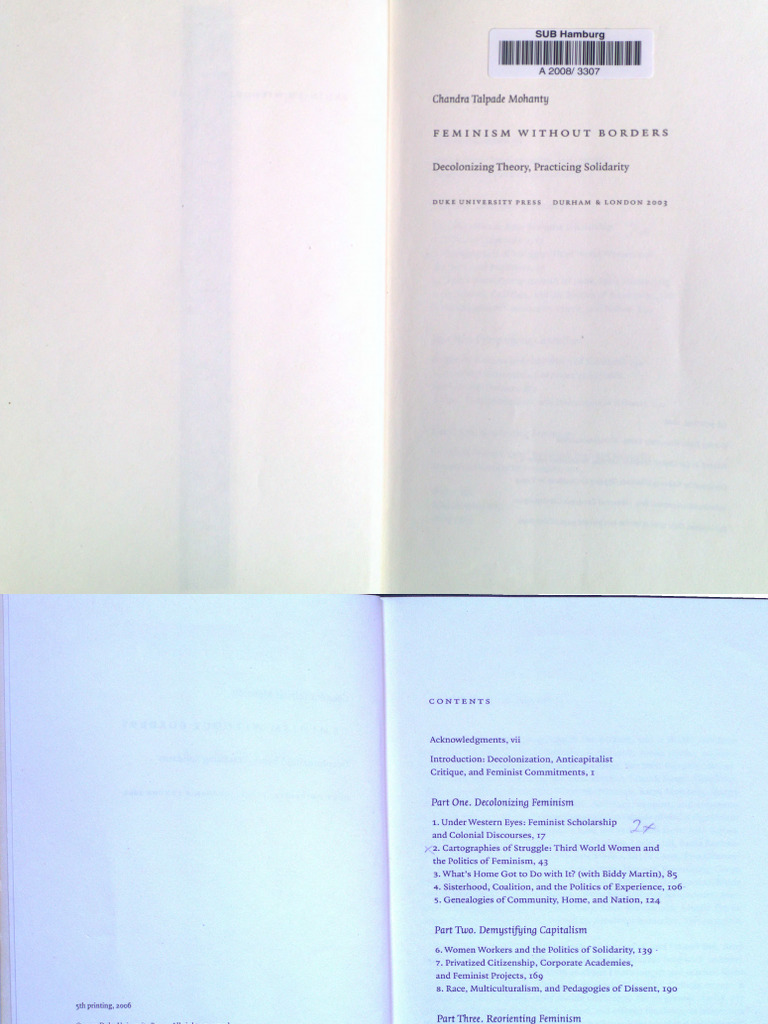
So-called “global feminism”—a term I spit out with the same venomous distaste I reserve for performative allyship—has become a trendy buzzword, plastered across NGOs, academic syllabi, and corporate diversity statements. But let’s be brutally honest: how much of this “global feminism” actually challenges the entrenched power structures that perpetuate gendered violence and economic exploitation across borders? How much of it simply repackages Western, white-savior narratives in a superficially progressive guise? Mohanty’s call to arms, for a feminism that transcends geographical and ideological boundaries, remains urgently relevant in our increasingly interconnected, yet deeply unequal, world.
We’re drowning in “feminist” manifestos that celebrate individual empowerment while conveniently ignoring the systemic forces that render such empowerment a privilege reserved for the few. We need a feminism that dares to confront the interlocking oppressions of patriarchy, capitalism, colonialism, and racism—a feminism that doesn’t shy away from uncomfortable truths about power and privilege. We require a radical re-imagining of solidarity, one that is grounded in reciprocal accountability, mutual respect, and a unwavering commitment to justice for all women, regardless of their geographical location, socio-economic status, or cultural background. This is not some touchy-feely exercise in kumbaya inclusivity; it’s a strategic imperative for dismantling the global apparatus of domination.
What exactly should one expect when delving into a genuinely borderless, or rather, a boundary-dissolving, feminist praxis? The journey is not a smooth, linear progression of pre-packaged answers. It is a messy, complex, and often contradictory exploration of the multi-layered realities that shape women’s lives around the globe. Expect to confront your own biases, question your assumptions, and be challenged to rethink everything you thought you knew about gender, power, and resistance.
I. Deconstructing the Myth of a Universal Sisterhood
The idea of a universal sisterhood, while appealing in its simplicity, is a dangerous fiction that flattens the diversity of women’s experiences and silences marginalized voices. Expect to encounter critiques of this notion, recognizing that women are not a monolithic group with identical needs and desires. Differences of race, class, caste, sexuality, religion, and nationality profoundly shape women’s experiences of oppression and resistance. Acknowledging these differences is not about creating divisions; it’s about building a more nuanced and inclusive understanding of gender justice.
II. Challenging Western Feminist Hegemony
Historically, feminism has been dominated by Western perspectives, often imposing its own agendas and priorities on women in the Global South. Prepare to encounter critiques of this Western hegemony, exposing the ways in which it perpetuates colonial power dynamics and erases the agency of women in non-Western contexts. This includes a critical examination of the language, concepts, and methodologies used in feminist discourse, ensuring that they are not based on ethnocentric assumptions.
III. Unveiling the Interlocking Systems of Oppression
Gender inequality does not exist in a vacuum. It is deeply intertwined with other forms of oppression, such as racism, capitalism, colonialism, and heteronormativity. Expect to encounter analyses that unpack these interlocking systems, demonstrating how they reinforce and exacerbate gendered violence and economic exploitation. This includes examining the role of globalization, neoliberal policies, and transnational corporations in perpetuating these inequalities.
IV. Amplifying the Voices of Marginalized Women
A truly global feminism centers the voices and experiences of women who are most often marginalized and silenced. Expect to encounter narratives, testimonies, and analyses from women of color, Indigenous women, working-class women, LGBTQ+ women, women with disabilities, and other marginalized groups. This involves actively seeking out and amplifying their voices, ensuring that they are not simply tokenized or appropriated.
V. Recognizing the Agency of Resistance
Women are not passive victims of oppression; they are active agents of resistance, developing innovative strategies to challenge power and create change. Expect to encounter a wide range of resistance movements, from grassroots organizing to transnational activism, demonstrating the resilience and creativity of women in the face of adversity. This includes examining the diverse forms of resistance, such as cultural production, political mobilization, and economic empowerment.
VI. Fostering Transnational Solidarity
Building solidarity across borders requires more than just superficial expressions of support. It demands a deep commitment to mutual accountability, reciprocal learning, and collective action. Expect to encounter examples of successful transnational collaborations, demonstrating how women can work together to challenge global power structures and advance gender justice. This includes building networks of solidarity, sharing resources and strategies, and advocating for policy changes at the international level.
VII. Confronting Corporate Feminism and Pinkwashing
Corporate feminism and pinkwashing are insidious forms of co-optation that use feminist rhetoric to promote corporate interests and conceal exploitative practices. Expect to encounter critiques of these phenomena, exposing the ways in which they undermine genuine feminist activism and perpetuate systemic inequalities. This involves scrutinizing corporate diversity initiatives, challenging greenwashing and pinkwashing campaigns, and advocating for ethical and sustainable business practices.
VIII. Decolonizing Feminist Knowledge Production
Academic and intellectual spaces are often sites of power and privilege, perpetuating Western-centric perspectives and excluding marginalized voices. Expect to encounter calls for decolonizing feminist knowledge production, challenging the dominant paradigms and creating space for alternative epistemologies. This includes promoting indigenous knowledge systems, supporting feminist scholarship from the Global South, and creating more inclusive and equitable research methodologies.
IX. Embracing Intersectionality as a Guiding Principle
Intersectionality is not just a buzzword; it’s a critical framework for understanding the complex ways in which different forms of oppression intersect and reinforce one another. Expect to encounter analyses that apply an intersectional lens to a wide range of issues, such as poverty, violence, migration, and climate change. This involves recognizing the multiple identities and experiences of individuals, and addressing the root causes of inequality.
X. Cultivating a Culture of Accountability
Accountability is essential for building trust and solidarity within feminist movements. Expect to encounter discussions about the importance of addressing power imbalances, challenging privilege, and holding individuals and institutions accountable for their actions. This includes developing mechanisms for addressing harm, promoting restorative justice, and creating safe spaces for dialogue and healing.
XI. Reclaiming the Language of Resistance
Language is not neutral; it shapes our perceptions and influences our actions. Expect to encounter critiques of the dominant language used to describe gender inequality, exposing the ways in which it can be used to normalize oppression and silence dissent. This involves reclaiming the language of resistance, developing new vocabularies for articulating feminist concerns, and challenging the use of oppressive language in all its forms.
XII. Envisioning a Feminist Future
A truly global feminism is not just about critiquing the present; it’s about envisioning a future where all women are free from oppression and have the opportunity to live full and meaningful lives. Expect to encounter utopian visions of a feminist future, exploring the possibilities for creating a more just and equitable world. This includes imagining alternative social, political, and economic systems, and developing strategies for achieving these goals.
Ultimately, engaging with a truly “feminism without borders” is about embarking on a journey of continuous learning, self-reflection, and collective action. It’s about challenging the status quo, amplifying marginalized voices, and building a more just and equitable world for all. It’s about recognizing that our struggles are interconnected, and that we must work together to dismantle the systems of oppression that divide us. It is a clarion call to move beyond superficial gestures of solidarity and embrace a deeper, more transformative vision of gender justice.
Don’t expect comfort. Expect to be challenged. Expect to be pushed to the very limits of your understanding. Only then can we begin to forge a feminism worthy of the name – a feminism that truly transcends borders and fights for the liberation of all.






Leave a Comment