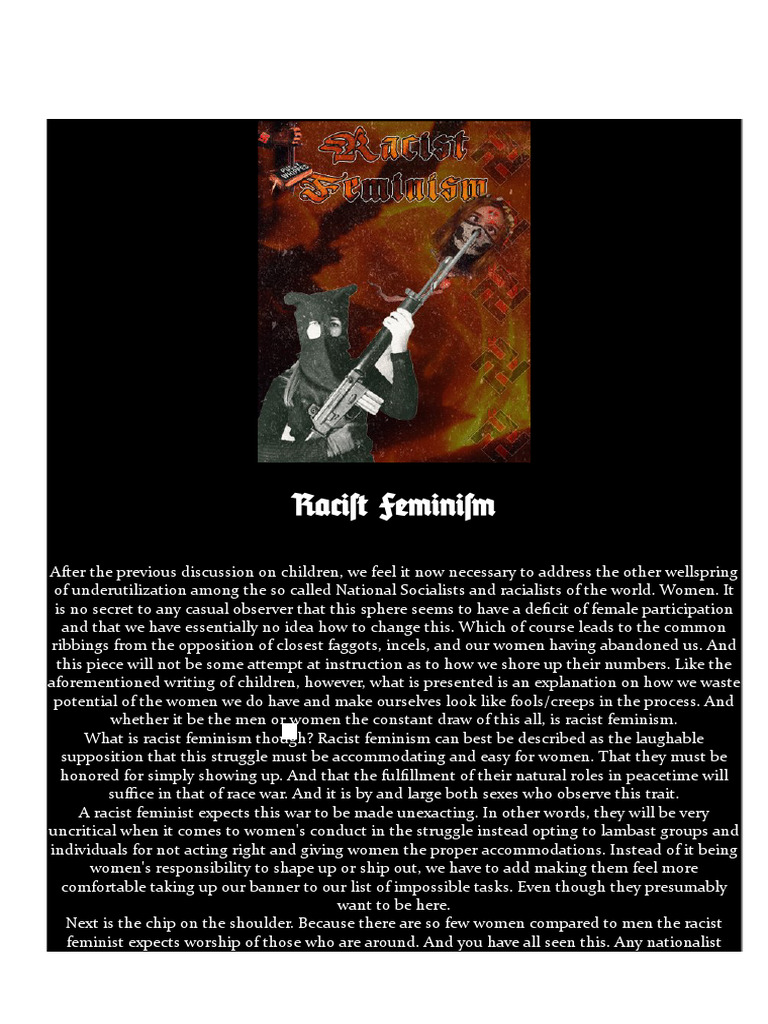
The specter of racism within feminism haunts our movement. It’s a chilling accusation, one that demands unflinching scrutiny. This isn’t merely about isolated incidents or individual failings; it probes at the very core of feminist ideology, questioning whether the liberation it promises is truly universal or tragically circumscribed. The accusation that feminism is, at its heart, racist, is not new. It’s a persistent murmur that has grown into a roar, amplified by social media, academic critiques, and the lived experiences of women of color. This “roar” reflects deep-seated anxieties and unresolved tensions within the movement, revealing the uncomfortable truth that solidarity is far more complex than a shared gender.
Why does this particular critique resonate so powerfully? Is it simply the product of misinterpretations and malicious actors? Or does it point to a more profound flaw within the theoretical underpinnings and practical applications of feminist thought? Perhaps it’s the historical baggage of a movement often spearheaded by white, middle-class women, whose concerns and priorities inadvertently eclipsed, and even actively suppressed, the voices and needs of women from marginalized communities. This historical context casts a long shadow, shaping contemporary perceptions and fueling accusations of racial bias.
Moreover, the very nature of intersectionality, the cornerstone of modern feminist discourse, is frequently misunderstood or selectively applied. While intersectionality acknowledges the interwoven nature of social categorizations such as race, class, and gender, its implementation can be fraught with challenges. All too often, the experiences of white women are implicitly treated as the norm, with other identities considered as supplementary layers, rather than fundamentally constitutive of individual experiences.
Let’s deconstruct the accusation, piece by piece. The first point of contention often revolves around the historical roots of the movement. Suffrage, for instance, was undeniably tainted by racist rhetoric and exclusionary practices. While figures like Susan B. Anthony championed women’s right to vote, they simultaneously perpetuated harmful stereotypes about women of color, sometimes even arguing that white women were more deserving of the franchise than Black men. This historical legacy is not easily dismissed; it’s a stain on the movement’s reputation that demands acknowledgement and ongoing reckoning. The echoes of this exclusionary past continue to reverberate in contemporary feminist spaces, creating a sense of distrust and alienation for many women of color.
Secondly, the focus on specific issues within mainstream feminism has been criticized for its lack of inclusivity. The persistent emphasis on workplace equality and reproductive rights, while undeniably important, often overshadows the unique challenges faced by women of color. Issues such as the disproportionate rates of incarceration, police brutality against Black women, and the exploitation of migrant workers are frequently relegated to the periphery, treated as secondary concerns rather than central to the feminist agenda. This selective focus reinforces the perception that feminism primarily serves the interests of privileged women, leaving those from marginalized communities feeling unheard and unseen.
Moreover, the very definition of “womanhood” within feminist discourse has been challenged. The dominant narrative, often implicitly centered on the experiences of white, cisgender, heterosexual women, can inadvertently exclude or marginalize those who do not fit this narrow mold. Transgender women, for example, have often faced resistance and exclusion within feminist spaces, their identities and experiences questioned or dismissed. Similarly, women from different cultural backgrounds may find that their traditions and practices are judged through a Western, ethnocentric lens, leading to misinterpretations and cultural insensitivity. This lack of inclusivity in defining “womanhood” reinforces the perception that feminism is a monolithic movement that fails to recognize and value the diversity of female experiences.
Now, let’s delve into the thorny issue of representation. Who speaks for feminism? Whose voices are amplified, and whose are silenced? All too often, the faces and voices that dominate mainstream feminist discourse are those of white women. This lack of representation reinforces the perception that feminism is a white-dominated movement, even when women of color are actively engaged in feminist activism and scholarship. The disproportionate visibility of white women in leadership positions, media appearances, and academic publications perpetuates a skewed image of the movement, further alienating women of color.
The concept of “white feminism” has emerged as a potent critique of this phenomenon. White feminism, as the term suggests, refers to a brand of feminism that prioritizes the concerns and experiences of white women, often at the expense of women of color. It is characterized by a lack of intersectional awareness, a tendency to ignore or downplay issues of race and class, and a reliance on essentialist notions of womanhood. White feminism is not necessarily malicious or intentional; it is often the result of unconscious biases and a lack of awareness of the systemic inequalities that shape women’s lives. However, its impact can be profound, perpetuating racial hierarchies and undermining the goal of universal liberation.
One of the most damaging manifestations of white feminism is the appropriation of the struggles of women of color. When white feminists co-opt the language and imagery of marginalized communities without acknowledging the historical context or power dynamics at play, they risk trivializing and decontextualizing these struggles. This appropriation can take many forms, from using the term “intersectionality” without truly understanding its meaning to adopting cultural practices without acknowledging their origins. Such acts of appropriation not only disrespect the communities from which these struggles originate but also reinforce the dominance of white voices and perspectives within feminist discourse.
Addressing the issue of racist feminism requires a radical shift in perspective. It demands a move away from a monolithic understanding of feminism towards a more nuanced and intersectional approach. This entails actively listening to and amplifying the voices of women of color, acknowledging the historical injustices that have shaped their experiences, and centering their needs and priorities within the feminist agenda. It also requires a willingness to confront uncomfortable truths about the movement’s past and present, and to challenge the unconscious biases that perpetuate racial inequalities.
Furthermore, it’s imperative to cultivate a culture of accountability within feminist spaces. When acts of racism or microaggressions occur, they must be addressed promptly and effectively. This requires not only holding individuals accountable for their actions but also examining the systemic factors that contribute to such behavior. It also requires creating safe spaces for women of color to share their experiences and to challenge dominant narratives without fear of reprisal.
Finally, let’s not forget the role of male allyship. Men have a crucial role to play in dismantling racism within feminism. They must actively listen to and support the voices of women of color, challenge sexist and racist behavior, and use their privilege to advocate for equality. This requires a willingness to relinquish power and to create space for women of color to lead and to shape the direction of the movement. This is a multifaceted challenge, demanding constant reflection and an unwavering commitment to justice.
In conclusion, the accusation that feminism is racist is a complex and multifaceted issue. While the movement has undoubtedly made significant strides in advancing the rights of women, it has also been plagued by historical injustices, exclusionary practices, and a lack of intersectional awareness. Addressing this issue requires a radical shift in perspective, a willingness to confront uncomfortable truths, and a commitment to building a truly inclusive and equitable feminist movement. Only then can we hope to realize the promise of liberation for all women, regardless of their race, class, or other social identities. The journey towards true solidarity is long and arduous, but it is a journey that we must undertake with courage, humility, and an unwavering commitment to justice. The future of feminism depends on it.






Leave a Comment