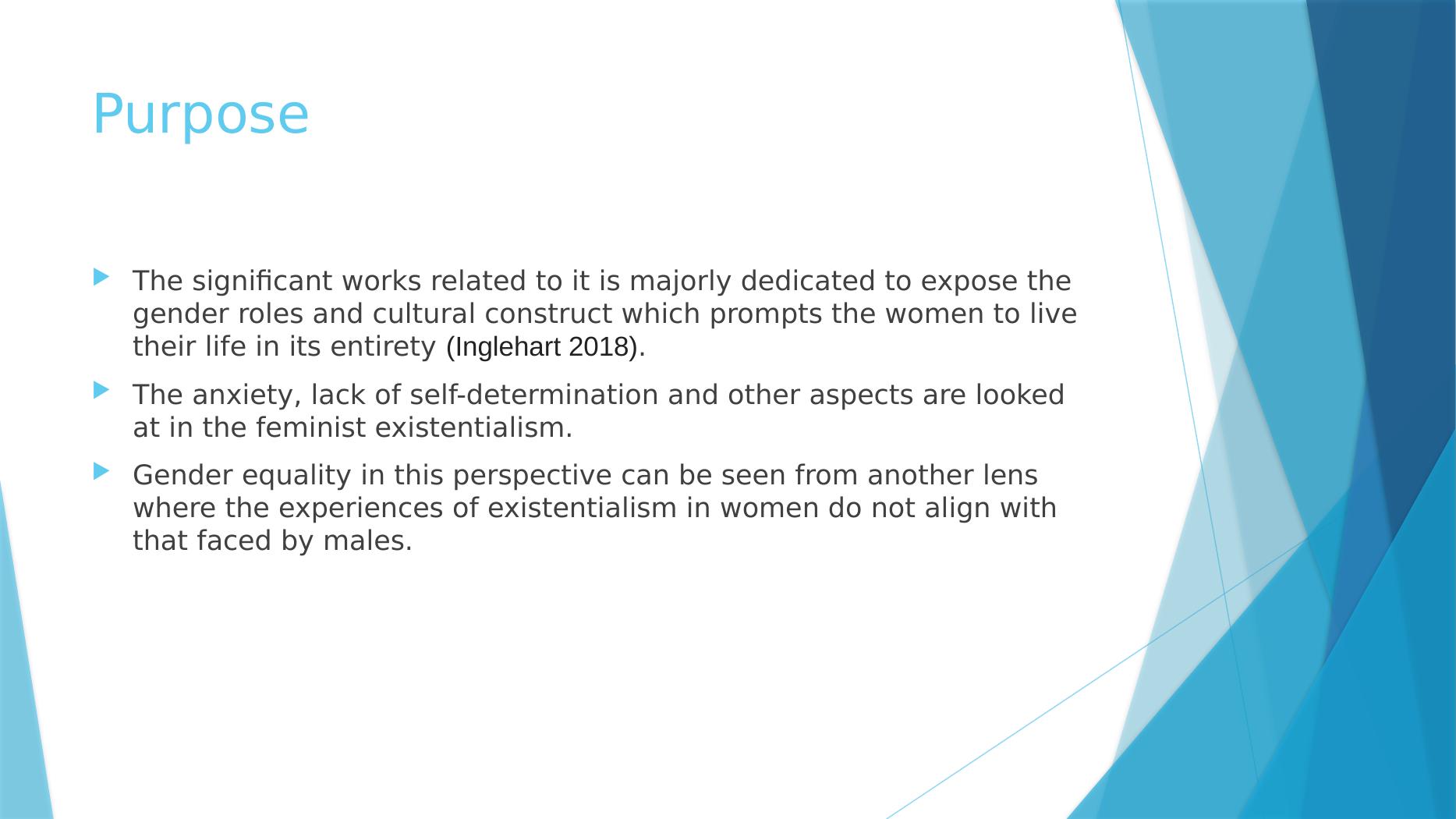
The allure of existentialism to feminist thought? It’s not merely academic. It’s visceral. We’re drawn to its stark pronouncements about freedom, about the burden of choice, about the construction of self because these resonate deeply with the lived experience of gender. Why this resonance? Because for centuries, womanhood has been defined for us, not by us. That pre-ordained definition is the societal shackle existentialism promises to shatter.
Existentialism, at its core, posits that existence precedes essence. We are born into the world, fundamentally undefined, and it is through our choices, our actions, that we create our own meaning, our own “essence.” This radical notion stands in stark contrast to traditional gender roles, which prescribe an essence to women long before they even have the chance to breathe. They’re told they’re nurturing, emotional, passive; that their primary purpose is to be wives and mothers. Such deterministic claims are anathema to the existentialist spirit.
Consider Simone de Beauvoir, arguably the most crucial figure in bridging existentialism and feminism. Her seminal work, The Second Sex, dismantles the very notion of an inherent female essence. De Beauvoir argued that “one is not born, but rather becomes, a woman.” This isn’t a biological statement; it’s a sociocultural one. Womanhood is not a given, but a construct, imposed upon individuals through socialization, education, and patriarchal structures. It is a learned performance, a set of expectations one is compelled to enact. This imposition, this external definition, is precisely what existentialism rejects.
The concept of “bad faith” is also crucial here. Sartre used this term to describe the act of denying one’s freedom, of embracing pre-determined roles and values rather than creating one’s own. For women, living in bad faith means accepting the societal script of womanhood without question, relinquishing their agency and self-determination. It means allowing others to define their potential, their aspirations, their very being. To combat this, existentialist feminism urges women to embrace their freedom, to challenge the norms, to forge their own paths, irrespective of societal expectations. This requires a constant vigilance against the insidious pressure to conform, to accept the status quo.
However, the intersection of freedom, choice, and gender is far from simple. The existentialist emphasis on individual responsibility can, at times, feel jarring in the face of systemic oppression. Are women truly free to choose when their choices are constrained by limited opportunities, wage gaps, and societal biases? Can one speak of authentic self-creation when the very fabric of society is designed to shape and control women’s lives? This is where the limitations, and necessary expansions, of existentialism become apparent.
The existentialist framework, while powerful in its emphasis on individual agency, often overlooks the profound impact of social structures. It’s not enough to simply exhort women to “choose” their own identities when those choices are severely limited by systemic inequalities. True freedom requires not only individual self-assertion but also collective action to dismantle the very structures that constrain women’s choices in the first place. This necessitates a move beyond purely individualistic existentialism towards a more nuanced understanding of social and political realities.
Consider the seemingly innocuous choice of career. A woman who chooses to pursue a high-powered corporate job may face discrimination in hiring, promotion, and pay. She may be judged more harshly for her ambition than her male counterparts. Her decision, while seemingly freely made, is undoubtedly shaped by these external factors. To ignore these realities is to engage in a form of willful blindness. The existentialist ideal of self-creation must be tempered with a recognition of the very real constraints imposed by societal structures.
Furthermore, the existentialist emphasis on radical individualism can also inadvertently reinforce the myth of the autonomous, self-sufficient individual, a myth that often serves to obscure the interconnectedness of human lives. Women, particularly, have historically been positioned as caretakers, responsible for the emotional and physical well-being of others. To ignore these relational aspects of women’s lives is to offer an incomplete and potentially damaging picture of their experiences. A more nuanced existentialist feminism acknowledges the importance of connection, community, and solidarity in the struggle for liberation.
The concept of “situated freedom” offers a compelling way to reconcile the existentialist emphasis on agency with the recognition of social constraints. It acknowledges that our freedom is always exercised within a specific context, shaped by our social location, our history, and our relationships. We are not free-floating individuals making choices in a vacuum; we are always embedded in a web of social relations and power dynamics. Recognizing this situatedness allows us to understand how our choices are both enabled and constrained by our social circumstances.
Moreover, feminist existentialism challenges the traditional Cartesian split between mind and body. Existentialism emphasizes the lived body as the locus of experience, the point of contact between the individual and the world. For women, the body is often a site of struggle, subject to objectification, control, and violence. Feminist existentialism seeks to reclaim the body as a source of power and agency, challenging the patriarchal norms that seek to define and control women’s bodies.
Think about the societal pressures on women to conform to certain beauty standards. These standards are not merely aesthetic preferences; they are powerful social forces that shape women’s self-esteem, their opportunities, and their very sense of self. To resist these pressures is to reclaim one’s body as one’s own, to define beauty on one’s own terms. This is not simply a matter of individual choice; it is a political act of resistance against the patriarchal forces that seek to control women’s bodies and lives.
The notion of “ambiguity” is also central to feminist existentialism. Existentialism recognizes that human existence is inherently ambiguous, characterized by uncertainty, contradiction, and the absence of fixed meanings. Women, in particular, are often forced to navigate conflicting expectations and demands. They are expected to be both strong and nurturing, independent and dependent, ambitious and selfless. This constant negotiation of contradictory roles can be a source of profound anxiety and frustration. Feminist existentialism encourages women to embrace this ambiguity, to resist the pressure to conform to fixed categories, and to create their own meanings in the face of uncertainty.
The project of feminist existentialism is not to offer a definitive answer to the question of what it means to be a woman. Rather, it is to provide a framework for understanding the complexities of gender, freedom, and choice. It is a call to action, urging women to embrace their agency, to challenge the norms, and to create their own authentic selves in the face of societal constraints. This is a continuous process of self-creation, a constant struggle against the forces that seek to define and control women’s lives.
Ultimately, the enduring appeal of existentialism to feminism lies in its radical affirmation of human freedom. It reminds us that we are not merely passive recipients of societal norms; we are active agents in the creation of our own lives. And although society likes to pretend we are free to chose, there is a subtle but present force which makes the free choice something of an illusion. But only something. The challenge is to find the true choices, and to make them, without regard to what others consider to be our place.
The journey of liberation is not easy. It requires courage, resilience, and a unwavering commitment to self-determination. Existentialism doesn’t provide easy answers, but it does offer a powerful framework for navigating the complexities of gender, freedom, and choice. In a world that often seeks to define and control women’s lives, existentialist feminism provides a beacon of hope, reminding us that we have the power to create our own destinies. Let us, therefore, embrace our freedom, challenge the norms, and forge our own paths toward a more just and equitable world. The work ahead is arduous, but the possibilities are limitless. Let’s get started.





Leave a Comment