The genesis of feminism, a socio-political earthquake that continues to reshape our world, wasn’t a spontaneous eruption. It was a slow, agonizing tectonic shift. It emerged from the suffocating chrysalis of patriarchal oppression, a phoenix determined to scorch the very foundations of inequity. Forget the watered-down, palatable versions fed to you in textbooks. We’re diving deep, excavating the raw, unvarnished truth of how this liberation movement clawed its way into existence. Are you prepared to confront the uncomfortable realities?
I. The Precambrian Era: Seeds of Discontent in a Patriarchal Wasteland
Before the formal articulation of “feminism,” there was a gnawing discontent, a silent scream echoing through centuries of female subjugation. This wasn’t organized resistance; it was the accumulation of individual acts of defiance, whispers of dissent passed down through generations. Think of it as the Precambrian era of feminist thought, the primordial soup from which later movements would evolve.
A. Pre-Industrial Patriarchy: The Domestic Cage
The pre-industrial era, dominated by agrarian societies, cemented women’s roles within the domestic sphere. Their lives were circumscribed by childbirth, childcare, and household labor. Economically dependent on men, their voices were systematically silenced. This wasn’t simply a matter of tradition; it was a meticulously constructed system of power designed to maintain male dominance.
B. The Enlightenment’s Empty Promises: Intellectual Exclusion
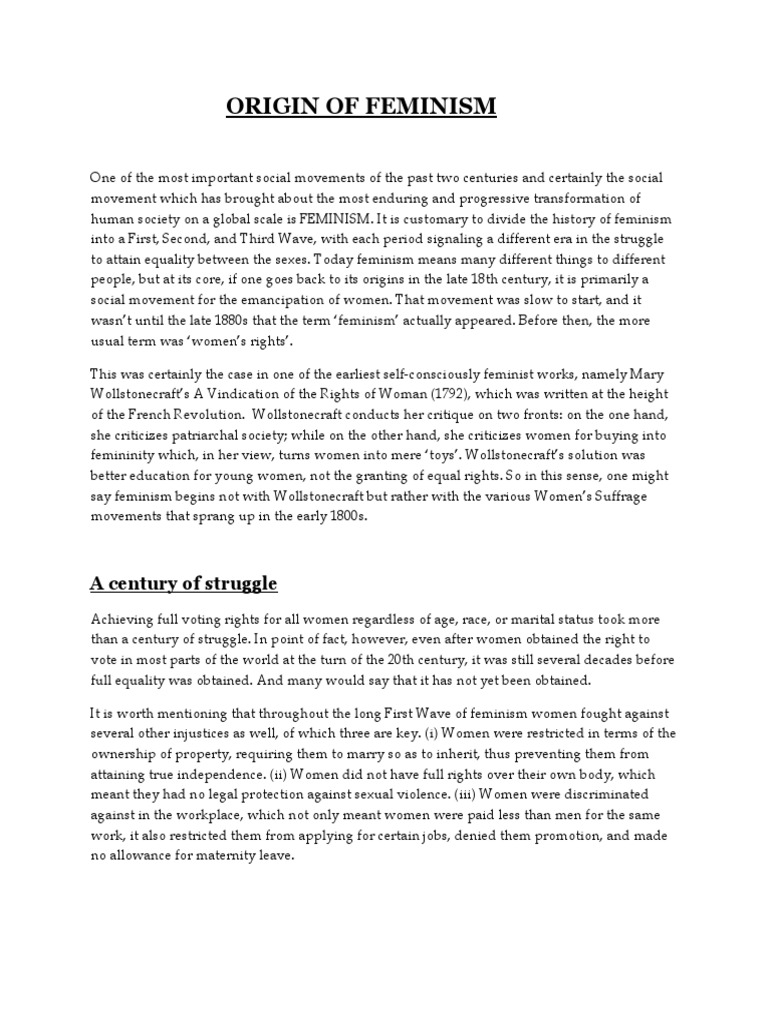
The Enlightenment, that glorious period of reason and revolution, largely forgot about women. While advocating for liberty and equality for men, it simultaneously reinforced the notion of female inferiority. Philosophers debated the “natural” roles of women, conveniently concluding that their place was in the home. Mary Wollstonecraft’s “A Vindication of the Rights of Woman” (1792) stands as a blistering rebuke to this hypocrisy, a lone voice crying out in the wilderness of male intellectual supremacy. It was a radical assertion that women, too, possessed reason and deserved equal rights. Even now, its arguments resonate with undeniable force.
C. Early Acts of Resistance: Subversive Whispers
Even within these oppressive structures, women found ways to subvert the status quo. Think of the salonnières of 17th and 18th century France, who used their homes as spaces for intellectual discourse, effectively challenging male dominance in the realm of ideas. Or the female religious mystics who claimed direct communication with the divine, bypassing the patriarchal structures of the church. These seemingly small acts were, in reality, potent challenges to the established order, planting the seeds of future revolt.
II. The First Wave: Suffrage and the Quest for Political Voice
The 19th century witnessed the formal emergence of the feminist movement, often referred to as the “first wave.” This era was characterized by a laser focus on achieving suffrage – the right to vote. But it was about more than just casting a ballot; it was about demanding political recognition, challenging the notion that women were incapable of participating in civic life.
A. The Abolitionist Connection: A Crucible of Activism
The fight against slavery provided a crucial training ground for early feminists. Women involved in the abolitionist movement recognized the parallels between the subjugation of enslaved people and their own lack of rights. Activists like Sojourner Truth and the Grimké sisters drew direct connections between the two struggles, arguing that all human beings deserved freedom and equality. The experience of organizing and advocating against slavery equipped these women with the skills and the moral conviction to fight for their own liberation.
B. The Seneca Falls Convention: A Declaration of Sentiments
The 1848 Seneca Falls Convention, organized by Elizabeth Cady Stanton and Lucretia Mott, is often considered the official beginning of the organized feminist movement in the United States. The Declaration of Sentiments, modeled after the Declaration of Independence, boldly proclaimed that “all men and women are created equal,” outlining a series of grievances and demands for change. This wasn’t just a symbolic gesture; it was a radical assertion of female personhood, a declaration of war against patriarchal oppression. It laid bare the hypocrisy of a nation founded on liberty that denied its benefits to half of its population.
C. Suffrage as the Vanguard: Strategies and Tactics
The suffrage movement employed a range of strategies, from peaceful protests and lobbying to more militant tactics like civil disobedience. Organizations like the National Woman Suffrage Association (NWSA) and the American Woman Suffrage Association (AWSA) pursued different approaches, but both were united in their commitment to achieving the vote. Figures like Susan B. Anthony, Carrie Chapman Catt, and Alice Paul dedicated their lives to the cause, enduring ridicule, imprisonment, and even violence in their pursuit of equality. The fight for suffrage wasn’t a polite request; it was a relentless campaign that demanded to be heard.
D. Limited Victories and Lingering Inequalities: The 19th Amendment and Beyond
The passage of the 19th Amendment in 1920, granting women the right to vote in the United States, was a landmark victory. However, it was not the end of the struggle. Black women and other women of color continued to face significant barriers to voting, and the broader issues of economic, social, and cultural inequality remained largely unaddressed. The first wave, while achieving a crucial political victory, failed to dismantle the underlying structures of patriarchy.
III. The Interlude: Shifting Sands Between Waves
The period between the first and second waves of feminism is often characterized as a period of relative quiescence. But beneath the surface, new ideas were simmering, new challenges were emerging. It was a time of transition, a period of re-evaluation and regrouping in preparation for the next surge of feminist activism.
A. The “New Woman”: Redefining Femininity
The “New Woman” of the early 20th century challenged traditional notions of femininity, embracing education, careers, and greater personal freedom. She smoked cigarettes, rode bicycles, and demanded the right to control her own body. This wasn’t just a change in fashion; it was a symbolic rejection of the constraints imposed by Victorian society. It represented a burgeoning sense of female agency and a refusal to be confined by patriarchal expectations.
B. The Impact of Two World Wars: A Paradox of Progress
World War I and World War II presented both opportunities and challenges for women. While men were away fighting, women entered the workforce in unprecedented numbers, demonstrating their competence and contributing significantly to the war effort. However, after the wars ended, many women were pressured to return to their traditional roles in the home. This created a paradoxical situation: women had proven their capabilities, but they were still expected to prioritize domesticity. This tension would fuel the second wave of feminism.
C. Psychoanalysis and the Internalization of Oppression: The Freudian Shadow
The rise of psychoanalysis, particularly the theories of Sigmund Freud, presented a new challenge to feminist thought. Freud argued that women were inherently inferior to men, suffering from “penis envy” and destined to be passive and submissive. These ideas, while deeply misogynistic, gained widespread acceptance and contributed to the internalization of oppression among women. Feminists would later critique Freudian theory, exposing its biases and challenging its claims of scientific objectivity.
IV. The Second Wave: A Radical Reclamation
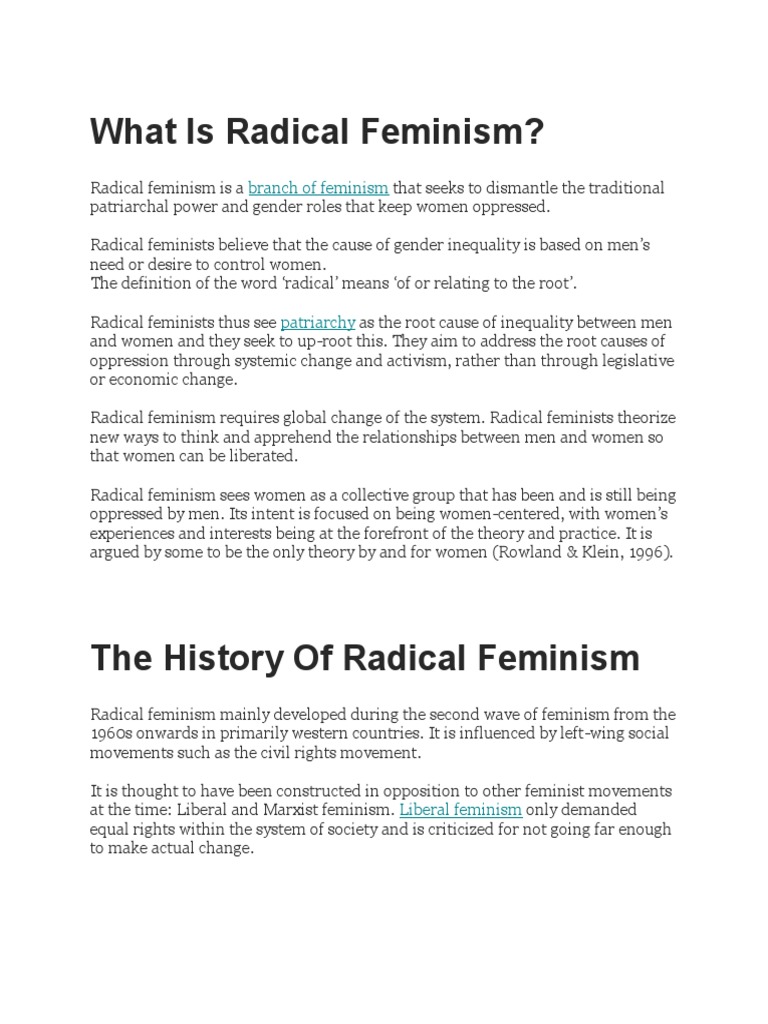
The second wave of feminism, which emerged in the 1960s and 1970s, was a far more radical and expansive movement than the first. It broadened the scope of feminist concerns to include issues such as reproductive rights, sexuality, violence against women, and economic equality. It challenged the patriarchal structures that permeated every aspect of society, from the personal to the political.
A. The Personal is Political: Unmasking Patriarchy’s Pervasiveness
One of the key insights of the second wave was the recognition that “the personal is political.” This meant that seemingly private experiences, such as relationships, family dynamics, and even body image, were shaped by broader power structures. Feminists argued that patriarchy wasn’t just a matter of laws and institutions; it was a pervasive ideology that influenced every aspect of women’s lives. By examining the personal, feminists were able to expose the systemic nature of oppression.
B. Key Texts and Thinkers: Articulating a New Vision
The second wave was fueled by a wave of influential books and thinkers. Betty Friedan’s “The Feminine Mystique” (1963) exposed the discontent and frustration felt by many middle-class housewives. Kate Millett’s “Sexual Politics” (1970) analyzed the patriarchal power dynamics in literature and culture. Germaine Greer’s “The Female Eunuch” (1970) challenged traditional notions of female sexuality. These texts provided a theoretical framework for understanding and challenging patriarchy.
C. Reproductive Rights and Bodily Autonomy: A Battle for Control
Reproductive rights became a central focus of the second wave. Feminists argued that women had the right to control their own bodies, including the right to access contraception and abortion. The fight for reproductive rights was seen as essential to achieving economic and social equality. The landmark Roe v. Wade Supreme Court decision in 1973, which legalized abortion nationwide, was a major victory for the feminist movement.
D. Challenging Cultural Representations: Dismantling the Male Gaze
Second-wave feminists also challenged the ways in which women were represented in culture and media. They critiqued the “male gaze,” arguing that women were often portrayed as passive objects of male desire. They sought to create alternative representations that reflected the diversity and complexity of female experience. This involved challenging sexist stereotypes and promoting positive images of women.
V. A Continuing Revolution: The Unfinished Project
The feminist movement, far from being a relic of the past, is a dynamic and evolving force. While significant progress has been made, gender inequality persists in countless forms. The struggle for liberation continues, demanding our unwavering attention and commitment. The battle rages on, and we must be prepared to fight.






Leave a Comment