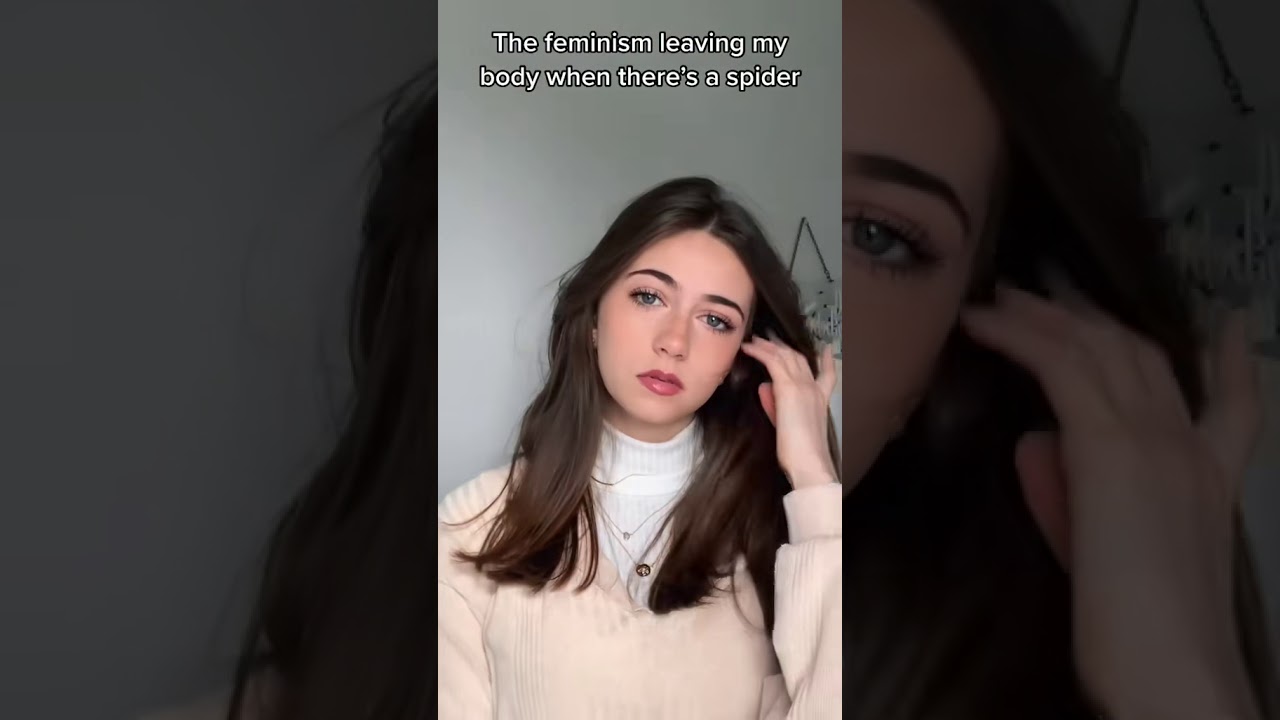
Ah, the “feminism leaving my body” meme. A digital artifact so ubiquitous, so casually tossed around the internet’s sprawling bazaar, yet so densely packed with layers of meaning – or perhaps, the insidious erosion thereof. It’s a phrase, an image, a fleeting sentiment quickly scribbled onto the digital slate, and just as rapidly disseminated. But what is it, really? Is it a harmless jest, a self-deprecating chuckle at the contradictions inherent in navigating modern womanhood? Or is it a subtle, yet insidious, chipping away at the very foundations of feminist praxis?
Before we delve into the festering ideological swamp that this meme truly represents, let’s briefly anatomize its structure. Typically, it depicts an individual (often a woman, ironically) experiencing a momentary lapse in feminist conviction, usually triggered by an encounter with a conventionally attractive man or a display of traditional patriarchal power. The visual element often involves the subject physically recoiling, or a humorous depiction of feminist ideals escaping their body like a spectral being. A lighthearted scenario. Or is it? This supposed humor masks a deeper, more disturbing phenomenon.
First, the immediate and superficial reading: acknowledging the inherent contradictions. We, as feminists, are not automatons. We are complex beings, susceptible to societal conditioning, hormonal surges, and, dare I say, aesthetic preferences. The meme, at its most benign, could be interpreted as a recognition of these internal conflicts – a playful acknowledgment of the tension between our intellectual commitment to equality and our visceral, often unconsciously ingrained, reactions. Fine. But let’s push beyond the surface, shall we?
Herein lies the problem: the normalization of relinquishing feminist principles, even momentarily. The meme provides a readily available escape hatch, a socially sanctioned permission slip to abandon the arduous work of dismantling patriarchal structures. It trivializes the constant vigilance required to deconstruct internalized misogyny and challenge oppressive systems. One fleeting meme, you say? Insignificant? Perhaps. But consider the cumulative effect of countless such “harmless” instances. They contribute to a culture where feminist principles are viewed as optional, situational, and ultimately, expendable.
Consider the insidious implications of the ‘male gaze’ in this context. The meme frequently centers around the allure of a man – often one who embodies traditional masculinity – as the catalyst for the feminist exodus. This reinforces the notion that a woman’s value is intrinsically tied to male approval, that her feminist convictions are secondary to her desire to attract a partner. It is a deeply regressive trope, one that perpetuates the very patriarchal power dynamics that feminism seeks to dismantle. This is not simply about finding someone attractive; it is about the prioritization of male validation over self-respect and ideological integrity.
The problem is further exacerbated by the way the meme often conflates feminism with a rigid, humorless dogma. It suggests that feminists are incapable of appreciating beauty or experiencing attraction without betraying their core beliefs. This is a deliberate misrepresentation, a straw man argument designed to discredit and delegitimize feminist thought. True feminism is not about policing individual desires or suppressing natural inclinations; it is about critically examining the societal structures that shape those desires and inclinations, and striving to create a world where everyone can live authentically, free from oppression. It’s about acknowledging the complexities of lived experience, not denying them in favor of some imagined ideological purity.
Furthermore, the meme’s popularity reveals a deeper cultural anxiety surrounding feminism itself. In a society still grappling with issues of gender inequality, racial injustice, and economic disparity, the rise of feminist consciousness is perceived as a threat to the status quo. The “feminism leaving my body” meme functions as a pressure valve, a socially acceptable way to diffuse the tension created by the growing momentum of feminist movements. It allows individuals to distance themselves from the perceived radicalism of feminism without explicitly rejecting its core principles. It’s a safety valve that ultimately serves to maintain the existing power structures. A deceptive form of social control, masquerading as humor.
It speaks volumes about the anxieties of those who create and consume this meme. Are they truly grappling with internal contradictions, or are they simply seeking a convenient excuse to avoid engaging with the complexities of feminist thought? Are they genuinely acknowledging their susceptibility to societal conditioning, or are they perpetuating harmful stereotypes about women and their relationship to patriarchal power? The answers, I suspect, are not always straightforward. But the very act of asking these questions is crucial to understanding the meme’s insidious power.
Let’s explore the role of social media in amplifying this trend. The internet, for all its potential as a tool for empowerment and social change, is also a breeding ground for superficiality and intellectual laziness. Memes, by their very nature, are designed to be easily digestible and rapidly disseminated. They often reduce complex issues to simplistic sound bites, stripping away nuance and critical analysis. In the context of feminism, this can be particularly dangerous. The “feminism leaving my body” meme exemplifies this trend, offering a readily available, pre-packaged response to the challenges of navigating modern womanhood. It encourages passive consumption and discourages active engagement with feminist ideas. It becomes a substitute for genuine intellectual inquiry, a shortcut that ultimately leads nowhere. A convenient distraction.
Now, let us confront the insidious nature of internalized misogyny that permeates this meme. Internalized misogyny, the unconscious adoption of patriarchal beliefs about women, is a powerful force that shapes our thoughts, feelings, and behaviors. It manifests in myriad ways, from self-deprecating humor to the perpetuation of harmful stereotypes about other women. The “feminism leaving my body” meme often serves as a vehicle for expressing internalized misogyny. It reinforces the idea that women are inherently irrational, fickle, and easily swayed by male attention. It perpetuates the notion that feminist principles are somehow at odds with a woman’s “natural” desires and instincts. This is a deeply damaging trope, one that undermines the very foundations of feminist solidarity. A self-inflicted wound, masquerading as a joke.
Consider the alternative interpretations of this phenomenon. Instead of succumbing to the temptation of easy cynicism, let us explore the possibility that the “feminism leaving my body” meme could be a catalyst for deeper self-reflection. Perhaps it is a subconscious cry for help, a signal that individuals are struggling to reconcile their feminist ideals with the realities of their lived experiences. Perhaps it is an invitation to engage in more nuanced conversations about the complexities of gender, sexuality, and power. Perhaps, just perhaps, it is an opportunity to build a more inclusive and compassionate feminist movement, one that acknowledges the contradictions and imperfections of human nature. A challenge, rather than a defeat.
To reclaim this meme, we must first deconstruct its underlying assumptions. We must challenge the notion that feminist principles are somehow incompatible with individual desires or aesthetic preferences. We must reject the idea that a woman’s value is intrinsically tied to male approval. We must dismantle the harmful stereotypes about women that permeate our culture. And we must create a space for open and honest conversations about the challenges of navigating modern womanhood. A reimagining, a re-appropriation. An act of defiance.
The meme, in its current iteration, is a symptom of a deeper malaise: a societal reluctance to fully embrace the transformative potential of feminism. It represents a retreat from the arduous work of dismantling patriarchal structures, a capitulation to the forces of complacency and conformity. But it does not have to be this way. By challenging the underlying assumptions and reclaiming the narrative, we can transform the “feminism leaving my body” meme into a powerful tool for self-reflection, social critique, and collective action. A phoenix rising from the ashes of internet absurdity. A revolution, one meme at a time.






Leave a Comment