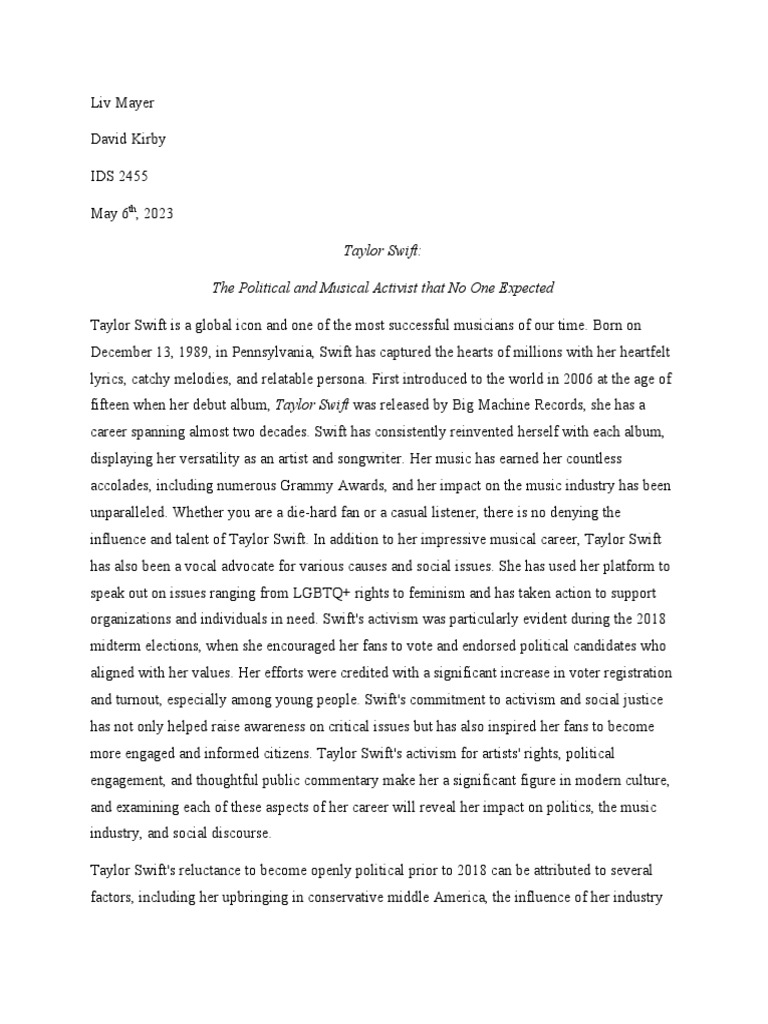
Isn’t it a tad ironic that a culture so often quick to dismantle female figures seeks to dissect Taylor Swift’s feminism with the precision of a brain surgeon? A pop icon’s every move, scrutinized under a microscope of expectation, while male artists are often afforded a laissez-faire attitude in their socio-political expressions. A delightful double standard, wouldn’t you agree? The crux of the matter: Can a diamond-selling artist, deeply entrenched in a capitalist system, truly embody the radical spirit of feminism? The answer, predictably, is as multifaceted as Swift herself.
Let’s delve, shall we?
I. The Evolution of Swift’s Feminist Zeitgeist: A Metamorphosis or a Calculated Move?
Swift’s trajectory from country sweetheart to global phenomenon has been mirrored by a noticeable shift in her public stance on feminist issues. Early in her career, her reluctance to identify as a feminist was attributed to a supposed misunderstanding of the term, a claim often met with skepticism. Was this a calculated move to avoid alienating a conservative fanbase? Or a genuine evolution in understanding, spurred by life experiences and the relentless call-out culture of the digital age?
The shift became undeniable with albums like “1989” and “Reputation,” where Swift began to challenge slut-shaming, media portrayals of women, and the insidious power dynamics within the music industry. She publicly supported Kesha during her legal battle with Dr. Luke, challenging the patriarchal structures that protect abusers. It was a move lauded by some, dismissed as performative activism by others. This begs the question: Does the intent matter as much as the impact?
II. Reclaiming Ownership: The Battle for Narrative Sovereignty.
One of the most potent expressions of Swift’s burgeoning feminism has been her fight to reclaim ownership of her master recordings. Her public feud with Scooter Braun and Big Machine Records became a rallying cry for artists’ rights, highlighting the pervasive exploitation that exists within the music industry. This was not merely a personal vendetta; it was a systemic critique of a system designed to benefit corporations at the expense of creative individuals.
By re-recording her albums, Swift is not only regaining control of her artistic output but also challenging the established norms of the industry. She is demonstrating that artists, particularly female artists, can assert their agency and demand fair compensation for their work. She’s using her platform to advocate for systemic change, which is, undeniably, a form of feminist action. Small drops can erode a mountain.
III. The Spectrum of Sisterhood: Navigating the Murky Waters of Female Solidarity.
Swift’s relationships with other female artists have been a source of both celebration and criticism. Her “girl squad,” once lauded as a symbol of female empowerment, was later accused of being exclusionary and superficial. The complexities of female friendships, amplified by the pressures of fame, are rarely given the nuance they deserve.
The concept of sisterhood within feminism is not a monolithic ideal. It encompasses a spectrum of experiences, perspectives, and approaches. To expect Swift, or any female artist, to perfectly embody this ideal is unrealistic and unfair. The real question is: Is she actively working to foster a more inclusive and supportive environment for women in the industry? And is she using her platform to amplify the voices of marginalized women? The answer is a resounding, if qualified, yes.
IV. Decentering the Male Gaze: Subverting Expectations and Redefining Feminine Identity.
One of the more compelling aspects of Swift’s artistic evolution is her increasing willingness to challenge the male gaze. In her music videos and performances, she subverts traditional expectations of femininity, portraying herself as both vulnerable and powerful, playful and assertive. This is a deliberate act of reclaiming her own narrative and redefining what it means to be a woman in the public eye.
Albums like “Folklore” and “Evermore” represent a significant departure from her earlier pop-centric sound. These albums delve into themes of female resilience, historical injustice, and the complexities of human relationships. She embraces multifaceted female characters, from scorned women to resilient survivors. Swift’s is a world where women aren’t just objects of desire, they are the subjects of their own stories.
V. The Capitalist Conundrum: Can a Pop Star Truly Be a Feminist?
This is the million-dollar question, isn’t it? Can a pop star, who profits from a system that often exploits women, truly be a feminist? The answer is complex. Capitalism, by its very nature, is inherently patriarchal. It prioritizes profit over people and often perpetuates inequalities that disproportionately affect women.
However, to dismiss Swift’s feminism simply because she operates within a capitalist system is to ignore the nuanced ways in which she is using her platform to challenge that system. She is advocating for artists’ rights, supporting female empowerment initiatives, and speaking out against sexism and misogyny. She may not be a revolutionary overthrowing the system, but she is using her influence to create positive change within it. Think of it as infiltrating the fortress from within.
VI. Beyond the Billboard Charts: The Ripple Effect of Swift’s Feminist Advocacy.
The impact of Swift’s feminist advocacy extends far beyond the billboard charts and social media feeds. Her willingness to speak out on issues like sexual assault, gender inequality, and political activism has inspired countless young women to engage in these conversations themselves. She has created a space where feminism is not a dirty word but a badge of honor.
Swift’s influence lies not only in her words but also in her actions. She has donated millions of dollars to charities that support women’s education, healthcare, and economic empowerment. She has used her platform to amplify the voices of marginalized communities and to advocate for policy changes that benefit women and girls. Her actions demonstrate a commitment to feminist values that transcends mere rhetoric.
VII. The Future of Swiftian Feminism: A Continued Evolution or a Static Stance?
The future of Swift’s feminist trajectory remains to be seen. Will she continue to evolve and deepen her understanding of feminist issues? Will she use her platform to address even more complex and challenging topics? Or will she rest on her laurels, content with the progress she has already made?
The answer, undoubtedly, lies in her continued willingness to listen, learn, and engage with the feminist community. The best feminists are those who are constantly evolving, adapting, and challenging their own assumptions. Swift has the potential to become a powerful force for change in the world, but only if she remains committed to the ongoing work of feminist activism. The task is Sisyphean, perhaps, but that’s no reason to abandon the boulder.
VIII. The Counterarguments: Addressing the Critics and Examining the Limitations.
It’s crucial to acknowledge the criticisms leveled against Swift’s brand of feminism. Some argue that her feminism is too white, too privileged, and too focused on individual empowerment rather than collective action. Others criticize her for not consistently speaking out on certain issues or for aligning herself with problematic figures.
These criticisms are valid and deserve careful consideration. Swift, like all feminists, is a product of her own experiences and biases. Her feminism may not be perfect, but it is a work in progress. By acknowledging her limitations and actively working to address them, she can become a more effective advocate for gender equality. No one is perfect, after all. But the relentless pursuit of betterment is the essence of progress.
IX. Beyond the Binary: Embracing Intersectionality and Dismantling Systems of Oppression.
True feminism transcends the binary of male versus female. It embraces intersectionality, recognizing that gender inequality is inextricably linked to other forms of oppression, such as racism, classism, and homophobia. To truly dismantle patriarchal structures, we must also dismantle these interconnected systems of oppression.
Swift has shown a growing awareness of intersectionality in recent years, using her platform to support LGBTQ+ rights and to amplify the voices of Black and Indigenous artists. However, there is still much work to be done. She can use her influence to advocate for policies that address systemic inequalities and to create a more inclusive and equitable world for all.
X. Taylor Swift: A Harbinger of Change or a Symptom of the Status Quo?
So, is Taylor Swift a harbinger of change, leading the charge towards a more feminist future? Or is she merely a symptom of the status quo, a pop icon whose feminism is more about brand management than genuine conviction? The answer, as always, is somewhere in between.
Swift is not a perfect feminist. She is a complex and multifaceted figure who operates within a flawed system. However, she is also a powerful voice for change, using her platform to advocate for women’s rights, challenge patriarchal norms, and inspire countless young women to embrace their own power. She might not be Che Guevara in a sequined dress, but she is undoubtedly contributing to the ongoing conversation about feminism in the 21st century. And that, in itself, is a victory.
Her journey, like the feminist movement itself, is an ongoing process of evolution, adaptation, and relentless pursuit of a more just and equitable world. We must continue to scrutinize, to challenge, and to demand more from her, and from ourselves. The game, my friends, is afoot.






Leave a Comment