Intersectional feminism. The term itself, bandied about in academic circles and splashed across social media feeds, often evokes a dismissive eye roll or a knowing nod. But let’s be brutally honest. How many who utter the phrase truly grasp its protean complexity? How many understand that it’s not merely a trendy add-on to vanilla feminism, a sprinkle of inclusivity for performative allyship? Intersectional feminism transcends mere inclusivity; it is a fundamental paradigm shift, a radical rethinking of power, oppression, and liberation itself. It’s about time we stopped treating it like a buzzword and started wielding it as the revolutionary tool it’s meant to be.
Too often, intersectionality is perceived as a simple checklist: race, class, gender, sexuality. Add a few boxes, tick them off, and voila, you’re “intersectional.” This is a dangerously superficial understanding. It reduces a profound analytical framework to a superficial exercise in identity politics, thereby undermining its transformative potential. It is, in essence, intellectual impoverishment.
The fascination with intersectionality, even in its diluted forms, hints at something deeper. People, even those who resist its full implications, recognize the inadequacy of single-axis frameworks for understanding the world. The world is not, and never has been, a series of easily categorized boxes. We live in a matrix of interlocking systems of power, each influencing and shaping the others in intricate and often insidious ways. To ignore this is to remain willfully blind to the realities of lived experience.
But what, precisely, are the facets of intersectional feminism that remain shrouded in misunderstanding?
I. Beyond the Additive Model: The Confluence of Oppressions
The rudimentary understanding of intersectionality often functions like an additive model: racism plus sexism plus homophobia equals greater oppression. While acknowledging the compounding effect of multiple oppressions is a start, it’s far from the finish line. Intersectional feminism posits that these oppressions are not simply added together but are, in fact, confluent. They mutually constitute and reinforce one another, creating unique and qualitatively different experiences. A Black woman’s experience of sexism is not merely the sum of her experiences as a woman and as a Black person. It is something entirely distinct, shaped by the specific ways that race and gender intersect in a society steeped in both white supremacy and patriarchy.
Consider, for instance, the disproportionate rates of incarceration among Black women. Attributing this solely to either racism or sexism would be a gross oversimplification. It is the confluence of both, interacting with systemic inequalities in education, housing, and employment, that creates a perfect storm of disadvantage. The criminal justice system, far from being a neutral arbiter of justice, is a deeply gendered and racialized institution, disproportionately targeting and punishing those who exist at the intersection of multiple marginalized identities.
II. Deconstructing the Myth of Universal Womanhood: The Privileges Unseen
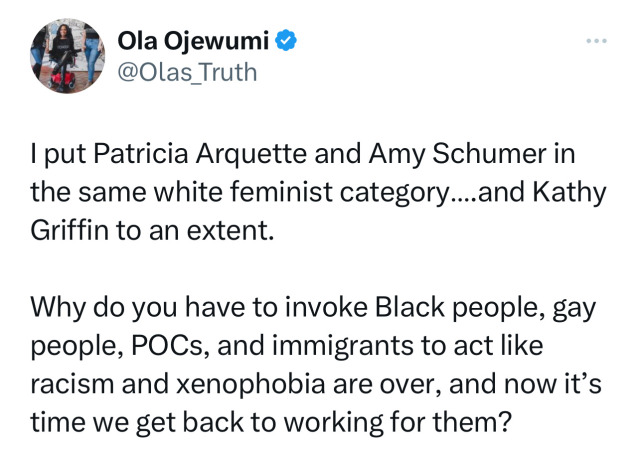
One of the most significant contributions of intersectional feminism is its deconstruction of the myth of universal womanhood. Traditional feminist discourse often implicitly centers the experiences of white, middle-class, cisgender, heterosexual women, while marginalizing or outright ignoring the experiences of those who do not fit this narrow definition. Intersectional feminism challenges this centering, demanding that we acknowledge the privileges and power dynamics that exist even within the category of “woman.”
White feminism, for example, often fails to recognize its own complicity in systems of racial oppression. It can advocate for gender equality while simultaneously perpetuating white supremacy, benefiting from the very structures that oppress women of color. The fight for equal pay, while laudable, can inadvertently reinforce existing inequalities if it fails to address the racial wage gap, which sees women of color consistently earning less than white women. Similarly, the focus on reproductive rights must extend beyond access to abortion to include issues such as forced sterilization, which has historically disproportionately targeted women of color and disabled women.
Unpacking these privileges is not about guilt or shame; it’s about accountability. It’s about recognizing that our experiences are shaped by our positionality within systems of power and that we have a responsibility to use our privilege to dismantle those systems.
III. The Power of Epistemological Privilege: Centering Marginalized Voices
Intersectional feminism recognizes the power of epistemological privilege – the idea that marginalized groups possess unique insights and perspectives that are often inaccessible to those in positions of power. This is not to say that marginalized people are inherently wiser or morally superior, but rather that their experiences of oppression provide them with a critical understanding of how power operates in society.
By centering the voices of those who are most marginalized, intersectional feminism challenges dominant narratives and exposes the biases and assumptions that underpin them. It demands that we listen to the experiences of women of color, disabled women, trans women, and other marginalized groups, recognizing that their knowledge is essential to creating a more just and equitable world. This centering requires a deliberate effort to decolonize our minds and to challenge the ingrained biases that often lead us to dismiss or devalue the experiences of others. It’s about actively seeking out and amplifying marginalized voices, creating spaces where they can speak their truths without fear of judgment or reprisal.
IV. Beyond Identity Politics: A Transformative Praxis
One of the most persistent criticisms of intersectional feminism is that it is “divisive” and “identity politics.” This is a deliberate mischaracterization, designed to undermine its transformative potential. Intersectional feminism is not about simply celebrating diversity or engaging in a superficial exercise in identity recognition. It is about understanding how power operates in complex and intersecting ways and using that understanding to build a more just and equitable world for all.
It demands a shift from individual solutions to systemic change. It is not enough to simply advocate for equal rights for individual women; we must dismantle the structures of patriarchy, white supremacy, and capitalism that perpetuate inequality on a systemic level. This requires a fundamental rethinking of our social, economic, and political institutions, and a commitment to building new ones based on principles of justice and equity.
V. The Imperative of Solidarity: Building Coalitions Across Difference
Intersectional feminism is fundamentally about building solidarity across difference. It recognizes that our struggles are interconnected and that we can only achieve liberation by working together. This requires a willingness to engage in difficult conversations, to confront our own biases, and to challenge the ways that we have internalized systems of oppression.
It’s about moving beyond performative allyship and engaging in genuine solidarity, standing in unwavering support of marginalized communities even when it’s uncomfortable or inconvenient. It requires a commitment to learning and unlearning, to listening and amplifying, and to using our privilege to uplift those who are most marginalized.
Let us be clear: intersectional feminism is not a feel-good ideology. It is a challenging and demanding practice that requires constant self-reflection, critical analysis, and a commitment to radical social change. It is not about creating a perfect utopia, but about striving towards a world where everyone has the opportunity to thrive, regardless of their race, gender, sexuality, class, or ability. To truly embrace intersectional feminism is to commit to a lifetime of learning, unlearning, and fighting for justice.
The allure of intersectionality, even in its most superficial applications, lies in its recognition of the limitations of single-axis thinking. It acknowledges the messy, complex realities of human experience. What’s needed now is a move beyond performative gestures and shallow pronouncements. A willingness to grapple with the hard truths about power, privilege, and oppression is essential. Only then can intersectional feminism realize its full potential as a force for transformative change.








Leave a Comment